P-12 NP (Spoon Rest B) Russian Mobile Early Warning Radar
P-12 NP
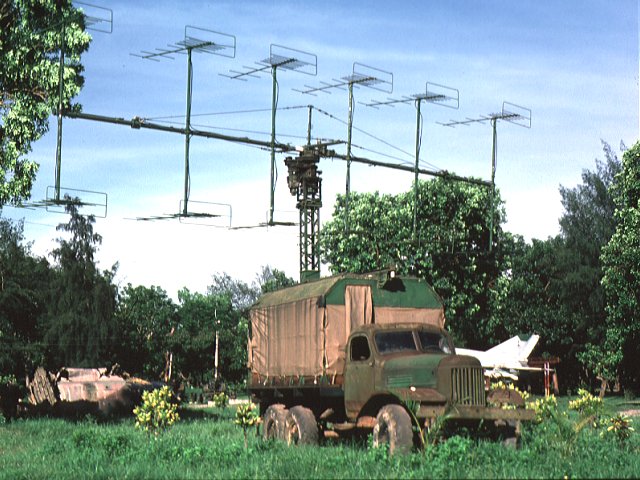
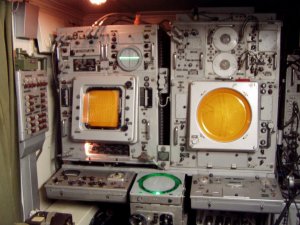
The former Soviet Union had considerable successes in the development of VHF- radar units. The assortment of VHF- radar units in the army and the air force sufficed of the P 8 over the P 12 up to the P 18 radar sets. One of them is the mobile variant NP, a version of the P 12 installed into two caravans. The radar unit also has an E-scope next to the plan position indicator (PPI). The elevation angle measures the goniometer (the green luminescent scale between the maintenance panels) by a phase comparison between the two echo signals received by the both antenna planes. The Goniometer produced a standing wave of the received RF impulses on two slip rings fed by the two antenna groups. An electrical engine alternately moves a measuring contact on the slip rings and simultaneous a variable resistor delivers the vertical deflecting voltage to the RHI-scope. The voltage difference of the slip rings reaches the value zero in a certain position. The mechanical angle of this position corresponds to the elevation angle of the target. With a nomogram on the screen the shown elevation angle could be converted to a height. But the method reduces, however, the maximum range of the radar unit. Therefore the crew usually switched off the Goniometer. The radar unit P 12 can be synchronized with other radar units and then the PPI-scope shows both received echos. If two stations working by the same frequency are in a favorable distance to each other, her maximum obtainable range can be increased by interference. The Goniometer produced a standing wave of the received RF impulses on two slip rings fed by the two antenna groups. An electrical engine alternately moves a measuring contact on the slip rings and simultaneous a variable resistor delivers the vertical deflecting voltage to the RHI-scope. The voltage difference of the slip rings reaches the value zero in a certain position. The mechanical angle of this position corresponds to the elevation angle of the target. With a nomogram on the screen the shown elevation angle could be converted to a height. But the method reduces, however, the maximum range of the radar unit. Therefore the crew usually switched off the Goniometer. The radar unit P 12 can be synchronized with other radar units and then the PPI-scope shows both received echos. If two stations working by the same frequency are in a favorable distance to each other, her maximum obtainable range can be increased by interference. The trailer-mounted P-12 NP (1RL 14 PIR) “Spoon Rest B” is a derivative of the truck-mounted P-12 MA “Spoon Rest A”. The later version P-12 NA is a truck-mounted version again.