ARMSNET
Military Equipment Database
Initializing 0%

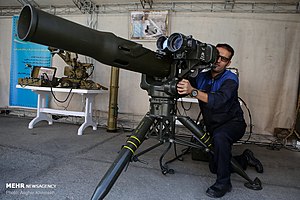
Toophan (BGM-71A TOW) Iranian Anti-Tank Guided Missile (ATGM)

BGM-71 TOW

Anti-Tank Guided Missile (ATGM)
Spotted an error? Sign in to suggest an edit.
Basic Information
Name
Toophan (BGM-71A TOW) Iranian Anti-Tank Guided Missile (ATGM)
Designation
BGM-71 TOW
Alternate Designation
BGM-71 TOW
Equipment Type
Anti-Tank Guided Missile (ATGM)
Manufacturer
Hughes Aircraft Company
Date of Introduction
1987
Description

Hezbollah and Houthi Proliferation. The Toophan (Persian: طوفان‎ "Storm", rarely Toofan) is an Iranian SACLOS anti-tank guided missile reverse-engineered from the American BGM-71 TOW missile. The Toophan 1, an unlicensed copy of the BGM-71A TOW missile, began mass production in 1988 and the Toophan 2, a BGM-71C ITOW variant, was publicly shown in 2000. The Toophan comes in at least 11 variants, many of which are poorly documented, including variants with laser guidance, thermobaric warheads, and tandem-warheads with increased penetration. The Toophan is manufactured jointly by the Aerospace Industries Organization of Iran and Iran Electronics Industries. The Toophan is normally deployed from ground-based tripods, and can also be mounted on fighting vehicles and helicopters. Like the BGM-71 TOW missile, the Toophan is a large, rugged, powerful, and reliable anti-tank guided missile deployed by small teams against tanks, armored vehicles, buildings, and other targets. The Toophan forms the backbone of the Iranian Armed Forces's ATGM inventory and is procured in large quantities in a variety of variants. The Toophan has been exported to the governments of Iraq and Syria and to a large number of non-state actors in the Middle East, and has been used in the Iran–Iraq War, the 2006 Lebanon War and the Iraqi, Syrian, and Yemeni Civil Wars. Identifying Toophan missiles is hard. The Toophan ATGM is very similar to the American BGM-71 TOW ATGM on which it is reverse engineered. Toophan missiles, launchers, control units, and crates are essentially interchangeable with their American counterparts and are regularly mixed together. The many variations of TOW and Toophan missiles also poses challenges. Toophan missiles can often be identified by their turquoise bands installed by Iran's Defense Industries Organization or by a faint black band on the rear end of the launcher. Toophan missiles, on their packaging, are instead labeled as TOW missiles; for example a Toophan 2M is labeled as a "TOW 2M". Iran was among the earliest countries to import the TOW missile, as far back as 1971. Extensive repair and assembly facilities were set up at the Iran Electronics Industries (IEI) by the Texas-based Emerson Energy Systems, as well as Hughes Missile Systems, to repair TOW and FGM-77A Dragon missiles. In May 1975, negotiations between Iran and Hughes Missile Systems on co-production of TOW and AGM-65 Maverick missiles stalled over disagreements in the pricing structure. Hughes set the royalty and initial investment costs for Iran at $20 million for the TOW and $25 million for the Maverick. The subsequent Iranian Revolution in 1979 ended all plans for such co-production. The Iran–Iraq war lead to Iran having an acute need for anti-tank guided missiles to counter Iraq's massive armored formations, leading Iran to import thousands more TOW missiles, as well as Soviet AT-3 Sagger ATGMs. Attempts at local production of both systems began in the first half of the war, with the TOW missile being prioritized due to its better performance. The earliest prototype version was ready in mid-1985, but performance was disappointing compared to Iran's US-made TOW missiles, which received widespread praise in Iran at the time. Following about a year and a half more of R&D work, the Toophan was tested against Iraqi tanks and showed better performance.[7][8] The missile was shown on an Iranian TV show on March 21, 1987, and production of what would be named the Toophan 1 began by early 1988. R&D and production work continued through the 1990s. The missile was not publicly revealed until 2000, when the Toophan 1 and Toophan 2 were publicly unveiled at the same time. The Toophan has since become Iran's primary anti-tank guided missile. n addition to Toophan missiles, Iran also produces reverse engineered tripod launchers, guidance sets, and storage boxes, all of which bear the Toophan name. Toophan missiles can be fired from TOW launchers, and their components are generally interchangeable. A number of sources say that the Toophan's quality is inferior to that of original American-made TOW missiles, but is still robustly capable. In 2014 Iran showed a Toophan/TOW simulator they built for helicopter-launched missiles. In a December 2016 military exercise Iran used the missile against naval targets. In 2018 Iran showed off thermal-sights which can be used with the Toophan. The Toophan can be mounted on Boragh APCs, ATVs, or Safir jeeps. Toophan missiles can be repaired by Iran's Shiraz Electronics Industries. The Toophan was later developed into the Sadid-1, an ambitious project to build a competitor to the Israeli Spike-ER fire-and-forget missile for attack helicopters and drones. The Sadid-1 had limited success, but was used to develop the successful Sadid-345 glide bomb, which in turn spun off a smaller counterpart, the Qaem air-to-ground munition.

Variants
BGM-71B It has improved range to 3 750 m. This missile flies faster and has a longer wire. Otherwise it is similar to the basic BGM-71A.
ITOW (Improved TOW), or BGM-71C It was adopted by the US Army in 1976. This missile has improved shape-charged warhead. It also has an extensible probe that triggers detonation of the warhead and provides optimum detonation distance. The probe is extended after the launch. This missile penetrates 630 mm of steel armor.
TOW 2 is an upgraded version of the TOW. It entered service with the US Army in 1983. This weapon system is composed of new BGM-71D missile, new reusable launcher, missile guidance set, and sight system. The launcher is lighter. It is compatible with all previous TOW missiles. It has thermal optics and can be used at night. The new missile has a larger warhead (5.9 kg) with extensible probe, as well as improved guidance. Over 77 000 BGM-71D anti-tank guided missiles were produced.
TOW 2A or BGM-71E It appeared in 1987. It has a tandem warhead and is intended to defeat tanks with Explosive Reactive Armor (ERA). It penetrates 900 mm of steel armor behind ERA. Newer missiles, starting from the TOW 2A are produced both in wireless and wire-guided forms. The wireless missiles require no special alterations to the launcher. Over 34 000 of the BGM-71E missiles have been delivered. In 2003 these missiles were used by US Marines in Iraq, destroying several Iraqi T-72 tanks.
TOW 2B or BGM-71F is a top-attack missile. It appeared in 1987. This missile explodes above a tank to penetrate its thin top armor. In concept it is similar to a Swedish RBS 56 BILL. It has a maximum range of 4 200 m. Its warhead weights 6.14 kg. This missile lacks extensible probe. These anti-tank missiles are produced in wireless and wire-guided forms. First unit was equipped with these missiles in 1992. In 2003 these missiles, alongside with the TOW 2As were used by US Marines in Iraq, destroying several Iraqi T-72 tanks. The conflict marked the first operational firing of the TOW 2B missiles. However during combat in Afghanistan the TOW 2B was found to be less effective than the older TOW 2A.
TOW 2N TOW 2N was an improved anti-tank system, that used missile with wireless data link. It appeared in 1989. However this weapon was not adopted by the US military.
BGM-71G BGM-71G is a top-attack missile with different warhead. It also lacks extensible probe.
BGM-71H BGM-71H is a bunker-busting missile. It is used against buildings or fortified structures. This missile has a range of 3 750 m. This missile is produced in wireless and wire-guided forms
TOW 2B Aero an extended-range version with a maximum range of 4.5 km. Previously this weapon was known as TOW 2B (ER). This missile is produced in wireless and wire-guided forms.
Toophan Toophan is an Iranian reverse-engineered version of the TOW.
System
Alternative Designation BGM-71 TOW
Type Anti-Tank Guided Missile (ATGM)
Proliferation HEZBOLLAH
Manufacturer Hughes Aircraft Company
Family BGM-71 Series
In Service 1970-Present
Crew Three soldiers, including commander, gunner and assistance gunner. ea
Displacement Time INA
Emplacement Time INA
Dimensions
Note See ATGM System
Automotive
Man Portable Yes
Communications
Primary INA
ATGM System
Launcher
Name BGM-71 TOW
Type Anti-Tank Guided Missile (ATGM)
Configuration factory-sealed tube contains a cylindrical missile body w/pop-out cruciform wings indexed 45 deg off line from cruciform rudders; 2 rocket exhausts at mid-body; 2 guidance wire spools in tail
Container Length 1.28 m
Container Diameter 218 mm
Note It is not a fire-and-forget type weapon. It requires the shooter to keep the target in the line of sight until the missile impacts.
Missile
Name BGM-71A/B TOW
Type ATGM
Missile Length 1.16 m
Missile Diamter 0.15 m
Fin Span 0.46 m
Missile Weight 18.9 kg
Warhead Type HEAT
Warhead Weight 2.63 kg
Maximum Range 3 km
Armor Penetration 430 mm
Guidance System Wire-Guided
Speed 300 m/s
Propulsion 2 x Hercules solid-fuel rocket motors; first motor has short burn to allow TOW to clear tube; second motor sustains TOW flight until impact; TOW 2 motor provides 30 percent greater impulse than the basic TOW
Fire Control
Name INA
Computerized FCS Analog
Guidance System Semi-automatic command to line-of-sight (SACLOS) wire guidance
Direct Fire Yes
Optical Sensor Yes
Infrared automatic tracking of xenon or thermal beacon in tail
Night Sight Texas Instruments AN/TAS-4 thermal
Thermal INA
Proximity INA
Details
Country of Origin Iran
Category Land
Land
Filter Label
T
Classification
Domain
Ground
Equipment Status
Active
Operators (6)
Iran
Iraq
Lebanon
Palestine
Syria
Non-State Actors
Something went wrong. Please reload the page. Reload