KJ-2000 (Mainring) Chinese Airborne Early Warning and Control (AEW&C) Aircraft
KJ-2000
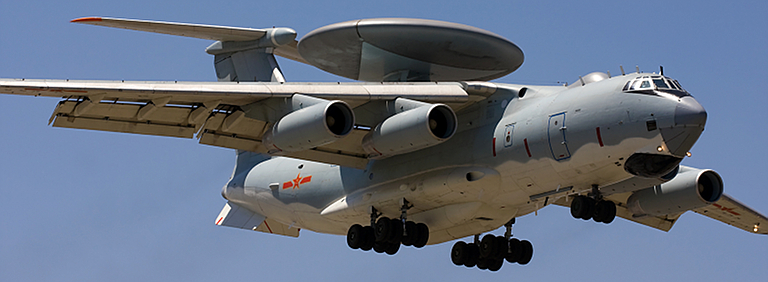


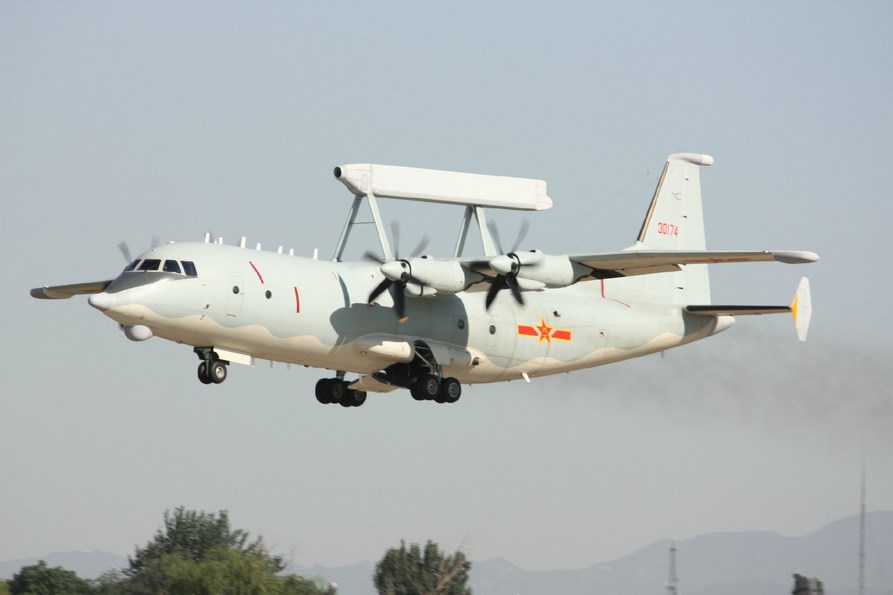


The KJ-2000, NATO reporting name: Mainring is a Chinese Airborne early warning and control system comprising domestically designed electronics and radars installed on a modified Ilyushin Il-76 airframe. The KJ-2000 development program started after the cancellation of the A-50I deal with Israel and Russia in July 2000, due to strong U.S. pressure regarding the Israeli radar that was to be mounted. China then went on to develop a domestic AWACS and the first aircraft made its maiden flight in 2003. Four KJ-2000 aircraft have been identified so far, but production of new aircraft will likely be delayed, dependent on the acquisition of IL-76 airframes. Currently, the Russian defense exporter Rosoboronexport has imposed a significant price hike on all future IL-76s delivered to China and India despite previous contracts. Both countries are currently in negotiation with Russia regarding this matter as of early 2008. In March 2011, Russia/China negotiations reached a new agreement to move production of IL-76s to Chinese owned companies, in this way it is expected production can be run smoothly to supply China with new IL-76 airframes, while the delivery of Soloviev D-30KP-2 engines is not affected by recent issues. Due to unreliable external supplier sources, China has developed a backup known as the KJ-200 by installing a simplified system onboard the Shaanxi Y-8. This aircraft has a similar configuration to that of the KJ-2000 and is characterized by the triple tail-fin configuration (one large and two small). The Chinese AWACS has a phased array radar (PAR) carried in a round radome. Unlike the US AWACS aircraft, which rotate their rotodomes to give a 360‑degree coverage, the radar antenna of the Chinese AWACS does not rotate. Instead, three PAR antenna modules are placed in a triangular configuration inside the round radome to provide 360‑degree coverage. The multi-function, three-dimensional pulse-Doppler radar was developed by NII (Nanjing Electronic Technology Research Institute) and is designed to detect and track airborne and surface targets. It operates in the frequency range of 1200–1400 MHz. The antenna system consists of three-phased arrays, located in a 14-meter-diameter (46 ft) disc. In contrast, the Russian Beriev A-50 and American Boeing E-3 Sentry use a 9-meter-diameter (30 ft) disc. Each phased array has a 120-degree field of view. The maximum range of detection of air targets is 470 km (290 mi). A-50I of India made by Israel adopted its design and entered service later than KJ-2000(service 2004) in 2009.
deagel.com: https://www.deagel.com/x/x/a002125