ARMSNET
Military Equipment Database
Initializing 0%

D-1 (M1943) Russian 152mm Towed Howitzer

D-1
Towed Gun
Spotted an error? Sign in to suggest an edit.
Basic Information
Name
D-1 (M1943) Russian 152mm Towed Howitzer
Designation
D-1
Alternate Designation
D-1; M1943
Equipment Type
Towed Gun
Manufacturer
No. 9 Plant
Date of Introduction
1943
Description

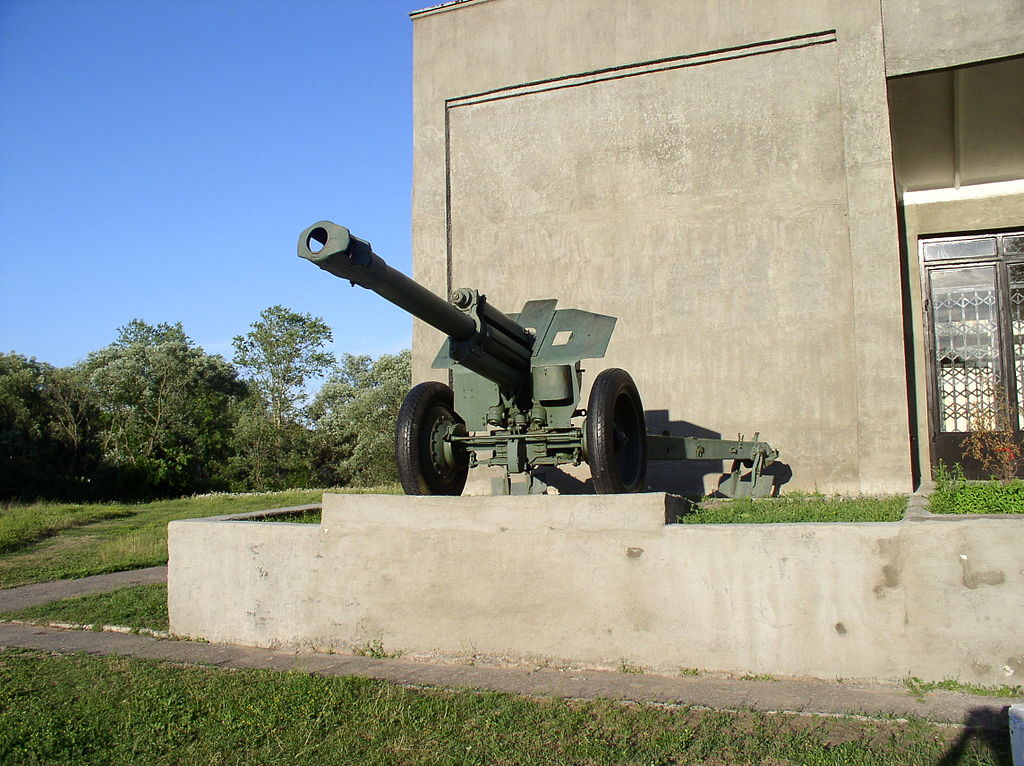
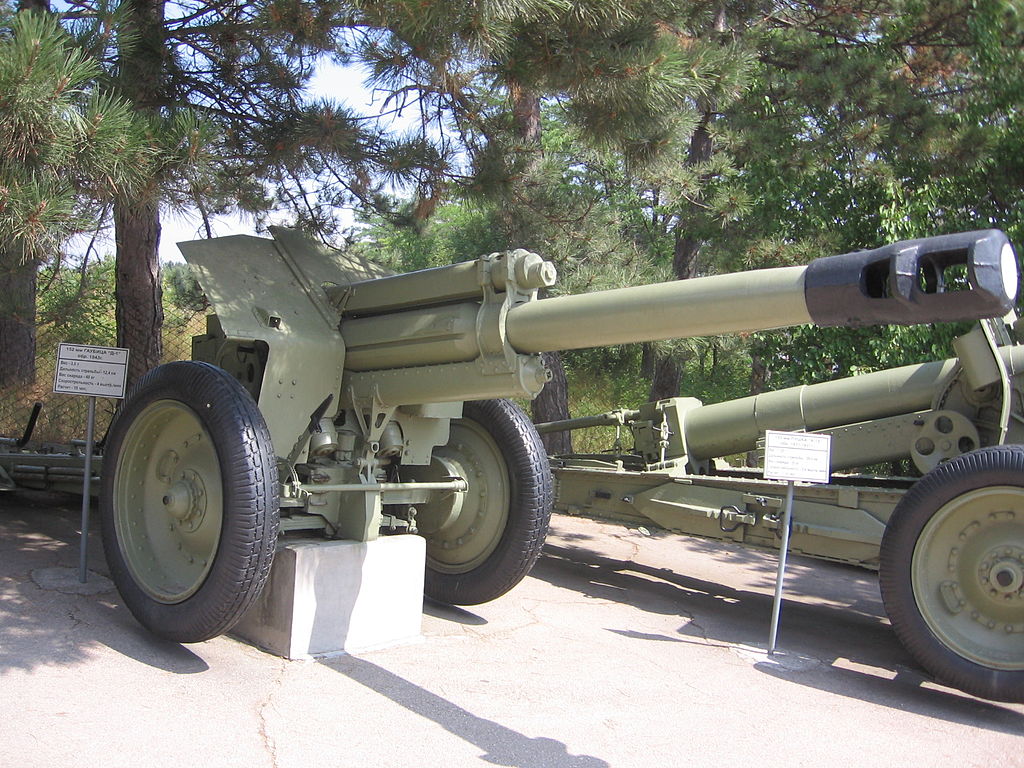
The D-1 howitzer M1943 (Russian: 152-mm gaubitsa obr. 1943 g. (D-1)) is a Soviet World War II-era 152.4 mm howitzer. The gun was developed by the design bureau headed by F. F. Petrov in 1942 and 1943, based on the carriage of the 122 mm howitzer M1938 (M-30) and using the barrel of the 152 mm howitzer M1938 (M-10). The powerful and mobile D-1, with its wide range of ammunition, significantly increased the firepower and breakthrough abilities of Red Army tank and motor rifle formations. Several hundred D-1s were manufactured before the end of World War II. Post World War II, the D-1 saw combat in numerous conflicts during the mid-to-late 20th century. The long operational history of D-1 howitzers in national armies of numerous countries is a testimony to its qualities; the gun still remains in service in a number of post-Soviet states and some other countries. The D-1 is widely considered a valuable element of Soviet artillery. The D-1 howitzer was essentially a combination of the barrel of the 152-mm howitzer model 1938 (M-10) on the carriage of the 122-mm howitzer M1938 (M-30). Since the new carriage was lighter than that of the M-10, the barrel was fitted with a massive double-baffle muzzle brake DT-3 to soften the shock of recoil. The breech block was of interrupted screw type, the recoil system consisted of a hydraulic buffer and a hydro-pneumatic recuperator. The separately loaded ammunition included a variety of shells and eight different propellant charges in cartridges. The carriage was nearly identical to the carriage of the M-30. It had suspension and steel wheels with pneumatic rubber tires. The trails were initially of riveted construction but were eventually replaced in production by welded ones. Late production pieces were equipped with caster wheels to ease manhandling. The time to set up for combat was about two minutes. In an emergency it was possible to fire without splitting trails; however, this was at the price of a drastically reduced traverse (1°30'). Since the gun was not equipped with a limber, it could be towed only by vehicle. The maximum towing speed was 40 km/h on paved roads, 30 km/h on cobbled roads, and 10 km/h off-road. To give the crew some protection from bullets and shell fragments, the gun was fitted with a shield.

Ground Specifications
Crew 8
Mobility Type Towed
Main Weapon 152.4 mm howitzer
Max Speed 40.0 km/h
Range 12.4 km
Variants
Variants In addition to the towed howitzer, Petrov's team developed a vehicle-mounted variant of the D-1. Red Army offensive operations in the summer and fall of 1943 reawakened interest in the idea of a heavy "artillery" tank similar to the KV-2, that could provide close fire support to rifle and tank units and would be capable of demolishing heavy fortifications. Probable causes for the development of such a vehicle were the cessation of mass production of the SU-122 medium assault gun and diversion of SU-152 heavy assault guns for anti-tank actions. The tank variant of the D-1 was originally intended for mounting in a variant of the KV-1s heavy tank. It utilized the amount of the 85 mm D-5, leading to the unofficial name D-1-5 and eventually to the official designation of D-15. Only one example was built. There is no information about the gun being mounted in the KV tank. By October 1943 Soviet authorities were anticipating the start of mass production of the powerful IS-2 heavy tank; as a result, the idea of a specialized artillery tank based on the obsolete KV chassis was dropped. Another project combining the T-34 tank chassis with the D-15 gun was also considered. Designated SU-D15, the medium assault gun was intended as a replacement for the SU-122. Although the project received a lot of support from the authorities it never entered production, both because of its shortcomings (the heavy gun put too much strain on the suspension and ammunition stowage was too limited) and because it was made redundant by the ISU-152. However, lessons learned mounting a powerful gun in the T-34 allowed for rapid development of the SU-100 tank destroyer.
Type 54 This is a Chinese-produced copy of the D-1. Firing weight is 5,512 lb (2,500 kg); projectile weight, 48 lb (21.76 kg); and maximum range, 12,904 yd (11,800 m). It is in service in China.
System
Alternative Designation D-1; M1943
Type Towed Howitzer
Caliber 152mm
Manufacturer No. 9 Plant
Crew 8
Carriage Split trail
Displacement Time 2 minutes
Emplacement Time 2 minutes
Dimensions
Length 6.7 m
Barrel Length 3.1 m
Width 1.9 m
Height 1.8 m
Weight, Combat 3,600 kg
Main Weapon System
System
Name D-1
Type Towed Howitzer
Caliber 152.4 mm
Breech Interrupted screw
Recoil Hydro-pneumatic
Carriage Split trail
Rate of Fire 3-4 rounds/min
Muzzle Velocity 508 m/s
Max Firing Range 12.4 km
Max Elevation 63.5 deg
Min Elevation -3 deg
Traverse Range 35 deg
Traverse Right 17.5 deg
Traverse Left 17.5 deg
Ammunition (Option 1)
Name BP-540
Type HEAT
Caliber 152.4 mm
Shell Separate loading charge and projectile
Maximum Range 3,000 m
Basic Load INA
Ammunition (Option 2)
Name OF-530A
Type HE-Fragmentation, steely iron
Caliber 152.4 mm
Shell Separate loading charge and projectile
Maximum Range 12,400 m
Basic Load INA
Note The D-1 had a large variety of ammunition, including high-explosive, armor-piercing, HEAT, shrapnel, illumination, and chemical. The D-1 used separate loading ammunition, with eight different charges. The charges included the "full charge" Zh-536 and smaller charges ranging from the "first" to "sixth", which was the smallest. A "special charge" was used with the BP-540 HEAT projectile. Propellant charges were produced in "full" and "third" variants in munitions factories. All other charges were derived from them by removing small gunpowder bags from the charge cartridge. For flash suppression there was a special chemical mixture which was to be inserted into a cartridge before night firing. 152 mm projectiles for the D-1 weighed about 40 kg; a difficult job for the loaders, who had to carry the projectiles alone. When set to fragmentation mode, the OF-530 projectile produced fragments which covered an area 70 meters wide and 30 meters deep. When set to high-explosive (HE) action, the exploding shell produced a crater about 3.5 meters in diameter and about 1.2 meters deep. Despite the D-1's withdrawal from service in the mid- 1970s, the OF-530 is still fired from modern 152 mm ordnance pieces of the Russian Army. The G-530 HEAC anti-concrete shell had a muzzle velocity of 457 m/s when fired with the "first" charge. At a range of one kilometer it had a 358 m/s terminal velocity and was able to punch through up to 80 centimeters of reinforced concrete before detonating a TNT charge which increased the total penetration to 114 centimeters. The G-530 could not be fired with a "full" charge without putting the crew at risk of having the shell explode in the barrel. A special version of the shell, the G-530Sh, was developed to allow use with the full charge. The BP-540 HEAT projectile was not used during World War II. It had an armour penetration of 250 millimeters at an incident angle of 90°, 220 millimeters at 60°, 120 millimeters at 30°. In the late 1950s old ammunition stocks for the D-1 were removed from the Soviet inventory. The only shells retained were the OF-530, O-530, G-530/G-530Sh, and possibly chemical shells. The Soviet Army also possessed a 152 mm nuclear shell, but it is not clear whether that shell could be used with the D-1
Details
Country of Origin Russia
Category Towed Gun/Howitzer Artillery Systems
Land > Artillery > Towed Gun/Howitzer Artillery Systems
Filter Label
D
Classification
Domain
Ground
Equipment Status
Active
Dimensions
Length
6.7 m
Width
1.9 m
Height
1.8 m
Weight
3600 kg
Operators (3)
Russia
China
North Korea
Something went wrong. Please reload the page. Reload