ARMSNET
Military Equipment Database
Initializing 0%

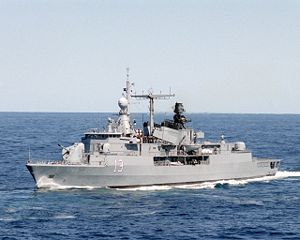
Almirante Brown Class Argentinian Guided Missile Destroyer

Almirante Brown Class
Destroyer
Spotted an error? Sign in to suggest an edit.
Basic Information
Name
Almirante Brown Class Argentinian Guided Missile Destroyer
Designation
Almirante Brown Class
Alternate Designation
Almirante Brown Class
Equipment Type
Destroyer
Manufacturer
Date of Introduction
1983
Description

The Almirante Brown class is a warship built in Germany for the Argentine Navy. They were commissioned between 1983 and 1984, after the Falklands War. The class comprises four ships; Almirante Brown, La Argentina, Heroína and Sarandí. They are classified as either frigates or destroyers by different publications. The MEKO 360 type warships are based on modular designs which allow quick changes to the vessel's armaments depending on mission requirements. The modular nature of the construction also allows the ships to be modernized or refitted with greater ease. Six vessels were initially ordered, however two ships were cancelled and replaced with orders for MEKO 140 type hulls. Ordered in 1979, construction of the ships was delayed as the British turbines were embargoed after the Falklands War. Furthermore, the acquisition of helicopters for the vessels has seen many incarnations. They were initially intended to be equipped with Westland Lynx helicopters, but the order was cancelled in 1982. The planned replacement Agusta-Bell AB 212 helicopters were not funded and instead, all of the Almirante Brown class deploy with AS 555 Fennec, while only La Argentina and Sarandí can employ SH-3D Sea King helicopters. Almirante Brown took part in Gulf War operations in 1990. All of the ships can be used as flagships. Six vessels were ordered and four vessels of a second variant, MEKO 360H2, were constructed for Argentina. They were locally named the Almirante Brown class. They are considered frigates and destroyers by different publications. The design is based on the concept of modular systems and is capable of changing the armament of the ship swiftly and can be modernized/refitted with more ease. Each ship is capable of being used as a flagship. The ships have a standard displacement of 2,900 long tons (2,900 t) and 3,360 long tons (3,410 t) at full load. The vessels are 125.9 metres (413 ft 1 in) long overall and 119.0 metres (390 ft 5 in) between perpendiculars with a beam of 15 metres (49 ft 3 in) and a draught of 5.8 metres (19 ft 0 in). The vessels are powered by a COGOG system driving two shafts composed of two Olympus TM 3B gas turbines rated at 51,800 shaft horsepower (38,600 kW) and two Tyne RM-IC gas turbines rated at 10,200 shaft horsepower (7,600 kW). The ships have a maximum speed of 30.5 knots (56.5 km/h; 35.1 mph) while using their Olympus gas turbines at 18 knots (33 km/h; 21 mph) using their Tyne turbines. The MEKOs have a maximum range of 4,500 nautical miles (8,300 km; 5,200 mi) at 18 knots. The Argentinian vessels are armed with eight Exocet surface-to-surface missiles in two quad launchers mounted centrally and one octuple launcher for Aspide surface-to-air missiles mounted aft of the superstructure. The MEKO 360H2 are also equipped with one OTO Melara 5-inch (127 mm)/54 calibre naval gun forward of the superstructure, eight Bofors 40 mm/70 calibre guns, and two triple-mounted 324 mm (13 in) ILAS torpedo tubes. The ships are equipped with a Graseby G1738 towed decoy countermeasure system, two Breda 105 mm (4 in) SCLAR chaff rocket launchers with each launcher sporting 20 tubes. For electronic support measures, the vessels are armed with the Sphinx system and the Scimitar system for electronic countermeasures. The class is equipped with two Signaal DA08A air/surface search radar operating on the F band and Signaal ZW06 surface search radar operating on I band. They have Decca 1226 navigational radar operating on the I band and their fire control systems are controlled by the Signaal SEWACO Link 10/11 system supported by Signaal STIR radar operating on the I/J and K bands, Signaal WM25 operating on I and J band, along with LIRODA radar systems that control the 40 mm gun mounts. For sub-surface search, the vessels have Atlas Elektronik 80 hull-mounted active search sonar. All of the Almirante Brown class are equipped with a helicopter deck and hangar. They all deploy with AS 555 Fennec helicopters, while only La Argentina and Sarandí can employ SH-3D Sea King helicopters. The ships have a complement of 200, including 26 officers.

Naval & Littoral Specifications
Crew 200
Beam 14.00 m
Variants
Almirante Brown Commissioned: 1983 Status: Active
La Argentina Commissioned: 1983 Status: Active
Heroína Commissioned: 1983 Status: Active
Sarandí Commissioned: 1984 Status: Active
System
Alternative Designation Almirante Brown Class
Total Built 4 ships total
Type Destroyer
Builder Blohm+Voss
In Service 1983-Present
Crew 200 (26 off. + 174 enl.)
Dimensions
Length, Overall 125.9 m
Length, Perpendiculars 119.0 m
Beam 14.0 m
Draft, Hull 4.3 m
Draft Sonar 5.8 m
Displacement, Standard 2,947 tons
Displacement, Full Load 3,667 tons
Propulsion System
Engine Name 2 x Olympus type TM3B gas turbines
Engine Power 25,800 shp each
Propellers 2 x Escher-Wyss controllable-pitch propellers
Maximum Range 4,500 nm at 18 kts
Maximum Speed 31 knots
Endurance INA
Gun Weapon System
Gun Weapon System #1
Name Otobreda 127/54 Compact
Type The Otobreda 127mm/54 Compact (127/54C) gun is a dual purpose naval artillery piece built by the Italian company Oto Melara. It uses the 127mm round which is also used in the 5 inch/ 54 gun, albeit that this gun calibre is measured in United States customary units rather than metric.
Caliber 127mm
Quantity 1 x 127-mm/54-cal Oto Melara DP
In Service 1992-Present
Proliferation Currently the gun is still in use by navies around the world but it is slowly being replaced by the Otobreda 127/64 for new vessels, such as the German Navy's F125-class frigate and Italian Navy's FREMM.
Length INA
Weight INA
Crew Remote Control
Loading System The gun uses an automatic loading system where 66 127mm rounds of various kinds can be stored ready-to-fire in three loader drums (each holding 22 rounds).
Elevation −15°/+83°
Traverse 360 deg
Rate of Fire 40 rounds/min
Effective Firing Range ±30 km (100 km with guided VULCANO ammunition)
Feed System Magazine capacity: 66 ready rounds
Ammunition Gun Weapon System #1
Type Rifle
Caliber 127 mm
Basic Load INA
Gun Weapon System #2
Name Bofors 40mm Gun
Type Anti-Aircraft Gun
Caliber 40mm
Quantity 4 x twin 40-mm/70-cal Breda/Bofors AA Systems
Length 6.5 m
Barrel Length 2.2 m
Width 1.8 m
Height 1.9 m
Weight 1,981 kg
Crew 4
Elevation −5°/+90°
Traverse 360 deg
Rate of Fire 120 round/min
Muzzle Velocity 881 m/s
Maximum Firing Range 7,160 m
Ammunition Gun Weapon System #2
Type Rifle
Caliber 40mm
Shell Complete round: L/43 40×311mmR L/60 40×311mmR L/70 40×365mmR
Shell Weight 0.9 kg (2 lb 0 oz)
Basic Load INA
Gun Weapon System #3
Name Oerlikon 20
Type Autocannon
Caliber 20 mm
Quantity 2 x Oerlikon 20mm Stations
Barrel Length 2,210 mm
Weight 68.04 kg
Barrels Single barrel (progressive RH parabolic twist, 9 grooves)
Action API blowback
Elevation Manual training, typically able to depress to -15° and elevate to +90°
Traverse Manual training, full 360°
Rate of Fire Cyclic: 450 rounds per minute Practical: 250-320 rounds per minute
Muzzle Velocity 820 m/s
Maximum Firing Range HE round at 45° L70: 4,389 m (4,800 yd)
Effective Firing Range Against low-flying aircraft (HE round) L70: 914 m (1,000 yd)
Feed System Cylindrical magazine holding 60 rounds, Later adjusted to be a belt fed gun
Ammunition Gun Weapon System #3
Type Rifle HE
Caliber 20mm
Shell 20×110mmRB
Shell Weight 123 g
Basic Load INA
Missile System
Missile System #1
Name Quad MM-40 Exocet
Type Anti-Ship Missile
Quantity 2 x Quad MM-40 Exocet SSM launchers
Launcher SSM Launcher
Missile Exocet
Basic Load 2
Length 6 m
Diameter 34.8 cm
Wingspan 1.35 m
Weight 780 kh
Warhead 165 kg
Engine solid propellant engine turbojet (MM40 Block 3 version)
Operational Range 180 km
Flight Altitude Sea-skimming
Speed Mach 0.93
Guidance System Inertial guidance and terminal active radar homing
Launch Platforms MM38 surface-launched; AM39 air-launched; SM39 submarine-launched; MM40 surface-launched
Missile System #2
Name Albatros (Mark 29)
Type Surface-to-Air Missile
Quantity 1 x Albatros (Mark 29) 8-cell launcher for Aspide SAM
Launcher 8-cell launcher
Missile Albatros (Mark 29) Missile
In Service 1973-Present
Proliferation Over 30 countries
Length 3.72 m
Diameter 234 mm
Wingspan 80 cm
Weight 220 kg
Speed 4520 km/h (mach 3.7)
Effective Firing Range 25 km
Warhead 35 kg warhead
Onboard Aviation Facilities
Facilities Helicopter deck and hangar
Helicopters 1 x AS-355M Fennec or SH-3D Sea King
Fire Control
FCS #1 1 x Thales WM-25 track-while-scan for missiles
FCS #2 1 x Thales STIR fire control
FCS #3 2 x Thales LIROD radar/optronic GFCS control the 40-mm guns
Sonar Systems
Sonar System 1 x STN Atlas-Elektronik KAE-80 (DSQS-21BZ) hull-mounted, medium-frequency
Radar Systems
Air and Surface Radar 1 x Thales DA-08A air/surface search
Surface Radar 1 x Thales ZW-06 surface search
Navigation Radar 1 x Racal-Decca 1226 navigation
Protection
Active Protection System Yes
Electronic Warfare Intercept 1 x Racal Rapids intercept
Electronic Warfare Jammer 1 x Racal Scimitar jammer
Decoy System #1 1 x Graseby G1738 towed torpedo decoy
Decoy System #2 2 x 20-round Oto Melara 105-mm SCLAR decoy rocket launchers
Decoy System #3 1 x CSEE Dagaie double mounting decoy launcher
ASW Weapon System 2 x depth charge racks [10 Mk 9 depth charges carried]
Details
Country of Origin Argentina
Category Naval
Naval
Filter Label
A
Classification
Domain
Naval & Littoral
Equipment Status
Active
Dimensions
Length
125.9 m
Width
Height
Weight
Operators (1)
Argentina
Something went wrong. Please reload the page. Reload