ARMSNET
Military Equipment Database
Initializing 0%

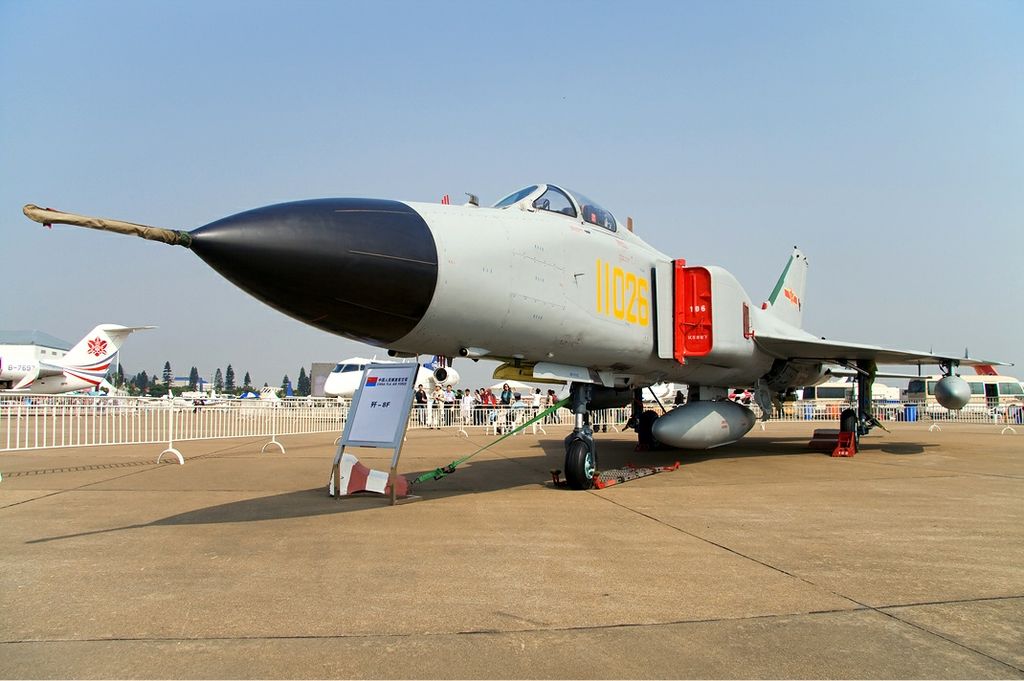
J-8F Chinese Interceptor Fighter Aircraft

J-8F

Spotted an error? Sign in to suggest an edit.
Basic Information
Name
J-8F Chinese Interceptor Fighter Aircraft
Designation
J-8F
Alternate Designation
Equipment Type
Manufacturer
Date of Introduction
2006
Description

The J-8F Chinese Interceptor Fighter Aircraft is a model of the J-8II Series. This variant features the Type 1492 X-band fire-control radar, glass cockpit and more powerful WP-13BII engines. Plans called for the latter to be replaced by the WP-4 power plant. There is an additional pair of wing fences to improve handling. Some newer models are equipped with a new data link antenna behind the cockpit. The J-8F is armed with the newer PL-12 active radar-guided missile. The J-8F features a glass cockpit, in-flight refueling probe and a secondary air-to-ground capability. The BM/KZ900 electronic intelligence pod has been integrated with the aircraft's centerline station. Development began in 1997, followed by a first flight in 2000. Testing concluded in 2002. The J-8F entered service in 2003. Retrofitted models are designated J-8DF. The naval variant is the J-8FH. The J-8II series appear quite different from the original J-8, with a new forward fuselage, intake ramps with splitter plates and nose structure more reminiscent of the F-4 Phantom II or Sukhoi Su-15 to house a new, more powerful radar. The J-8II is powered by two Wopen-13A (WP-13A) engines. The design and development team was led by Gu Songfen, who is also a key member of J-8I design team. It was hoped to equip the production J-8B with an American AN/APG-66(V) radar (to be dubbed the J-8C), but this proved politically impossible after the Tiananmen Square protests of 1989 so the indigenous Type 208A monopulse radar fire-control radar initially was used. Although the Type 208A was an improvement over the original J-8I radar, the Type 208A did not have true beyond visual range capabilities (The detection range of the Type 208 was 40 km) nor look-down/shoot-up ground attack capabilities, thereby falling short of the PLAAFs initial requirements and the redesign of the airframe. The J-8B was the early production batch of the new J-8II series. In addition to receiving a new radar, new engine and redesigned noses, cockpit and intake, the J-8B also benefited from a new head-up display, integrated inertial navigation system/Global positioning satellite system and TACAN technology. Later J-8Bs were equipped with the more robust KLJ-1 pulse-Doppler radar fire-control radar and radar warning receiver, theoretically giving the later batch BVR capabilities. J-8B is the second Chinese aircraft to be equipped with a data link, the first being the Chengdu J-7III, and the data link is designated as Type 483 (developed from Type 481 data link used for J-7III), which enables ground-controlled interception centres to feed directions directly to the autopilots of J-8Bs to fly "hands off" to the interception. At least 30 J-8Bs have been converted by the PLA Navy to J-8D standard, with an aerial refuelling probe for use with Xian H-6DU tankers in addition to newly built J-8Ds. The most significant difference between the J-8B and J-8D is the use of the new Type-02 airframe that was heavier than the J-8B and featured uneven length wing fences. The heavier 'Type 02' airframe is able to carry a larger payload and can tolerate higher G-loadings. The new airframe also has a stiffer radome. A few minor differences between the later J-8B batches and the J-8D are the J-8Ds slightly improved avionics. The use of the KLJ-1 pulse-Doppler radar was used through the J-8Ds entire production run. The J-8B and J-8D both suffered from China's difficulty in developing a MRAAM. Although the Type 208A was theoretically capable of using semi-active radar homing missiles and the KLJ-1 was certainly capable; no such missile, semi-active or active, were available at the time. Both variants were only initially armed with SRAAMs such as the PL-2 and PL-5, and the more advanced infrared-homing PL-8 SRAAM. An early attempt to remedy these technological shortcomings still present after the redesign of the J-8 to the J-8II was the J-8C. The project began shortly after failure to obtain American cooperation for the J-8B, so Shenyang turned to Israel and Russia instead. The J-8C was considered a 'radical' upgrade of the original J-8II with a new radar based on the Israeli Elta EL/M 2035 multi-mode pulse Doppler radar, digital fire-control system, a new 'glass' cockpit, in-flight refuelling probe and equipped with a new WP-14 Kunlun engine. These upgrades were said to 'bring the fighter into the same league as modern Russian and Western fighters such as Mikoyan MiG-29 and Dassault Mirage 2000'. The project was cancelled in the late 1990s after two prototypes were built in favour of further development of the Shenyang J-11 fighter (which is based on the Sukhoi Su-27). The J-8IIM, first flown in 1996, is a further improved version. One major improvement over the J-8II is the capable Russian-made Zhuk-8II coherent pulse-Doppler radar, 100 of which have been delivered in the 1990s. Additionally, the J-8IIM carried new multifunction displays, integrated INS/GPS navigation system, new fire-control systems, new alternators and a new electronic countermeasures suite. The J-8IIM possessed true BVR capabilities with the use of the R-27 (air-to-air missile) semi-active infrared seeker medium-ranged missile. New WP-13B turbojet engines were adopted as well. The J-8IIM has had no new orders from China or the export market, where it is offered as the F-8IIM. It was heavily marketed to Iran but ultimately was not exported anywhere. However the experience and technological achievements gained from the J-8C and F-8IIM projects were later applied by Shenyang Aircraft Company to the later J-8H/F variants. It was also during this time that the Shanghai Academy of Spaceflight Technology certified the PL-11 in 2001 after successfully test firing five missiles from the J-8II. The J-8H configuration features the more powerful WP-13B turbojet engines, improved avionics and the improved Type 1471 pulse-doppler fire control radar with look-down/shoot-down capability and a range of new operating modes. With the radar upgrade comes the ability to fire the PL-11 and the PL-12/SD-10 MRAAM, which employs an Active radar homing (ARH) seeker. The J-8H also is equipped with IFR probe, INS/GPS, HOTAS, and an integrated ECM suite, with twin wing fences on each side of the wings that greatly increased handling ability. The J-8Ds heavier airframe is used but with modified wing fences. Production of the J-8H and the J-8D it had superseded has now ceased in favor of upgrading earlier J-8D aircraft to J-8H standards. It is uncertain if the older J-8B will be upgraded to J-8H standards given the difference in airframe. The J-8F is the most modern and capable J-8 variant currently in service and has been in production since 2003. The J-8H/F has inherited many of the improvements of the earlier J-8C and F-8IIM, and in some cases, has improved on them. The J-8F features a glass cockpit, a more powerful WP-13BII turbojet engine and enhanced Type 1492 radar for enhanced air-to-air capabilities with the PL-12 active radar homing medium range air-to-air missile, full air-to-ground and air-to-sea capabilities using the AS-17 'Krypton' anti-radar missile, and a variety of Chinese designed precision guided laser and satellite guided bombs, making it the first true Multirole combat aircraft variant of the J-8 series. The J-8F also possesses all the avionic and electronic upgrades the J-8H received. The earlier J-8B/Ds can be distinguished from later J-8H/Fs by their dark green radomes, compared to the latter's black radomes. Introduction of the more powerful WP-14 Kunlun turbojet engine for the J-8 series is planned to go under way in the coming years. The J-8F also serves in the People's Liberation Army Naval Air Force as well. A notable variant of the J-8F is the JZ-8F which has been introduced into the PLAAF in the tactical reconnaissance role. Little information has been released on the JZ-8F, other than the use of an internal camera compartment which replaces the twin 23 mm cannon, rather than a camera pod as used by the older JZ-8. In 1988, one J-8II airframe was converted into the J-8ACT an experimental fly-by-wire testbed for the J-10 programme. The J-8ACT had a shorter fuselage and a pair of canards were fixed to the side of each intake, and replaced older FBW technological demonstrators based on the older Shenyang J-6 and J-8I airframes. To date, no plans for a twin-seat J-8 design have been announced.

Air & Air Defense Specifications
Crew 1
Wingspan 9.34 m
Variants
J-8 (Finback-A) Series First flew on 5 July 1969. Initial day fighter variant, resembles an enlarged MiG-21. Equipped with 2 x WP-7A turbojet engines, SR-4 ranging radar 2 x Type 30-I 30mm cannon (200 rounds each), and 2 x PL-2 IR-guided AAMs. Limited production. J-8I First flew on 24 April 1981. Improved all-weather version with SL-7A fire-control radar (40 km range), twin-barrel Type 23-III 23 mm cannon, & up to 4 AAMs (or rockets/bombs). Limited production. J-8E Final version of the J-8I series. J-8E is equipped with a type 204 (JL-7) mono-pulse fire-control radar with look down shot down capability, SM-8A aeronautical optical gun-sight, onboard computer, new cockpit panel, and redesign ejection escape system and oxygen supply system. The original two Type 30-I 30mm cannons were replaced by two Type 23-III 23mm cannons. The four under-wing stores stations are capable of carrying the more advanced PL-5 series short-range AAM. These aircraft were also fitted with an improved electronic countermeasures (ECM) suite including KJ-8602B all-aspect radar warning receiver (RWR). JZ-8 (J-8R) Reconnaissance version of J-8 or J-8I. J-8ACT First flew on 24 June 1990, fly-by-wire testbed aircraft.
J-8II (Finback-B) Series J-8II (Finback-B) First flown on 12 June 1984, the improved J-8I prototype with redesigned nose/front section and fuselage. replacing the nose air inlet with a solid nose and lateral air intakes, similar to those of the MiG-23. China received several MiG-23s in the late 1970s from Egypt and the hinged ventral fin and lateral intakes indicate probable reverse engineering from the MiG-23. Equipped with Type 208 (SL-4A) monopulse radar (40 km range). J-8II Batch 02 (J-8IIB) First flew in November 1989, improved J-8II with SL-8A (Type 208?) PD radar (70 km range). Powered by 2 x WP-13AII turbojet engines. Armed with twin-barrel 23mm Type 23-III cannon (copy of GSh-23L) and up to 4 PL-5 or PL-8 AAMs (or rockets/bombs). No BVR capability. Peace Pearl J-8 (J-8II) During the Sino-US cooperation era, up to 50 J-8IIs were to be delivered to the US for upgrades and installation of AN/APG-66(v) radar and fire control system for US$500 million, under the Peace Pearl programme. However, the project was cancelled and only about 24 J-8II were produced. USAF Air Force Flight Test Center (6510 Squadron) took the task of test flight of modified J-8II. J-8IIACT (J-8II-BW2) First flew in 1988, fly-by-wire testbed and technology demonstrator. J-8IID (J-8D) First flew on 21 November 1990, modified J-8B with fixed refuelling probe and updated avionics such as TACAN navigation system. F-8IIM Unveiled in Zhuhai Air Show 1996, export version of J-8B with Russian Phazotron Zhuk-8II PD radar (75 km range, and able to track up to ten airborne targets and attack two of them simultaneously), R-27R1 (AA-10) AAM and Kh-31P anti-radiation missile. The F-8IIM was to be powered by two, more powerful WP-13B turbojet engines. This aircraft is often mistakenly referred to as the "J-8IIM" with Kh-31A anti-ship missile (ASM) capability, but its radar lacked sea search mode for anti-shipping role. The F-8IIM failed to attract any export customers and no domestic orders.[7] Conversion from older airframe was reportedly much fewer than the 100 units of Zhuk-8II radar delivered, and the conversion might have only been an experimental programme with none entering service. The F-8IIM fighter will probably be equipped with Russia's or China's helmet sight and advanced PL-9 and P-73 missiles. Phazotron, a Russian firm, has signed contracts with China to provide 150–200 improved Zhuk radars mainly in support of China's new F-8II fighter. J-8III (J-8C) Upgraded J-8II with FBW system and 2 x WP-14 powerplants. Compared to the J-8II, the J-8C had a number of improvements including a new multi-mode pulse Doppler radar which was reportedly based on the Israeli Elta EL/M 2035 radar technology. The aircraft was also equipped with a digital fire-control system and a new 'glass' cockpit with multifunctional displays (MFD). The J-8C programme entered full scale development around 1991 and the aircraft first flew successfully on 12 December 1993. Development halted in favour of other version described below, but was used to test new radars such as Type 1471 (KLJ-1) and other avionics associated with FBW system. From this version on, electronic warfare pods such as BM/KG300G and KZ900, as well as navigational / targeting pods including Blue Sky navigation pod and FILAT become operational on J-8II. Canceled after 2nd testbed had crashed. J-8IIF (J-8F) It is reported that during 2006–2008, J-8II production suffered major setback due to engine problem. J-8IIG Modified J-8II with tail hook and other improvements for developmental work on ship-borne aircraft for carrier operations, such as in April 1987, evaluating & testing the Chinese reverse-engineered steam catapult from that of HMAS Melbourne (R21), which was finally confirmed 27 years later in April 2014 by CCTV-13. J-8G An advanced modified variant of the J-8II tasked with the suppression of enemy air defence (SEAD) mission was said to have been developed by the SAC in the 2000s. The aircraft, reportedly designated J-8G, was said to be capable of carrying two indigenous YJ-91 anti-radiation missile and electronic warfare suite to attack enemy radar stations. J-8IIM (2006) At Zhuhai Air Show 2006, a new variant "J-8IIM" was put on display with upgraded systems similar to the J-8H.[16] The most significant improvement is the radar upgrade with a new Type 1471 domestic radar used by the J-8H. JZ-8F A reconnaissance version of the J-8F with internal camera in the forward fuselage replacing the cannon. J-8T Upgraded J-8 with JL-10A X-band radar. Export variant, F-8T, has WP-13B-II engines. China National Aero-Technology Import & Export Corporation claims J-8T is equipped with improved integrate avionic and various guided weapons. J-8T can carry out air-to-air BVR intercepting mission, air-to-ground precise attacking mission and stand-off attacking mission. J-8DF J-8D upgraded to J-8F standard. Lack of cooling duct below intake. Can fire PL-12 and PL-8 missiles.
System
Alternative Designations J-8F
Manufactuer Shenyang Aircraft Corporation
Crew 1
Underfuselage Hardpoint 1 x under fuselage hardpoint
Underwing Hardpoints 6 x underwing hardpoints for external fuel, bombs,rockets or PL-2B or PL-7 air-to-air missiles
Dimensions
Length 21.59 m
Height 5.41 m
Wingspan 9.34 m
Wing Area 42.2 sq m
Empty Weight 9,820 kg
Normal Takeoff Weight 14,300 kg
Maximum Takeoff Weight 17,800 kg
Automotive
Engine Name 2 x Wopen 13A-II turbojets
Engine Power 14,815 lb (6,720 kg) static thrust each with afterburner
Maximum Speed at Maximum Altitude 1,263 knots (1,454 mph, 2,340 km/h, Mach 2.2)
Maximum Speed at Sea Level 01 knots ( 808 mph, 1,300 km/h)
Combat Radius 800 km
Climb Rate 12,000 m/min
Acceleration 20,000 m
Ceiling 20,000 m
Main Gun System
Gun System #1
Name 1 x Gryazev-Shipunov GSh-23
Type Autocannon
Caliber 23mm
Location underfuselage gun pack
Length 1,387 mm
Barrel Length 1,000 mm
Weight 49.2 kg
Barrels 2
Action Gast principle
Rate of Fire 3,400–3,600 rounds/min (alleged)
Muzzle Velocity 715 m/s
Effective Firing Range INA
Gun System #1 Ammunition
Type Autocannon
Caliber 23mm
Cartridge 23x115 mm
Basic Load 200 Rounds
Missile Weapon System
Missile Weapon System #1
Name PL-2B
Type Air-to-Air Missile
Manufacturer Luoyang Electro-Optics Technology Development Centre (EOTDC)
Length 2.99 m
Diameter 127 mm
Wingspan 528 m
Weight 76 kg
Warhead 11.3 kg high explosive
Detonation Mechanism Impact / Proximity
Propellant solid fuel
Operational Range 10 km
Flight Ceiling 21,500 m
Maximum Speed Mach 2.5
Guidance System Nitrogen cooled passive InPb infrared seeker
Missile Weapon System #2
Name PL-7
Type Air-to-Air Missile
Length 2.74 m
Wingspan 0.66 m
Weight 89 kg
Warhead 12.5 kg
Speed Mach 2.5
Range 14 km
Guidance System Infrared Homing
Missile Weapon System #3
Name PL-12
Type Air-to-Air Missile
Length INA
Diameter INA
Weight 180 kg
Operational Range 100 km
Guidance System Active Radar
Avionics / Fire Control
Fire Control Radar Type 1492 X-band fire-control radar
Data Link Antenna Yes
Navigation Radar INA
In-FLight Refueling Probe Yes
Intelligence Pod BM/KZ900 electronic intelligence pod
Details
Country of Origin China
Category Fixed Wing Aircraft
Air > Fixed Wing Aircraft
Filter Label
J
Classification
Domain
Air & Air Defense
Equipment Status
Active
Dimensions
Length
21.59 m
Width
Height
5.41 m
Weight
14300 kg
Operators (1)
China
Something went wrong. Please reload the page. Reload