ARMSNET
Military Equipment Database
Initializing 0%

M-1985 North Korean 240mm Multiple Rocket Launcher

M-1985
Multiple Launch Rocket System (MLRS)
Spotted an error? Sign in to suggest an edit.
Basic Information
Name
M-1985 North Korean 240mm Multiple Rocket Launcher
Designation
M-1985
Alternate Designation
M-1985; M1985
Equipment Type
Multiple Launch Rocket System (MLRS)
Manufacturer
INA
Date of Introduction
1985
Description

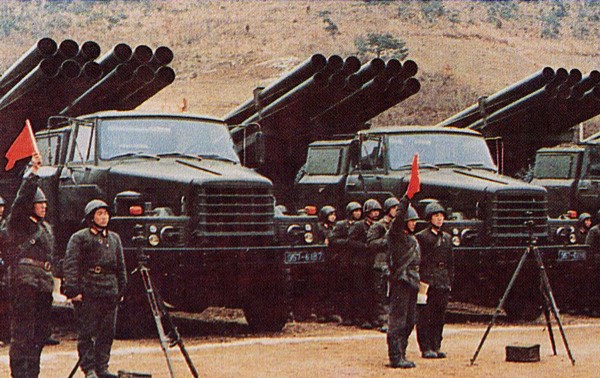
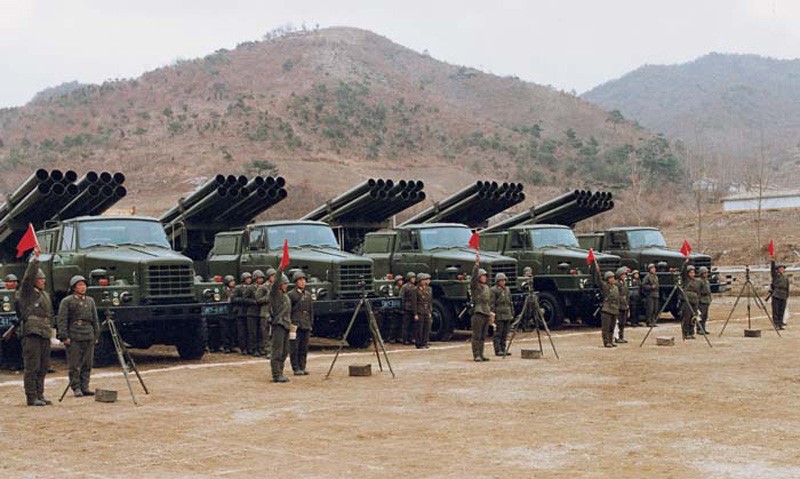
The M-1985 North Korean 240mm Multiple Rocket Launcher, developed in North Korea. It was first observed by US intelligence in 1985. The number in the designation indicates the year it was first observed. This artillery system was produced in quantity. According to some reports, North Korea has about 200 of these launchers in service. Large numbers of these systems are located north of the demilitarized zone and are targeted towards South Korea. The DPRK has about 500 various long-range artillery systems within the range of Seoul. This artillery system has been exported to Iran. Despite its simplistic appearance, the M1985 is a very capable system. At the time of its introduction, it was one of the most capable artillery rocket systems in the world. In some cases, it even outperformed a contemporary Soviet Uragan and a US M270 MLRS. This artillery rocket system is intended to engage important enemy targets, such as concentrations of troops and armored vehicles, command posts, artillery batteries, radar sites, airfields, as well as other important targets. The range of this system allows to strike targets behind enemy lines. This rocket system can also engage hostile warships. The M1985 has 12 launching tubes for 240 mm unguided spin-stabilized rockets. The type is easily identified by its two rows of 6 tubes. A standard HE-FRAG warhead weighs 90 kg and contains 45 kg of high explosives. Other types of warheads exist, including incendiary, smoke, and chemical. It is claimed that the maximum range of fire is 43 km. The operator can launch all rockets in full salvo, or just individual rockets manually. This artillery system can launch one rocket every 4 or 8 seconds. So it takes 48 to 96 seconds to launch all 12 rockets. Four manually-operated stabilizing jacks have to be lowered, prior to the rockets being launched. Elevation and traverse controls are also manually operated. The vehicle can leave the firing position within 2 minutes. The M1985 MLRS is based on a Japanese Isuzu 6x6 truck. The same chassis is used for the North Korean 122 mm MLRS. This launcher pack can be also adapted to any suitable cross-country truck. Behind the vehicle cabin, there is another cabin for the crew. This artillery rocket system is operated by a crew of around 5 men. The forward control cab accommodates 3 crew members, while the rest are seated in the rear cab. The M1985 is supported by a reloading vehicle, which carries one complete reload and is fitted with a crane. Reloading would normally be carried out well away from the firing position, to avoid counter-battery fire. A typical battery of the M1985 consists of five launching vehicles.

Ground Specifications
Crew 5
Mobility Type Wheeled (6x6)
Main Weapon 240 mm unguided spin-stabilized rockets
Engine Diesel
Max Speed 60.0 km/h
Range 43.0 km
Variants
Fadjr 3 Fadjr 3 is an Iranian artillery rocket system, similar to the M1985. Iran have taken delivery of 9 M1985 artillery rocket systems from North Korea, based on the Isuzu 6x6 truck. It is understood that production technology has also been transferred to Iran. Iranian-built vehicles were based on a commercially available Mercedes-Benz truck chassis with 6x6 configuration. Production reportedly commenced in the 1990s.
M1991 a more powerful North Korean artillery rocket system, fitted with 22 tubes for 240 mm rockets.
System
Alternative Designation M-1985; M1985
Type Multiple Rocket Launcher
Chassis The M1985 MLRS is based on a Japanese Isuzu 6x6 truck. The same chassis is used for the North Korean 122 mm MLRS. This launcher pack can be also adapted to any suitable cross-country truck.
Manufacturer North Korea, Company: INA
Crew 5 ea
Displacement Time 2 min
Emplacement Time 2 min
Note The M-1985 is supported by a reloading vehicle, which carries one complete reload and is fitted with a crane. Reloading would normally be carried out well away from the firing position, to avoid counter-battery fire. A typical battery of the M-1985 consists of five launching vehicles.
Dimensions
Length 10.5 m
Width 3.3 m
Height 2.6 m
Weight, Empty 15 tons
Automotive
Engine Name INA
Engine Type Diesel
Engine Power INA
Operational Range 600 km
Speed, Maximum Road 60 km/h
Speed, Average Cross INA
Speed Maximum Swim Not Amphibious
Gradient 60 %
Side Slope 30 %
Vertical Step 0.6 m
Trench 1.2 m
Fording Depth 1.2 m
Main Weapon System
System
Name M-1985
Type Multiple Rocket Launcher
Loader Type Manual
Number of Tubes 12 ea
Maximum Elevation INA
Minimum Elevation INA
Traverse Range INA
Traverse Left INA
Traverse Right INA
Time to Fire Each Rocket This artillery system can launch one rocket every 4 or 8 seconds.
Time to Fire all 12 Rockets 48 to 96 seconds
Ammunition
Name INA
Type HE-FRAG
Caliber 240 mm
Fuse Type INA
Rocket Weight 407 kg
Rocket Length INA
Warhead Weight 90 kg
Maximum Range 43 km
Armor Penetration INA
Basic Load 24 ea
Other Ammunition Types Other types of warheads exist, including incendiary, smoke and chemical.
Fire Control
Name INA
Computerized FCS INA
Direct Fire Yes
Indirect Fire Yes
Position Location System INA
Note Four manually-operated stabilizing jacks have to be lowered, prior to the rockets being launched.
Protection
Hull Armor INA
Turret Armor INA
Applique Armor INA
Explosive Reactive Armor No
Mine Clearing No
NBC Protection INA
Smoke Equipment INA
Details
Country of Origin North Korea
Category Rocket Artillery Systems
Land > Artillery > Rocket Artillery Systems
Filter Label
M
Classification
Domain
Ground
Equipment Status
Active
Dimensions
Length
10.5 m
Width
3.3 m
Height
2.6 m
Weight
15000 kg
Operators (3)
Iran
North Korea
Myanmar
Something went wrong. Please reload the page. Reload