LCM-8 (Mike Boat) American Landing Craft Mechanized (LCM)
LCM-8


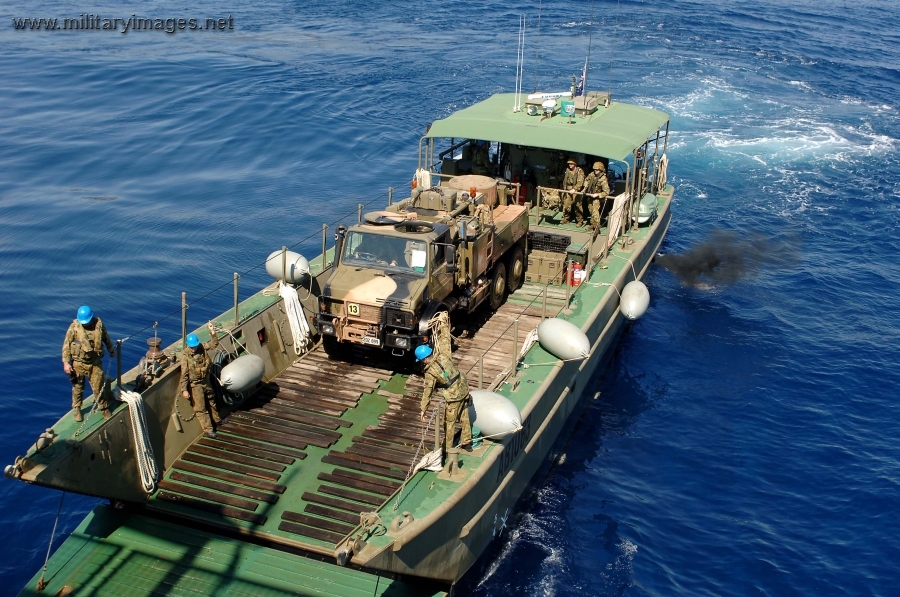
The LCM-8 ("Mike Boat") is a riverboat and mechanized landing craft used by the United States Navy and Army during the Vietnam War and subsequent operations. They are currently used by governments and private organizations throughout the world. The acronym stands for "Landing Craft Mechanized, Mark 8". (The "Mike Boat" term refers to the military phonetic alphabet, LCM being "Lima Charlie Mike".) The vessel weighs 135,000 pounds (61,200 kg) and has a crew of four: a Boatswain's Mate petty officer, an Engineman petty officer, a non-rated fireman, and a seaman. US Army specifications call for a crew of six during 24-hour operations: two coxswains, two seamen, and two enginemen. The LCM-8s are constructed from welded steel and powered by four 6V71 or two 12V71 diesel engines, twin propellers, and rudders. The ship can carry 60 short tons of cargo. It was designed by Marinett Marine Corp Dimensions. It has a range of 190 miles at 9kts with a full load. They were used by the United States Navy and Army during the Vietnam War. During the Vietnam War, there were two new aluminum LCM-8s on Johnston Island, which carried trucks and cargo between islands, and one being used as a rescue boat. They had the newer fluid shift transmissions, and 2-671's paired up to two props. In I Corps (the northernmost military district in Vietnam) boats based at Da Nang, Tan My and Cửa Việt had three-man crews of various rates and ranks. On U.S. Navy boats, the senior rate was usually a third-class petty officer or above, and the two crewmen could be E-2, E-3, or E-4 ranks (i.e. seaman apprentice, seaman, or petty officer third class). One of the two crewmen was almost always an Engineman and could be an ENFA, ENFN, or an EN3 in rank. The LCM-8s there all had two sets of twin 6-71 Detroits paired up to a hydro transmission. Two air compressors, port, and starboard of the engine sets, provided air pressure to operate the air cylinders that raised and lowered the bow ramp. The air cylinders were below deck in the eighth void from the bow and stretched cables attached to the ramp to raise it. Lowering the ramp was accomplished by releasing the air and allowing gravity to bring the ramp down. They also saw use during Operation Just Cause in Panama as well as Operation Desert Shield and Operation Desert Storm. Three Army LCM-8s served in the 1992–1993 US mission to Somalia (fictionalized in Christian Bauman's 2002 novel The Ice Beneath You, which is set in part on a US Army LCM-8 near Kismaayo, Somalia), and a platoon of LCM-8s from the 1098th Trans Co. deployed to Port-au-Prince for the Haitian invasion (1994). The United States Army Reserve's 464th Transportation Company assisted the United States Coast Guard in patrolling the Potomac River after the terrorist attacks on September 11, 2001. Some are currently deployed aboard Maritime Prepositioning ships to facilitate their mission of being able to unload all their cargo while still offshore with no outside assistance. The LCM-8 was constructed in Australia for the Australian Army from 1965 to 1967 and again in 1972 using a heavily modified design, crewed (four) and administered by the Royal Australian Corps of Transport and one engineer from the Royal Australian Electrical and Mechanical Engineers (RAEME). The modification of the vessels included an extended enclosed wheelhouse with full galley facilities, a chart table, and storage space to aid in extended operations beyond the original design parameters. A water purification system allows the vessels to be somewhat independent for longer periods of time. A fully functioning toilet (head) and shower are also installed as part of the wheelhouse extensions; external provision for bedding is also included for the full crew complement. The extension of the wheelhouse increased the rigidity of the craft leading to excessive vibration and cavitation with the original three-blade propeller. Further development included a more balanced and expensive five-blade propeller, negating the vibration and cavitation of the original. The prop change found a few negative effects on the beaching performance of the vessel but over time tactics have been changed to suit the new system. The vessels are also installed with a full suite of electronics allowing the craft to navigate in all weather, day or night in military operations anywhere in the world with little to no special training requirements for an indefinite period. During the mid-1990s, the Army LCM-8 received a life of type extension with a re-engine program. The original twin-pac 6-71 two-stroke Detroit Diesel engines and Allison mechanical transmissions were replaced with 8v-92 Silver Series Detroit Diesel engines and Allison Hydraulic Transmissions thus extending the life of the craft for another 20 years. Two craft were utilized during the invasion of Iraq in 2003, patrolling the shallow waters of the Khawr Abd Allah estuary using HMAS Kanimbla as their base of operations. They were extensively used in East Timor for logistic operations in direct support of multinational peacekeepers. Other deployments include peacekeeping and peace monitoring operations in Bougainville and the Solomon Islands. The LCM-8 fleet of fifteen was to be replaced by six Australian designed type LCM2000 waterjet propelled craft, however, these crafts were scrapped, after not meeting the required in-service specifications and being deemed not fit for use for the intended Kanimbla-class. The Army will now continue to operate the LCM-8 until 2027.