FV 511 Warrior British Infantry Command Vehicle
FV 511 Warrior
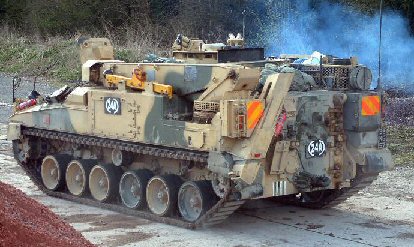
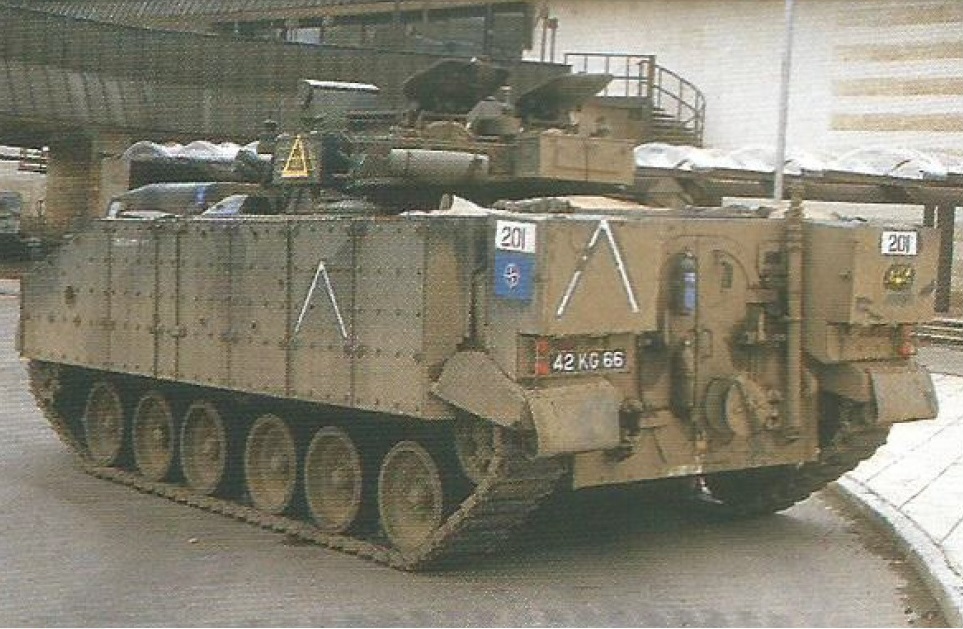
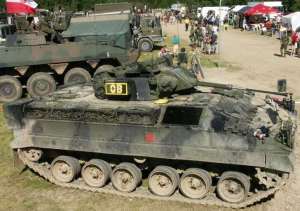
Command Vehicle This variant comes in three configurations: battalion, company and platoon command vehicles, all-purpose outfitted by the British army. Command vehicles are outfitted with different types of radios, map boards and other staff support equipment, depending on the command level of the vehicle. It is also fitted with the Vickers Defense Turret mounting the 30-mm Rarden cannon. The Warrior tracked vehicle family is a series of British armored vehicles, originally developed to replace the older FV430 series of armored vehicles. The Warrior started life as the MCV-80, "Mechanised Combat Vehicle for the 1980s". One of the requirements of the new vehicle was a top speed able to keep up with the projected new MBT, the MBT-80 - later canceled and replaced by what became the Challenger 1 - which the then-current FV432 could not. The project was begun in the 1970s. GKN Defence won the production contract in 1980. A total of 789 FV510 and variants were manufactured for the British Army, and 254 of a modified version (Desert Warrior) was produced for the Kuwaiti Army. The Warrior incorporates several design features in keeping with the UK's battlefield experience. In particular, there are no firing ports in the hull, in line with British thinking that the role of the armored personnel carrier/infantry fighting vehicle (APC/IFV) is to carry troops under protection to the objective and then give firepower support when they have disembarked. The absence of firing ports also allows additional appliqué armor to be fitted to the sides of the vehicle, which is invariably applied to Warriors involved in active operations. The cage armor used at one stage was replaced in 2007 by "Wrap Two" appliqué armor. The basic armor provides all-around protection against small arms ball ammunition. The crew of a Warrior comprises the driver, seated in the front hull, and the gunner and commander, who are both seated in the turret. The embarked infantry section can number up to seven soldiers, who are seated facing each other in the rear hull compartment. Passenger access is through a single electric ram powered door at the rear of the hull, rather than a drop-down ramp as in the US M113 APC and M2 Bradley IFV. Warrior Section Vehicles are able to carry and support seven fully equipped soldiers together with supplies and weapons, including a number of anti-tank weapons, for a 48-hour battlefield day in nuclear/biological/chemical conditions. The Warrior is driven by a Perkins-Rolls-Royce V8 Condor engine through a four-speed automatic gearbox. It is capable of a road speed of 46 miles per hour (74 km/h). The Warrior has the speed and performance to keep up with a Challenger 2 main battle tank over the most difficult terrain. The vehicle is fitted with a two-man GKN Sankey turret, armed with a non-stabilized L21A1 30 mm RARDEN cannon capable of destroying some APCs at a maximum range of 1,500 meters (1,600 yd), and an L94A1 EX-34 7.62 mm Hughes Helicopters coaxial chain gun. It is fitted with two clusters of four defensive grenade launchers (usually used with Visual and Infrared Screening Smoke – VIRSS). All Warrior Infantry Section Vehicles are now equipped with Bowman radios, which replaced the earlier Clansman radios, for enhanced communications, command and control. When first introduced, the vehicles were fitted with passive Image intensifier night vision sights. These have since been progressively replaced with Thales Optronics Battle Group Thermal Imaging (BGTI) sights to upgrade night fighting capabilities, with 8x magnification. As of 2007, 350 vehicles were fitted with BGTI.