Kfir (Lion Cub) Israeli Multi-Role Fighter

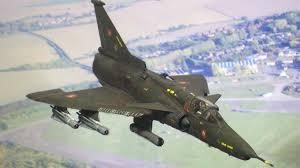
The Israel Aircraft Industries Kfir (Hebrew: כְּפִיר, "Lion Cub") is an Israeli-built all-weather multirole combat aircraft based on the French Dassault Mirage 5, with Israeli avionics and an Israeli-built version of the General Electric J79 turbojet engine. The Kfir programme originated in the quest to develop a more capable version of the IAI Nesher, which was already in series production. After General De Gaulle embargoed the sale of arms to Israel, the IAF feared that it might lose qualitative superiority over its adversaries in the future, which were receiving increasingly advanced Soviet aircraft. The main and most advanced type of aircraft available to the IAF was the Mirage, but a severe problem developed due to the Mirage fleet's depletion due to attrition after the Six-Day War. Domestic production would avoid the problem of the embargo completely; efforts to reverse engineer and reproduce components of the Mirage were aided by Israeli espionage efforts to obtain technical assistance and blueprints from third party Mirage operators. Two power plants were initially selected for trials, the General Electric J79 turbojet and the Rolls-Royce Spey turbofan. In the end, the J79 was selected, not least because it was the same engine used on the McDonnell Douglas F-4 Phantom II, which the Israelis began to acquire from the United States in 1969, along with a license to produce the J79 themselves. The J79 was clearly superior to the original French Atar 09, providing a dry thrust of 49 kN (11,000 lbf) and an afterburning thrust of 83.4 kN (18,750 lbf). In order to accommodate the new powerplant on the Mirage III's airframe, and to deliver the added cooling required by the J79, the aircraft's rear fuselage was slightly shortened and widened, its air intakes were enlarged, and a large air inlet was installed at the base of the vertical stabilizer, so as to supply the extra cooling needed for the afterburner. The engine itself was encased in a titanium heat shield. A two-seat Mirage IIIBJ fitted with the GE J79 made its first flight in September 1970, and was soon followed by a re-engined Nesher, which flew in September 1971. An improved prototype of the aircraft, with the name Ra'am B ("Ra'am" means "Thunder"; the "Ra'am A" was the Nesher),[6] made its first flight in June 1973. It had an extensively revised cockpit, a strengthened landing gear, and a considerable amount of Israeli-built avionics. The internal fuel tanks were slightly rearranged, their total capacity being increased to 713 US gal (2,700 l). There were unconfirmed reports that a number of the original Mirage IIICs, re-engined with the J79 and given the name Barak ("Lightning"), took part in the Yom Kippur War of 1973, but some sources point out that there is no evidence that these aircraft ever existed.