Vikrant Class Indian Aircraft Carrier
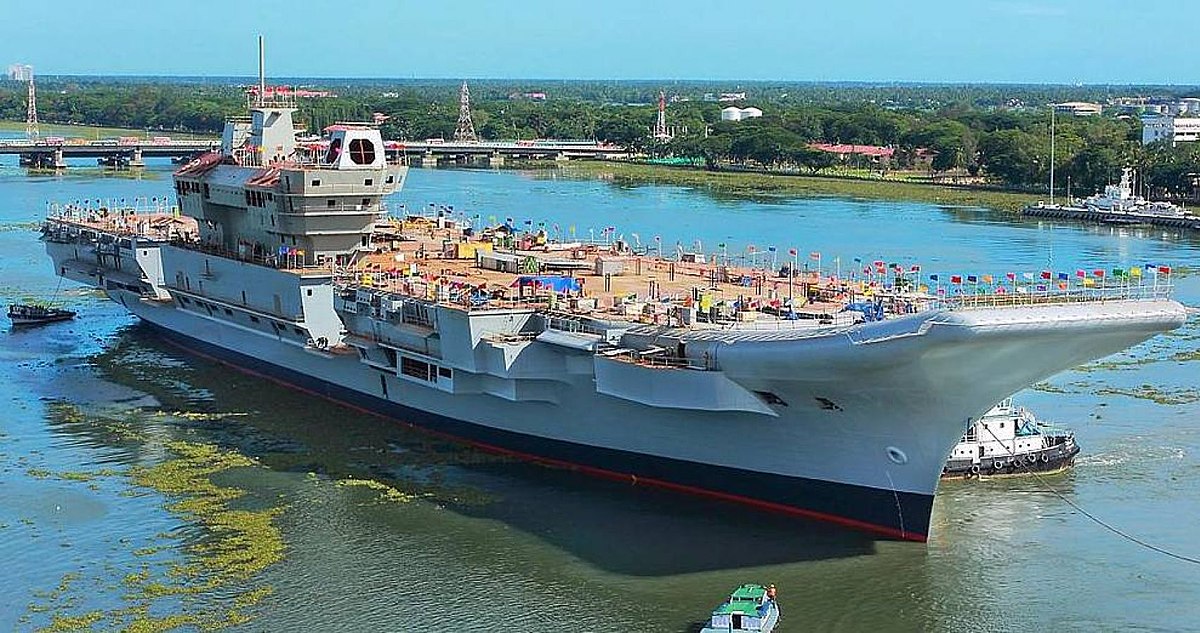
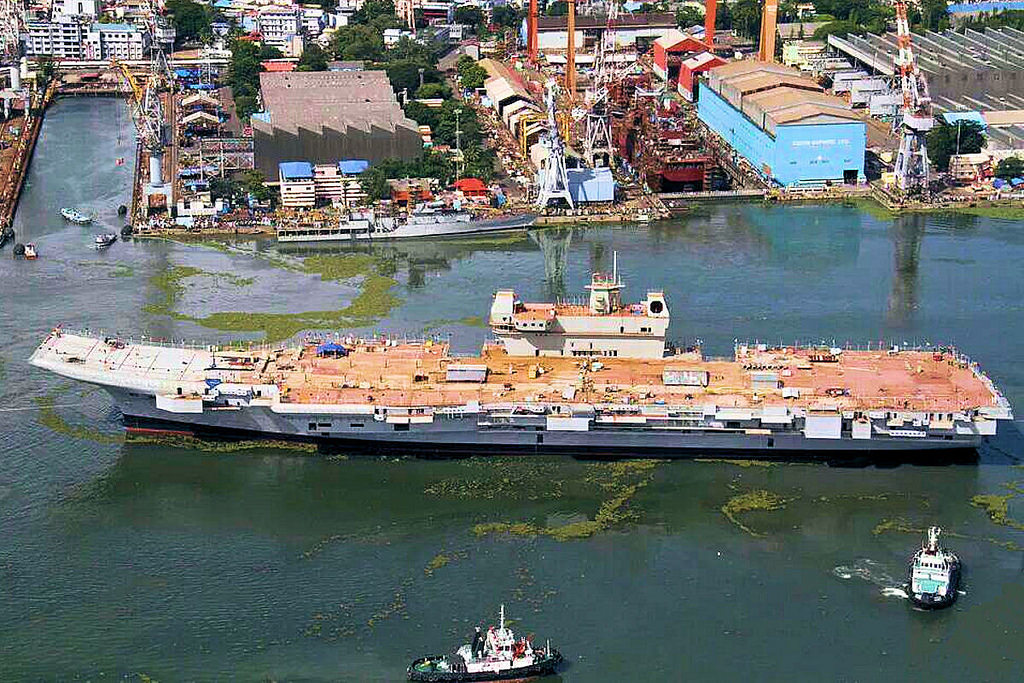

The Vikrant Class Indian Aircraft Carrier is an aircraft carrier under construction by Cochin Shipyard in Kochi, Kerala for the Indian Navy. It is the first aircraft carrier to be built in India. The name Vikrant (Sanskrit vikrānta, literally "stepping beyond") means "courageous". The motto of the ship is Jayema Sam Yudhi Sprdhah, which is taken from Rigveda 1.8.3 and can be translated as "I defeat those who fight against me". Work on the ship's design began in 1999, and the keel was laid in February 2009. The carrier was floated out of its dry dock on 29 December 2011 and was launched on 12 August 2013. As of 2019, the ship is expected to start sea trials in February 2021 and enter into service in early 2022. The project cost has escalated, by 2014, to ₹19,341 crore (equivalent to ₹230 billion or US$3.2 billion in 2018). With an additional ₹3,000 crore (US$420 million) authorised for phase III, in 2019. It is 262 metres (860 ft) long and 60 metres (200 ft) wide, and displaces about 40,000 metric tons (39,000 long tons). It features a STOBAR configuration with a ski-jump. The deck is designed to enable aircraft such as the MiG-29K to operate from the carrier. It is expected to carry an air group of up to thirty aircraft, which will include up to 24–26 fixed-wing combat aircraft,[23] primarily the Mikoyan MiG-29K, besides carrying 10 Kamov Ka-31 or Westland Sea King helicopters. The Ka-31 will fulfill the airborne early warning (AEW) role and the Sea King will provide anti-submarine warfare (ASW) capability. Vikrant is powered by four General Electric LM2500+ gas turbines on two shafts, generating over 80 megawatts (110,000 hp) of power. The gearboxes for the carriers were designed and supplied by Elecon Engineering. The ship's combat management system (CMS) was developed by Tata Power Strategic Engineering Division in collaboration with Weapon and Electronics System Engineering Establishment and MARS, Russia. It is the first CMS developed by a private company for the Indian Navy, was handed over to the Navy on 28 March 2019 India considered a number of aircraft for operation from its INS Vikramaditya and the planned indigenous aircraft carrier. India evaluated the Russian Sukhoi Su-33, but chose the lighter Mikoyan MiG-29K as Vikramaditya was smaller and lacked an aircraft catapult. On 18 January 2010, it was reported that India and Russia were close to signing a deal for 29 MiG-29K fighters to operate from IAC-1. In addition, the navy signed a deal for six naval-variants of the HAL Tejas. In June 2012, Flight Global reported that the Indian Navy was considering the use of Rafale M (Naval variant) on these carriers. In December 2016, the navy announced that the HAL Tejas was overweight for carrier operations, and other alternatives would be looked at. The ship's completion and commissioning has been delayed several times. Vikrant was originally intended to be delivered in December 2010 and commissioned in 2016. This was later postponed, with sea trials to begin in 2017 and commissioning planned for 2018. In July 2016, the Comptroller & Auditor General (CAG) published a 2014 project plan, supplied by the Cochin Shipyard, that shows an expected completion date in 2023, though the Navy hoped to partially commission the ship before this date. In December 2017, the Chief of Naval Staff Admiral Sunil Lanba announced that the ship was expected to be commence sea trials and be commissioned in 2020.[62][64] In January 2018, Commodore Chowdhary, the principal director of naval design, announced the remaining procurement delays stalling Vikrant's construction had been resolved, and that the carrier would be completed and delivered by December 2018; it would then undergo two years of sea trials before its expected commissioning in October 2020. In July 2019, Vice Admiral Saxena, Controller of Warship Production and Acquisition in the Navy, said that the ship was expected to be delivered by 2021.