Tu-154B (Careless-B) Russian Jet Airliner
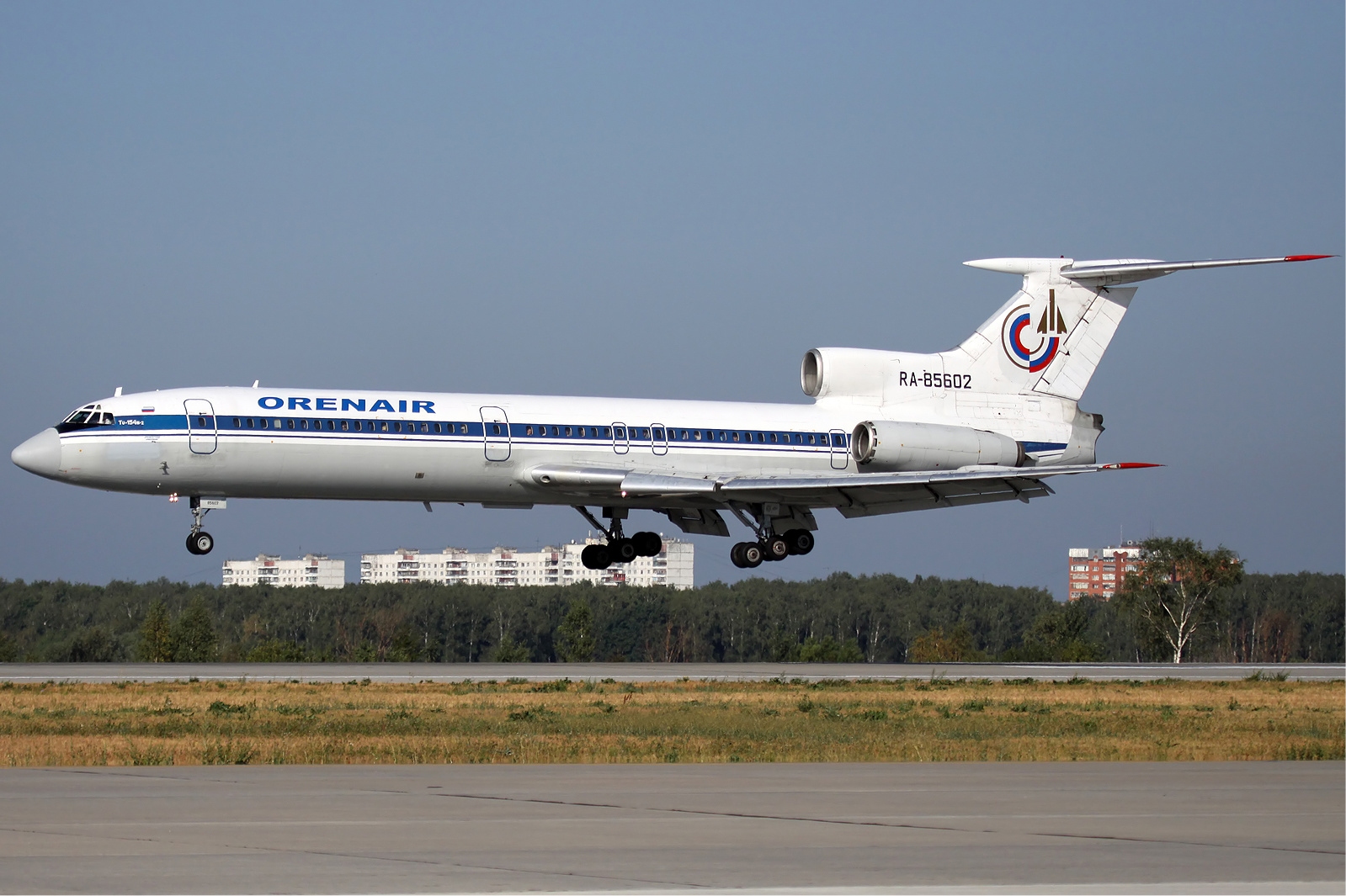


Tu-154B As the original Tu-154 and Tu-154A suffered wing cracks after a few years in service, a version with a new, stronger wing, designated Tu-154B, went into production in 1975. It also had an additional fuselage fuel tank, additional emergency exits in the tail. Also, the maximum takeoff weight increased to 98,000 kg (216,053 lb). Important to Aeroflot was the increased passenger capacity, hence lower operating costs. With the NK-8-2U engines the only way to improve the economics of the airplane was to spread costs across more seats. The autopilot was certified for ICAO Category II automatic approaches. Most previously built Tu-154 and Tu-154A were also modified into this variant, with the replacement of the wing. Maximum takeoff weight increased to 96,000 kg (211,644 lb). 111 were built. The Tupolev Tu-154 (Russian: Tyполев Ту-154; NATO reporting name: "Careless") is a three-engine medium-range narrow-body airliner designed in the mid-1960s and manufactured by Tupolev. A workhorse of Soviet and (subsequently) Russian airlines for several decades, it carried half of all passengers flown by Aeroflot and its subsidiaries (137.5 million/year or 243.8 billion passenger km in 1990), remaining the standard domestic-route airliner of Russia and former Soviet states until the mid-2000s. It was exported to 17 non-Russian airlines and used as a head-of-state transport by the air forces of several countries. With a cruising speed of 850 kilometers per hour (530 mph) the Tu-154 is one of the fastest civilian aircraft in use and has a range of 5,280 kilometers (3,280 mi). Capable of operating from unpaved and gravel airfields with only basic facilities, it was widely used in the extreme Arctic conditions of Russia's northern/eastern regions where other airliners were unable to operate. Originally designed for a 45,000-hour service life (18,000 cycles) but capable of 80,000 hours with upgrades, it was expected to continue in service until 2016, although noise regulations have restricted flights to western Europe and other regions. Since 1968 there have been 39 fatal incidents involving the Tu-154, most of which were caused either by factors unrelated to the aircraft, incorrect maintenance, or by its extensive use in demanding conditions. Few of the Tu-154 accidents appear to have involved technical failure. The Tu-154 is powered by three rear-mounted low-bypass turbofan engines arranged similarly to those of the Boeing 727, but it is slightly larger than its American counterpart. Both the 727 and the Tu-154 use an S-duct for the middle (Number 2) engine. The original model was equipped with Kuznetsov NK-8-2 engines, which were replaced with Soloviev D-30KU-154 in the Tu-154M. All Tu-154 aircraft models have a relatively high thrust-to-weight-ratio which give excellent performance, at the expense of lower fuel efficiency. This became an important factor in later decades as fuel costs grew. The cockpit is fitted with conventional dual yoke control columns. Flight control surfaces are hydraulically operated. The cabin of the Tu-154, although of the same six-abreast seating layout, gives the impression of an oval interior, with a lower ceiling than is common on Boeing and Airbus airliners. The passenger cabin accommodates 128 passengers in a two-class layout and 164 passengers in single-class layout, and up to 180 passengers in high-density layout. The layout can be modified to what is called a winter version where some seats are taken out and a wardrobe is installed for passenger coats. The passenger doors are smaller than on its Boeing and Airbus counterparts. Luggage space in the overhead compartments is very limited. Like the Tupolev Tu-134, the Tu-154 has a wing swept back at 35° at the quarter-chord line. The British Hawker Siddeley Trident has the same sweepback angle, while the Boeing 727 has a slightly smaller sweepback angle of 32°. The wing also has anhedral (downward sweep) which is a distinguishing feature of Russian low-wing airliners designed during this era. Most Western low-wing airliners such as the contemporary Boeing 727 have dihedral (upward sweep). The anhedral means that Russian airliners have poor lateral stability compared to their Western counterparts, but also are more resistant to Dutch roll tendencies. Considerably heavier than its predecessor Soviet-built airliner the Ilyushin Il-18, the Tu-154 was equipped with an oversized landing gear to reduce ground load, enabling it to operate from the same runways. The aircraft has two six-wheel main bogies fitted with large low-pressure tires that retract into pods extending from the trailing edges of the wings (a common Tupolev feature), plus a two-wheel nose gear unit. Soft oleo struts (shock absorbers) provide a much smoother ride on bumpy airfields than most airliners, which very rarely operate on such poor surfaces. The original requirement was to have a three-person flight crew – captain, first officer and flight engineer – as opposed to a four- or five-person crew, as on other Soviet airliners. It became evident that a fourth crew member, a navigator, was still needed, and a seat was added on production aircraft, although their workstation was compromised due to the limitations of the original design. Navigators are no longer trained and this profession is becoming obsolete with the retirement of the oldest Soviet-era planes. The latest variant (Tu-154M-100, introduced 1998) includes an NVU-B3 Doppler navigation system, a triple autopilot, which provides an automatic ILS approach according to ICAO category II weather minima, an autothrottle, a Doppler drift and speed measure system (DISS), and a "Kurs-MP" radio navigation suite. A stability and control augmentation system improves handling characteristics during manual flight. Modern upgrades normally include modernized TCAS, GPS, and other systems (mostly American-made or EU-made). Early versions of the Tu-154 cannot be modified to meet the current Stage III noise regulations and are no longer allowed to fly into airspace where such regulations are enforced, such as the European Union. However, the Tu-154M's D-30 engines can be fitted with hush kits, allowing them to meet noise regulations.