Orca Class American Extra Large Unmanned Undersea Vehicle (XLUUV)
Orca
American Extra Large Unmanned Undersea Vehicle (XLUUV)
Spotted an error? Sign in to suggest an edit.
Other


Basic Information
Name
Orca Class American Extra Large Unmanned Undersea Vehicle (XLUUV)
Designation
Orca
Alternate Designation
Orca
Equipment Type
American Extra Large Unmanned Undersea Vehicle (XLUUV)
Manufacturer
Lockheed Martin
Date of Introduction
2020
Description
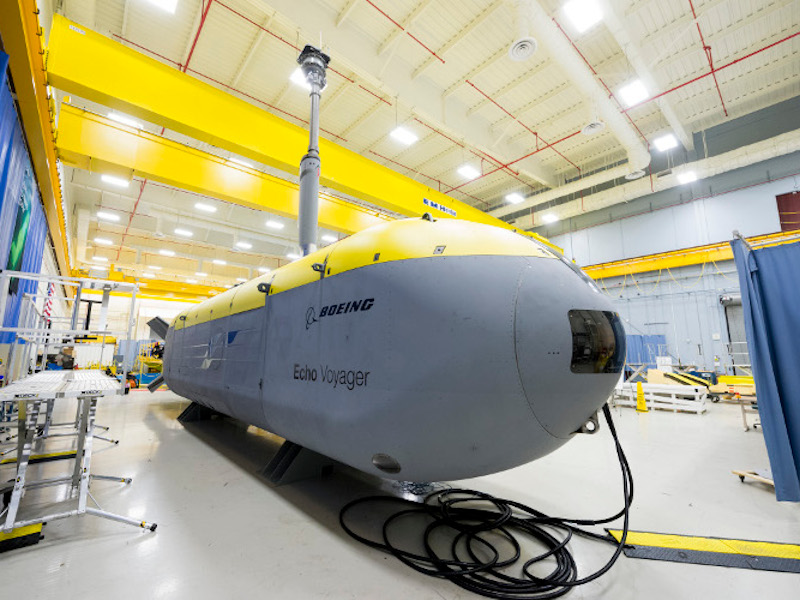
The US Navy plans to use the Orca American Extra Large Unmanned Undersea Vehicle (XLUUV) for potential capabilities such as mine countermeasures, anti-surface warfare (ASuW), anti-submarine warfare (ASW), electronic warfare (EW), and strike missions. The XLUUV is a migration from the Echo Voyager from Boeing, with a mission module placed in the middle of it, to initially carry mines. The Orca American Extra Large Unmanned Undersea Vehicle (XLUUV) is an open-architecture, reconfigurable UUV that will be modular in construction and have a modular payload bay. The underwater vehicles are expected to be delivered by June 2022 under a program to address a Joint Emergent Operational Need (JEON).
Naval & Littoral Specifications
Beam
2.60 m
System
Alternative Designation
Orca
Type
American Extra Large Unmanned Undersea Vehicle (XLUUV)
Builder
Lockheed Martin
Crew
Autonomous
Mission
The US Navy plans to use the Orca American Extra Large Unmanned Undersea Vehicle (XLUUV) for potential capabilities such as mine countermeasures, anti-surface warfare (ASuW), anti-submarine warfare (ASW), electronic warfare (EW), and strike missions. The long-range underwater vehicle is being developed to perform critical missions with reliability. It is expected to provide the ability to launch, recover, operate and establish communications with the vehicle from a home base away from the area of operation without the need for navy personnel.
Force Multiplier
Key attributes include extended vehicle range, autonomy, and persistence. Orca XLUUV will transit to an area of operation; loiter with the ability to periodically establish communications, deploy payloads, and transit home.
Navigation System
Kalman filtered Inertial Navigation Unit (INU)
GPS
Yes, equipped with GPS to support its operations on or near the surface.
Launch and Recovery
The vehicle can be launched and recovered without the requirement of support ships.
Modular Payload Bay
Yes, The payload bay will have interfaces to support requirements for existing and future payloads.
Payload Capacity
The modular payload bay will have the capacity to hold 8t of dry weight and the bay is powered by an 18kW battery.
Dimensions
Length
26 m
Beam
2.6 m
Draft
Submersible
Displacement, Standard
50 tons in the air
Displacement, Full Load
INA
Propulsion System
Engine Name
INA
Engine Type
Hybrid rechargeable power system
Engine Power
INA
Active Buoyancy Control System
An Active buoyancy control system aboard will mainly provide capabilities, including autonomous buoyancy control, seafloor mooring and forward and aft trim control.
Range
6,500 nm
Maximum Speed
8 knots
Optimal Speed
2.5-3 knots
Minimum Speed
2.5 knots
Endurance
The submersible can carry out operations for months.
Communications
Inmarsat IV
Yes, Encrypted Inmarsat IV
Iridium Global Satellite Communications
Yes
Wi-Fi
Yes
FreeWave Enabled Communications
Yes, FreeWave enabled communications are used for command, control and mission re-planning, while the vehicle performs near-surface operations.
Note
The submersible uses acoustic communications for command and control during submerged operations.
Armament
Note
The Navy is developing new types of mines: the cylindrical-shaped Clandestine Delivered Mine and the Hammerhead, an encapsulated torpedo designed to lie in wait for submarines. The capsule for the torpedo would be anchored to the ocean floor, much like the Mk60 CAPTOR mine of Cold War vintage that housed a Mk46 antisubmarine torpedo. (The CAPTOR was withdrawn from the Navy’s inventory in 2001.) The Hammerhead is designed to have modular architecture to allow for technology insertion.
Sonar Systems
Forward-Looking Sonar (FLS)
Yes
Doppler Velocity Logs (DVLs)
Yes, The FLS and the DVL facilitate terrain-following capability at the seabed.
Autonomous Obstacle Avoidance System
Yes
Depth Sensors
Yes
Seafloor Long Baseline (LBL)
Yes
Synthetic Aperture Sonar System
Available, Raytheon PROSAS PS60-6000 synthetic aperture sonar for improved ocean floor mapping.
Protection
Hull Armor
INA
Countermeasures
No
NBC Water Washdown System
No
EW Intercept
No
Details
Country of Origin
United States
Category
Naval
Naval
Filter Label
O
Classification
Domain
Naval & Littoral
Equipment Status
Active
Dimensions
Length
26 m
Width
2.6 m
Height
—
Weight
50000 kg
Operators (1)
United States
Something went wrong. Please reload the page.
Reload