SIR-C/X-SAR
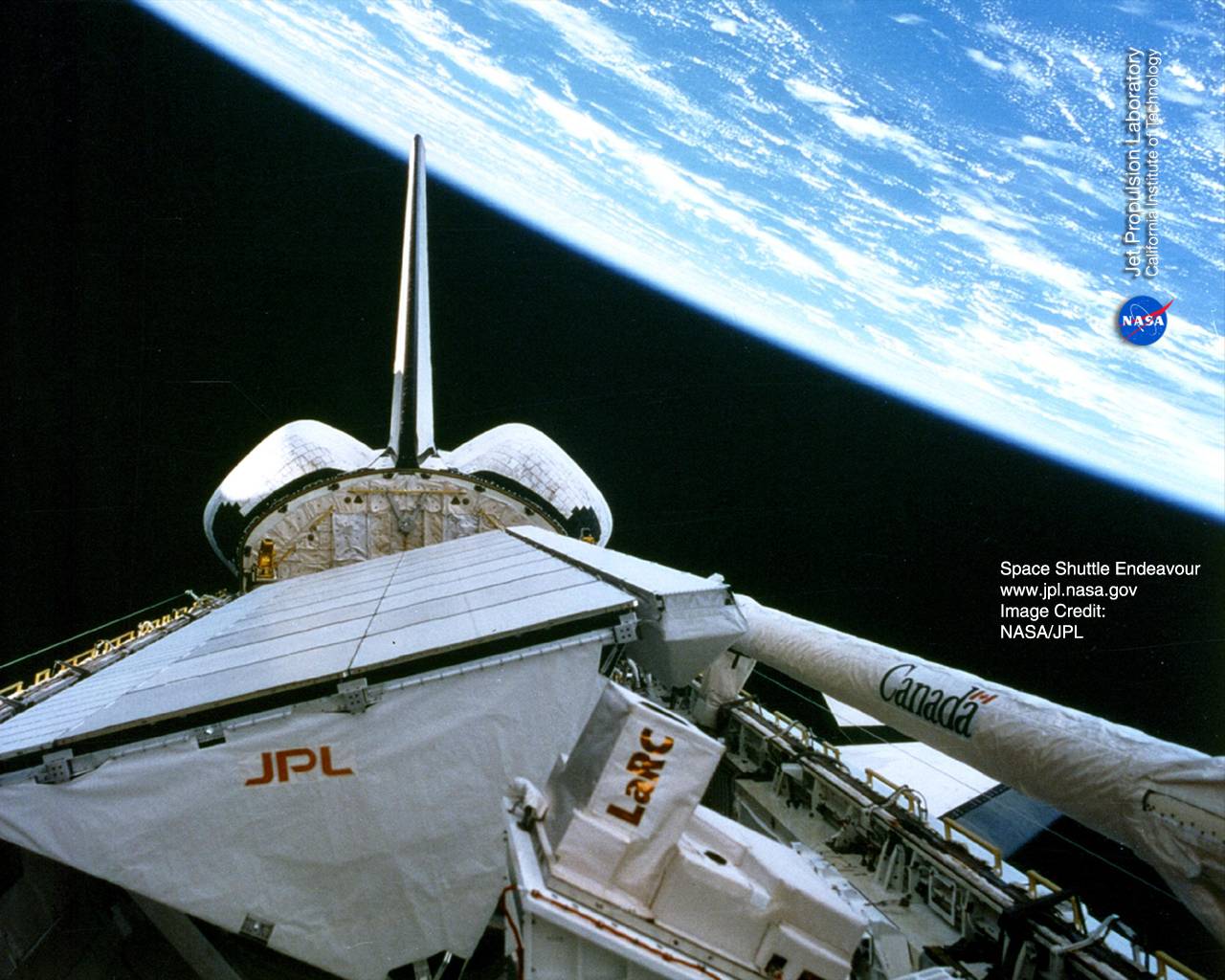
SIR-C/X-SAR, or Spaceborne Imaging Radar-C/X-band Synthetic Aperture Radar, was a spaceborne imaging radar system flown aboard the Space Shuttle on two missions: April 9-20, 1994, and September 30-October 11, 1994. Operating from a 225 km circular orbit with a 57-degree inclination, this three-frequency, multi-polarization radar system was a joint project of NASA, the German Space Agency (DARA, now DLR), and the Italian Space Agency (ASI). It conducted Earth environmental observations to enhance understanding of the planet's carbon, water, and energy cycles, with applications including monitoring deforestation, desertification, and soil moisture. The SIR-C/X-SAR antenna structure, the most massive hardware assembled at the Jet Propulsion Laboratory at the time (10,500 kg, 12m x 4m), consisted of three individual antennas: L-band (0.235 m wavelength), C-band (0.058 m wavelength), and X-band (0.03 m wavelength). The L-band and C-band antennas, built by JPL and Ball Communication Systems Division, utilized phased array technology with hundreds of low-power solid-state transmitters, enabling electronic beam steering of ±23 degrees from the nominal 40 degrees off-nadir position without physical movement. These antennas provided dual-polarization measurements (HH, VV, HV, VH) and relative phase differences, allowing for the derivation of a complete scattering matrix for detailed analysis of surface geometric structure, vegetation cover, and subsurface discontinuities. The X-SAR instrument, built by Dornier and Alenia Spazio, operated at a single frequency with a slotted waveguide antenna that used mechanical tilt for beam pointing. The system operated with a pulse repetition frequency (PRF) ranging from 1395 to 1736 pulses per second, pulsewidths (τ) of 33.8, 16.9, or 8.5 µs, and transmitter bandwidths of 10, 20, or 40 MHz. It achieved an across-track resolution of 3.7 m, with interferogram resolutions of 5.8 m along-track, 54 m across-track, approximately 17 m slant ra
radartutorial.eu: https://www.radartutorial.eu/19.kartei/09.space/karte003.en.html