IL-62 (Classic) Russian Jet Airliner
IL-62
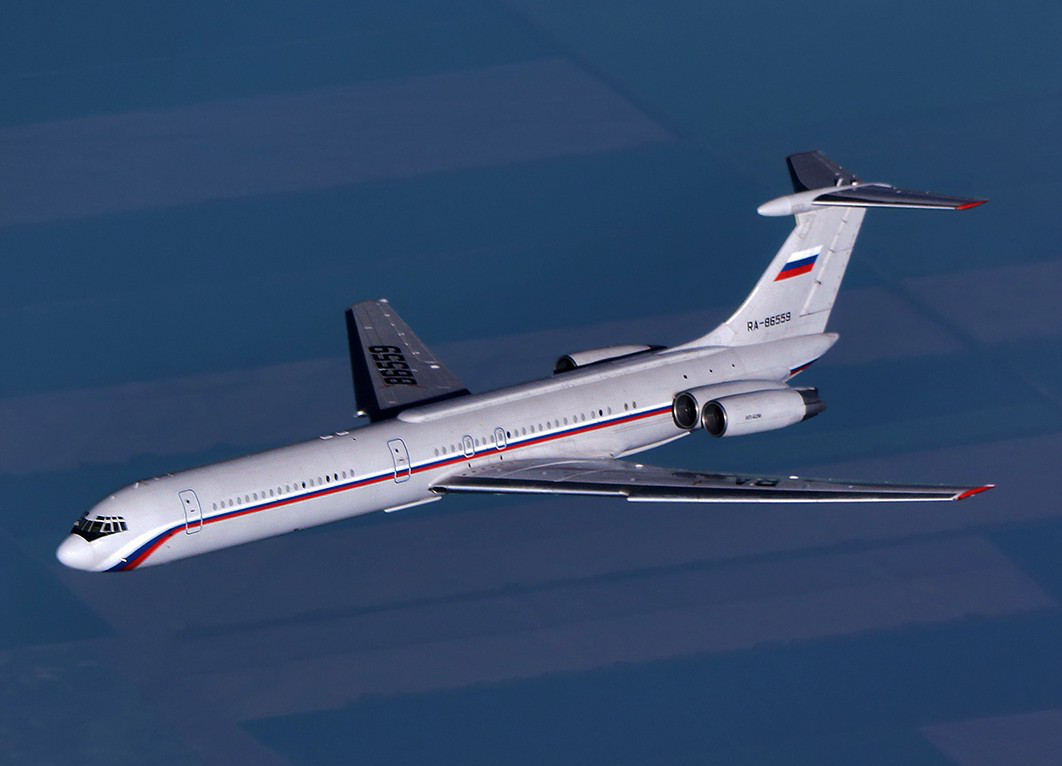

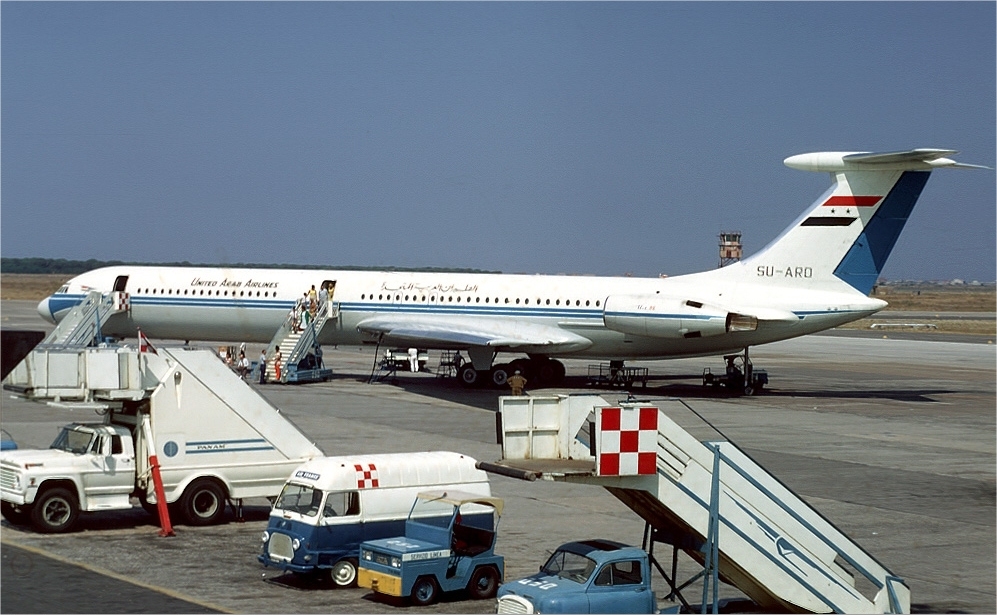
The Ilyushin IL-62 (Russian: Илью́шин Ил-62; NATO reporting name: Classic) is a Soviet long-range narrow-body jetliner conceived in 1960 by Ilyushin. As successor to the popular turboprop Il-18 and with capacity for almost 200 passengers and crew, the Il-62 was the world's largest jet airliner when first flown in 1963. One of four pioneering long-range designs (the others being Boeing 707, Douglas DC-8, and Vickers VC10), it was the first such type to be operated by the Soviet Union and a number of allied nations. The Il-62 entered Aeroflot civilian service on 15 September 1967 with an inaugural passenger flight from Moscow to Montreal, and remained the standard long-range airliner for the Soviet Union (and later, Russia) for several decades. It was the first Soviet pressurised aircraft with non-circular cross-section fuselage and ergonomic passenger doors, and the first Soviet jet with six-abreast seating (the turboprop Tu-114 shared this arrangement) and international-standard position lights. Over 30 nations operated the Il-62 with over 80 examples exported and others having been leased by Soviet-sphere and several Western airlines. The Il-62M variant became the longest-serving model in its airliner class (average age of examples in service as of 2016 is over 32 years). Special VIP (salon) and other conversions were also developed and used as head-of-state transport by some 14 countries. However, because it is expensive to operate compared to newer generation airliners, the number in service was greatly reduced after the 2008 Great Recession. The Il-62's successors include the wide-bodied Il-86 and Il-96, both of which were made in much smaller numbers and neither of which was widely exported. The Il-62 is a conventional all-metal low-wing monoplane of riveted sectional semi-monocoque construction to fail-safe design principles (a structure designed so that failure of one major member does not cause immediate failure of the whole). Its service life was initially set at 30,000 flight hours and subject to extensions and curtailments according to the quality of service procedures, inspection and manufacturer's bulletins. The aircraft features pressurised cabin and freight holds (with fuselage dimensions of 3.8 m width x 4.1 m height), duplex all-mechanical flight controls, though with twin electric motors for tailplane incidence control; hydraulic nosewheel steering, landing gear and tail strut actuation, and wheel brakes. The Il-62M has spoilers and lift dumpers which extend automatically upon landing and are hydraulically operated. Control surfaces include a variable-incidence tailplane with dynamically and weight-compensated elevators with trim tabs, triple-section tabbed ailerons (outermost for low speed and innermost for high speed) which are interlinked with a torsion bar, spoilerons (Il-62M), spoilers and lift dumpers, and pneumatically actuated thrust reversers on the two outboard engines (the reversers are flight-rated on the Il-62M). 27 V AC electrics are used throughout with a TA-6 auxiliary power unit (a turbine generator which supplies electric power and air conditioning on the ground) in the lower tailcone plus backup lead-zinc batteries. The aircraft uses conventional hot air de-icing using engine bleed air. Its sea level is equivalent to 2,400 m (8,000 ft) above mean sea level and thereafter reducing to the equivalent of 2,400 m (8,000 ft) to cruise altitude. It was originally built with no automatic oxygen masks; emergency supply comprises hatrack-housed oxygen bottles and masks for manual distribution to passengers by cabin crew. Since 1997, most aircraft have been retrofitted with automatic oxygen supply systems with drop-down masks. Its avionics include a Polyot-1 automatic flight control system (a "super autopilot," able to be programmed with a set route which it can fly without human intervention but under constant flight crew monitoring; ICAO Cat. 1 approaches standard, Cat. 2 optional), Doppler navigational radar replaced by triplex INSS (Inertial Navigation System Sets) on Il-62M after 1978 and by GPS (Global Positioning System) navigation sets on many aircraft after 1991, triple VHF and HF flightdeck radios, automatic direction finders, Soviet and Western instrument landing system receivers, vertical omnidirectional radio range and radio beacon receivers, duplex radio altimeters, automatic radio transponders, a full ICAO-standard navigation lights fit, cabin tannoy and intercom systems. Soviet/Russian and Warsaw Pact sovereign examples are additionally fitted with triplex "Odd Rods" (NATO code name) IFF (identification friend or foe) air defence transponders identifiable by three closely spaced short aerials. Emergency evacuation systems include inflatable life rafts and manually extendable canvas evacuation slides. Most aircraft are now retrospectively fitted with emergency floor lighting strips and some aircraft equipped with automatically inflatable evacuation slides. Fire extinguishers are sited in engine nacelles, flightdeck compartment, cabin crew rest areas and toilets. The Il-62 offers accommodation for up to 198 passengers in a single-class layout, seated six-abreast at 84 cm (33 in) seat pitch in two cabins separated by a vestibule, galley/pantry and cabin crew rest area. There are three toilets, forward, midships, and aft. It has a buffet/bar and a further cabin crew rest area in a vestibule forward, with a further optional cabin crew rest area aft. Typical mixed-class accommodation ranges between 128 and 144, seated four or six abreast, and a common single aisle configuration for long distance Aeroflot examples was first class (2-abreast) 3 rows, business class (3-abreast) 4 rows, economy class (3-abreast) 17 rows (Thiel, 2001). In this configuration, the central aisle in business and economy classes is quite narrow. A first class compartment is optionally sited aft of forward entry door or just forward of midships entry door, with an economy compartment further forward in the latter case. "Skycot" fitments are located in hatracks, while later Il-62Ms (1978 onwards) feature enclosed hatracks. Customer-optionable interior fitments. No in-flight entertainment systems are available except a public-address system that may be coupled to an open-reel or audio cassette player. Individual aircraft were experimentally fitted with television sets for Soviet-standard videotape entertainment during the 1970s. Some aircraft were retrospectively fitted with Western in-flight entertainment (solely audio) systems after 1991.