ARMSNET
Military Equipment Database
Initializing 0%

Kh-31A Russian Anti-Ship Missile
Spotted an error? Sign in to suggest an edit.
Basic Information
Name
Kh-31A Russian Anti-Ship Missile
Designation
Alternate Designation
Equipment Type
Manufacturer
Date of Introduction
1982
Description

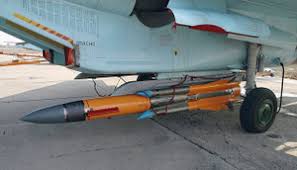
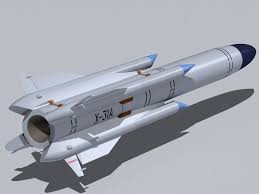
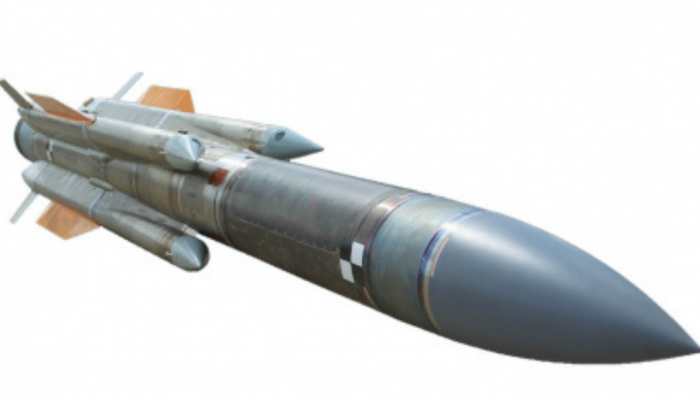
Kh-31A - active seeker head for use as an anti-ship missile against vessels up to destroyer size, range of 25 km–103 km (13.5–55.6 nmi). Missile is sea-skimming as it approaches the target. The Kh-31A is a variant of the KH-31 (AS-17 Krypton) New air defense weapon systems of the American Patriot kind have raised the requirements which antiradar missiles must meet. These include first of all higher speed and longer range, then also high interference immunity and radar turn-off when attacked. For the special purpose of meeting these requirements, the "Zvezda" group under the direction of V. Bugayskiy began in 1977 working on the Kh-31 missile (Article) 77P). The first launchings of this missile took place in 1982. The most interesting component of the Kh-31P is its dual propulsion system designed by the "Soyuz" Design Bureau in Turayevo near Moscow (note: there are several "Soyuz" engineering groups in Russia). First the missile is accelerated by its solid-fuel rocket engine to a speed of Mach 1.8, then the engine is discarded and the interior of the missile is converted into the combustion chamber of the missile's jet engine. The latter accelerates the missile to a speed of almost Mach 4.5, while four air intake holes on the sides of the missile body open up. On the basis of the Kh-31P antiradar missile were developed the Kh-31A missile (Article 77A) with an active-radar guidance head and also an M-31 flying target for air defense training exercises. The Kh-31 was for the first time publicly displayed in November 1991, in Dubai (United Arab Emirates). The State Scientific Production Center Zvezda-Strela has upgraded the air-to-surface supersonic ASM Kh-31A NATO: AS-17 Krypton). Recently a variant of the air-to-air class based on the Kh-31 was made available, equipped with a hybrid active-passive guidance head for use against nonmaneuvering airborne targets such as AWACS (passive guidance) from far distances. The range of this missile is 200 km. The unofficial designation of this missile is 'mini-Moskit'. The Kh-31A missile has been developed from the technologies of the 1970-80s. The improved version of the KH-31PM, a missile that is already very well known in the US Navy, was deployed in 2015. The KH-31 was a missile that the American fleet bought from Russia in the 1990s as a target missile for developing ships' anti-aircraft systems. The Americans used the KH-31PM to learn how to hit the Chinese 3M-54 Moskit anti-ship missiles, which had been produced by Russia. In the West the Moskit is codenamed “Sunburn”, due to its speed of over 1,700 mph and its destructive potential. The KH-31, which is very similar to the Moskit, is smaller and cheaper and is used for destroying above-water targets, radar stations and anti-aircraft missile complexes such as the Patriot. It can be installed in all types of Russian destroyers and bombers. The new KH-31PM has an increased range of 160 miles. It also has a new guidance system and engine, which make its flight more unpredictable and deadlier for the adversary. For example, the missile is equipped with the broadband guidance head, which can be used against practically all anti-aircraft systems. The earlier missiles were equipped with selective heads, which could only be used against one type of system.

Variants
Kh-31A active seeker head for use as an anti-ship missile against vessels up to destroyer size, range of 25 km–103 km (13.5–55.6 nmi). Missile is sea-skimming as it approaches the target.
Kh-31P Type 77P) - passive seeker head for use as an anti-radiation missile. Stays at high altitude throughout its flight, allowing higher speeds and increasing range to 110 km (60 nmi; 70 mi). The seeker has three interchangeable modules to cover different radar frequency bands, but they can only be changed at the factory.
Kh-31AD/Kh-31PD ("Kh-31 Mod 2") increase range through increasing the fuselage from 4.70 m (15 ft 5 in) to 5.3 m (17 ft 5 in) long.[18] As of 2012, the Kh-31PD is serially produced. Kh-31AD is in series production since 2013.
Kh-31PK installed non-contact fuse, maximum speed 900 m/s, range 120–160 km. Destined for Su-27SM, Su-30MK, Su-35. In serial production since 2009.
MA-31 telemetry and other systems installed by McDonnell Douglas/Boeing for use by the US Navy as a target drone. Tested between 1996-2007; a version upgraded with GPS, the MA-31PG, was offered to the Navy as a replacement for the MQM-8 Vandal but they bought the GQM-163 Coyote. Even with the additional equipment, the MA-31 was capable of Mach 2.7 and 15G manoeuvres in its anti-ship (sea-skimming) flight profile and Mach 3.5 in ARM mode at 48,000 ft (15,000 m).
KR-1 version of the Kh-31P exported to China in 1997. It seems that Zvezda wanted to sell an initial batch of KR-1's to China, before the KR-1 went into production in China. Rather than the original three seeker modules, the KR-1 has a single K-112E "export" seeker targeting D-F band (S band) emissions, and reportedly optimised for specific Taiwanese radars.
YJ-91 Ying Ji 91 - Chinese missile based on the Kh-31P.[citation needed] They are also reported to have developed an anti-shipping version with an indigenous active seeker, and are looking to develop this for use in submarines. The name YJ-91 was already in use by 1997, and may have been a Chinese name for the original Russian missiles designated X-31 by the Russians. By 2005, the name YJ-93 was being applied to missiles made in China, but Western reports generally do not distinguish between YJ-91 and YJ-93.
Note An active/passive air-to-air version for use against slow-moving support aircraft, a so-called "AWACS killer", was announced at the 1992 Moscow air show with 200 km (110 nmi; 120 mi) range. That would be less than the 300–400 kilometres (160–220 nmi; 190–250 mi) promised by the Vympel R-37 (AA-13 'Arrow') and Novator R-172 missiles, but a Kh-31 derivative could be carried by a wider range of aircraft. However this may have been mere propaganda; in 2004 the Tactical Missiles Corporation "emphatically denied" that it had ever worked on an air-to-air version of the Kh-31. In 2005 rumours persisted of a Russian AWACS killer based on the Kh-31A anti-shipping model, and of the Chinese adapting the YJ-91, derived from the Kh-31P, for the same purpose.
KH-31 (AS-17 Krypton) Russian Air-to-Surface Missile
Missile
Name KH-31A
Type Medium-range Anti-Ship Missile
Basic Load INA
Manufacturer Tactical Missiles Corporation (Zvezda-Strela before 2002)
Length Mod 1 : 4.700 m (15 ft 5.0 in)[3] Mod 2 (AD/PD) : 5.3 m (17 ft 5 in)
Diameter 360 mm
Weight Kh-31A :610 kg (1,340 lb) Kh-31P :600 kg (1,320 lb)
Warhead HE shaped charge
Detonation Mechanism Impact
Warhead Weight Kh-31A :94 kg (207 lb) Kh-31P :87 kg (192 lb
Engine Solid fuel rocket in initial stage, ramjet for rest of trajectory
Wingspan 914 mm
Propellant Kerosene
Operational Range Kh-31A: 25 km–103 km (13.5–55.6 nmi; Kh-31P: up to 110 km (60 nmi; 70 mi)
Speed Kh-31A/P: 2,160–2,520 km/h (1,340–1,570 mph) MA-31: Mach 2.7 (low), Mach 3.5 (high)
Guidance System Kh-31A: inertial guidance with active radar homing Kh-31P: inertial with passive radar
Launch Platform Both : Su-27SM, Su-30MKI, Su-25, Su-34, Su-35, MiG-29M, HAL Tejas Mk1 and Mk2, MiG-29K Kh-31A only : Su-33 Also : Su-24M
Note Missile is sea-skimming as it approaches the target.
Details
Country of Origin Russia
Category Anti-Ship Missiles
Air > Anti-Ship Missiles
Filter Label
K
Classification
Domain
Air & Air Defense
Equipment Status
Active
Operators (6)
Russia
China
India
Algeria
Venezuela
Vietnam
Something went wrong. Please reload the page. Reload