Heckler and Koch G3 German 7.62mm Battle Rifle

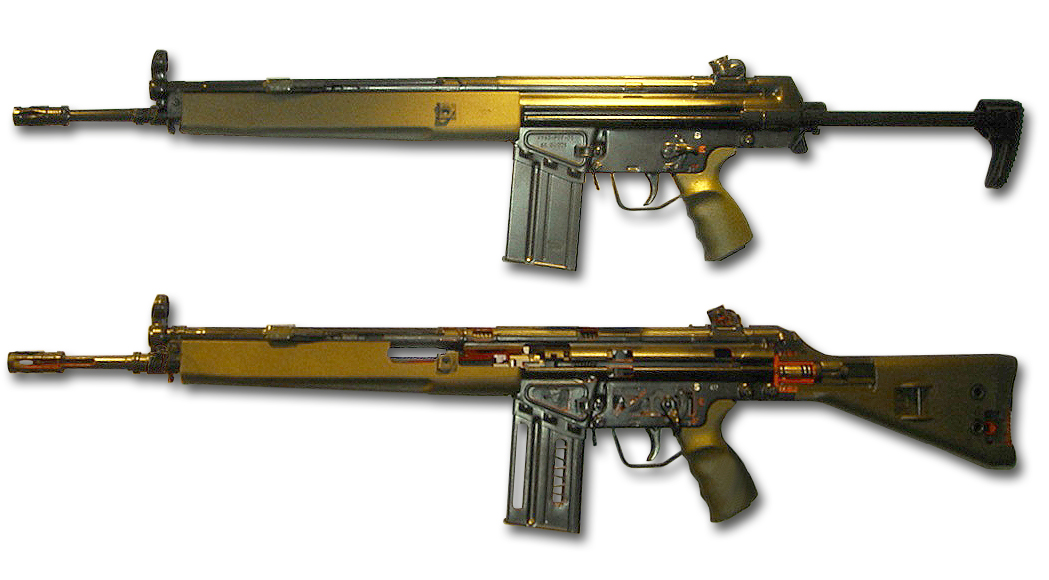

The G3 (Gewehr 3) is a 7.62×51mm NATO, select-fire battle rifle developed in the 1950s by the German armament manufacturer Heckler & Koch (H&K) in collaboration with the Spanish state-owned design and development agency CETME (Centro de Estudios Técnicos de Materiales Especiales). G3A3: The most well known version. Drum sights, a fixed plastic buttstock, and a plastic handguard that does not contact the barrel. The handguard came in a slim, ventilated version and a wide version. The latter allows for the attachment of a bipod. The G3A3 (A4) is a selective-fire automatic weapon that employs a roller-delayed blowback operating system. The two-piece bolt assembly consists of a breech (bolt head) and bolt carrier. The bolt is held in battery by two sliding cylindrical rollers that engage locking recesses in the barrel extension. The breech is opened when both rollers are compressed inward against camming surfaces driven by the rearward pressure of the expanding gases upon the bolt head. As the rollers move inward, recoil energy is transferred to the locking piece and bolt carrier which begin to withdraw while the bolt head slowly moves rearward in relation to the bolt carrier. As the bolt carrier clears the rollers, pressure in the bore drops to a safe level, the bolt head is caught by the bolt carrier and moves to the rear as one unit, continuing the operating cycle. The bolt features an anti-bounce mechanism that prevents the bolt from bouncing off the barrel's breech surface. The "bolt head locking lever" is a spring-loaded claw mounted on the bolt carrier that grabs the bolt head as the bolt carrier group goes into battery. The lever essentially ratchets into place with friction, providing enough resistance to being re-opened that the bolt carrier does not rebound. The spring-powered claw extractor is also contained inside the bolt while the lever ejector is located inside the trigger housing (actuated by the recoiling bolt). The rifle is hammer fired and has a trigger mechanism with a 3-position fire selector switch that is also the manual safety toggle that secures the weapon from accidentally discharging (fire selector in the "E" or "1" position – single fire mode ("Einzelfeuer"), "F" or "20" – automatic fire ("Feuerstoß"), "S" or "0" – weapon is safe ("Sicher"), trigger disabled mechanically). The weapon can be fitted with an optional 4-position safety/fire selector group illustrated with pictograms with an ambidextrous selector lever. The additional, fourth selector setting enables a 3-round burst mode of fire. The rifle has a relatively high trigger pull of 50–55 N (11.2–12.4 lbf) due to a drop safety requirement. An interchangeable set-trigger pack assembly featuring a trigger stop and less trigger pull is available for the G3SG/1 and other sniping orientated variants. The firearm is equipped with a relatively low iron sight line that consist of a rotary rear drum and hooded front post. The rear sight is mechanically adjustable for both windage and elevation with the help of tools. This deliberately prevents non-armorers to (re)zero the iron sight line. The rotary drum features an open V-notch (numbered 1) for rapid target acquisition, close range, low light and impaired visibility use and three apertures (numbered 2, 3 and 4) used for: 200–400 metres (219–437 yd) in 100 metres (109 yd) increments for more precise aiming. The 1 V-notch and 2 or 200 metres (219 yd) aperture settings have an identical point of aim. The V-notch and apertures are calibrated for US M80 / German DM111 series or other equivalent 9.5 grams (147 gr) 7.62×51mm NATO ball ammunition. The receiver housing has recesses that work with STANAG claw mounts/HK clamp adapters used to mount day or night aiming optics. The rifled barrel (contains 4 right-hand grooves with a 305 mm twist rate) terminates with a slotted flash suppressor which can also be used to attach a bayonet or serve as an adapter for launching rifle grenades. From the G3A3 the barrel was free floated from the stock and had polygonal rifling. The barrel chamber is fluted, which assists in the initial extraction of a spent cartridge casing (since the breech is opened under very high barrel in internal cartridge case pressure). The G3A3 (A4) uses either steel (260 g) or aluminium (140 g) 20-round double-stacked straight box magazines, or a 50-round drum magazine. H&K developed a prototype plastic disposable magazine in the early 1960s, but it was not adopted as aluminum magazines were just as light and proved more durable, as well as easier to produce. Standard accessories supplied with the rifle include: a detachable bipod (not included with rifles that have a perforated plastic handguard), sling, cleaning kit and a speed-loading device. Several types of bayonet are available for the G3, but with few exceptions they require an adapter to be inserted into the end of the cocking tube. The most common type features a 63⁄4 inch spear-point blade nearly identical with the M7 bayonet, but with a different grip because of its mounting above the barrel. The weapon can also mount a 40 mm HK79 under-barrel grenade launcher, blank firing adapter a straight blowback bolt (called a "PT" bolt, lacks rollers) used for firing 7.62×51mm ammunition with plastic bullets, a conversion kit used for training with .22 Long Rifle ammunition and a sound suppressor (that uses standard ammunition). The G3 is a modular weapon system. Its butt-stock, fore-stock and pistol-grip/fire-control assembly may be changed at will in a variety of configurations (listed below). Simple push-pins hold the components in place and removing them will allow the user to remove and replace parts rapidly. The G3 served as a basis for many other weapons, among them: the PSG1 and MSG90 precision rifles, the HK11 and HK21 family of light machine guns, a semi-automatic version known as the HK41, a "sporterized" model called the SR9 (designed for the civilian market in countries where the HK91 would not qualify, primarily the US after the 1989 importation restrictions) and the MC51 carbine.