ARMSNET
Military Equipment Database
Initializing 0%

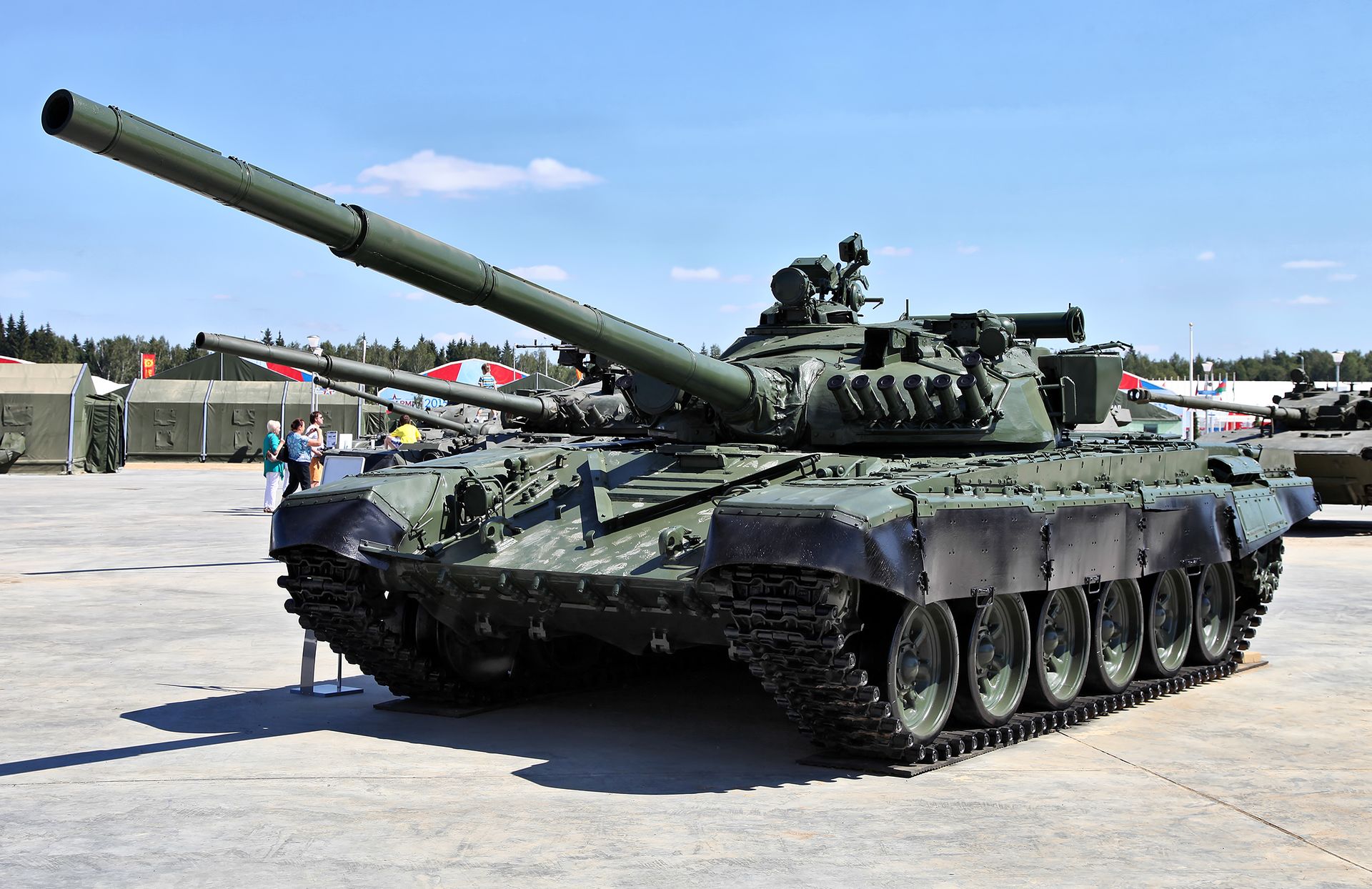
T-72M Russian Main Battle Tank (MBT)

T-72M

Main Battle Tank (MBT)
Spotted an error? Sign in to suggest an edit.
Basic Information
Name
T-72M Russian Main Battle Tank (MBT)
Designation
T-72M
Alternate Designation
T-72M
Equipment Type
Main Battle Tank (MBT)
Manufacturer
Uralvagonzavod
Date of Introduction
1979
Description

The T-72M is an export version, similar to T-72A. The T-72A is the second generation of Soviet-made main battle tank MBT in the T-72 family. The first version of the T-72 entered production in 1970. It is a further development of the T-62 with some features of the T-64A (upgraded version of basic T-64) and has been further developed as the T-90. The T-72A was accepted for service with the Russian army in June 1979 and is a further development of the standard MBT T-72. The T-72 was the most common tank used by the Soviet Army from the 1970s to the collapse of the Soviet Union. It was also exported to other Warsaw Pact countries, as well as Finland, India, Iran, Iraq, Syria, and Yugoslavia, as well as being copied elsewhere, both with and without licenses. T-72A (1979) Added laser rangefinder and electronic fire control, turret front and the top being heavily reinforced with composite armor (nicknamed Dolly Parton by US intelligence), provisions for mounting reactive armor, smoke grenade launchers, flipper armor mount on front mudguards, internal changes. T-72 Uralvagonzavod produced the first prototype with a 125-mm gun and V-45K engine in 1968 as "Object 172". After intensive comparative testing with the T-64A, Object 172 was re-engineered in 1970 to deal with some minor problems. However, being only a mobilization model, the serial production of Object 172 was not possible in peacetime. In an unclear political process decree number 326-113 was issued, which allowed the production of Object 172 in the Soviet Union from 1 January 1972, and freed Uralvagonzavod from the T-64A production. The first batch was built as "Object 172M" and, after some modifications, it was tested again in 1973 and accepted into service as the "T-72" under Soviet ministry directive number 554-172 dated 7 August 1973. At least some technical documentation on the T-72 is known to have been passed to the CIA by the Polish Colonel Ryszard Kukliński between 1971 and 1982. In 2018, the 3rd Central Research Institute in Moscow had tested a proof-of-concept demonstration for robotic tank mobility and was planning to further develop it based on the T-72B3 and other platforms.

Ground Specifications
Crew 3
Engine V-12 Diesel (780 hp)
Active Protection ZETS11-3 Control System
Variants
T-72B Second Russian main variant of the T-72 after the T-72A.
T-72B1 In 1986, a limited production variant without an ATGM launch capability. Some do not have ERA.
T-72BK The Commander's variant with additional radios.
T-72BM Russian T-72B upgrade with 2nd gen ERA. The system is fielded, available for export, and upgraded. Tier 2 and some Tier 3 tanks can challenge US forces under favorable conditions when using modern ammunition and employed by well-trained units with sound tactics. A variety of upgrades are available for the T-72B. They include protection upgrades, such as improved ERA, APS, defensive aids suites with IR jammers, plate armor, welded turret, and grill armor around tracks and grill. Mobility upgrades include a new power train, improved steering, improved mine plows and rollers, and electronic mine spoofing system. Fire control system upgrades include new sights, gun, ammunition, and improved stabilization. With the expanding number of upgrades offered by former Warsaw Pact, Asian, Israeli, and other firms, most T-72-type tanks have some level of upgrade from the basic T-72 MBT. The more affordable upgrade approach for most countries is to execute specific upgrades during maintenance work. But this approach may result in only partially modernized tanks at any one point in the life of the vehicle, and which are not as modern as more recent competitors. An alternative is to produce modernized tanks in small numbers, resulting in high per-unit production costs.
T-72BU Upgrade variant with the fire control system from the T-80U as well as well as a variety of other changes.
T-72BU renamed T-90 With the limited market for new tanks, the world tank industry has developed upgrades and whole vehicle upgrade packages to tap into the market. Older T-72 tanks can be brought up to the T-72B standard. Some approach the T-90 standard. Most T-72-type tanks fielded reflect some level of upgrade. Upgrade options are expanding from former Warsaw Pact, Asian, Israeli, and other international firms.
T-72S / Shilden Russian export T-72A upgraded to the T-72B standard. Although visually similar to T-72B, it has slightly less chassis and turret protection. Former Warsaw Pact countries such as Slovakia and Middle Eastern countries like Iran have upgraded their tanks to the T-72S standard.
M-84AB1 Yugoslav upgrade to the M-84, bringing it close to the T-90, and the latest T-72B improved tanks.
M-95 Degman Croatian M-84 upgrade with box composite armor, ERA, 1200hp and thermal FCS. An export upgrade conversion, AKA M-84D, is offered for Kuwaiti M-84A tanks.
PT-91 Polish upgrade tanks with ERA, Drawa improved FCS, Savan-5 thermal sight, improved gun stabilization, and countermeasures.
PT-91M Has a 1000hp engine, new guns and FCS, armor changes, and other improvements. PT-91M exported to Singapore. PT-91P is designed for export to Peru.
T-72M1 Demonstrator with 2nd generation ERA and other upgrades were displayed at military shows.
T-72M1M Includes 3rd generation Relikt ERA and optional Arena Active Protection System (APS). Alternative designations: Rogata and SMT M1988. It is almost the same as the T-72S (Export), except more ERA on the side skirts.
AJEYA MK 2 India is upgrading T-72A tanks close to a Bhishma (T-90S) standard.
System
Alternative Designation T-72M
Type Main Battle Tank (MBT)
Manufacturer Uralvagonzavod
Date of Introduction 1979 to present
Family INA
Crew 3 ea
Passenger Capacity INA
Maximum Effective Range 500 m
Dimensions
Length (Gun Forward) 9.53 m
Length (Hull) 6.95 m
Width 3.59 m
Height 2.23 m
Weight, Combat 41 tons
Ground Pressure INA
Automotive
Engine Name V-46-6
Engine Type V-12 Diesel
Engine Power 780 hp
Power to Weight Ratio 18.8 hp/ton
Cruising Range 700 km
Speed, Maximum Road 60 km/h
Speed, Maximum Off-Road 35-45 km/h
Acceleration Speed (0-32 km/h 18 sec
Speed Maximum Swim Not Amphibious
Gradient 60 %
Side Slope 40 %
Vertical Step 0.85 m
Trench 2.8 m
Fording Depth 1.2 m
Fording (with Preparation) 5.0 m
Fording Kit OPVT deep water fording kit
Transmission Synchromesh, hydraulically assisted, with 7 forward and 1 reverse gears
Suspension Torsion bar
Ground Clearance 0.49 m
Fuel Capacity 1,200 liters
Fuel used Per Hour 240 liters
Gyrocompass GPK-59 gyrocompass
Rechargeable Batteries four 12ST-85R 34 AMP rechargeable batteries
Starter Generator SG-10-1S
Communications
Radio #1 R-173 (Standard Radio for Russian Tanks)
Radio #2 R-168-100U (Standard VHF)
Main Gun
System
Name 1 x 2A46M/2A46M-5 125mm Smoothbore Gun
Type Smoothbore Gun
Caliber 125 mm
Max Rate of Fire 8 rds/min
Manually Load Time 1-2 rds/min
Barrel Life 600 rounds
Sustain Rate of Fire INA
Thermal Sleeve Yes, alloy thermal sleeve
Bore Type Central Bore Evacuator
Breech Type semi-automatic horizontal sliding breech block via an interrupted screw thread.
Autoloader Yes, electromechanical carousel autoloader
Time to reload the Autoloader 4-5 min
Fire on the Move Yes, Main Gun
Maximum Elevation -6 deg
Minimum Elevation +14 deg
Traverse Range 360 deg
Traverse Right 180 deg
Traverse Left 180 deg
Ammunition (Option 1)
Type Armour-Piercing Fin-Stabilized Discarding Sabot (APFSDS)
Caliber 125 mm
Muzzle Velocity 2,050 m/s
Effective Range 2,000-3,000 m
Armor Penetration 1,000 mm
Muzzle Energy 15-24 MJ
Projectile Dimension 900 mm
Projectile Weight 11 kg
Variants 1.1 3VBM3/3BM9/10 1.2 3VBM6/3BM12/13 1.3 3VBM7/3BM15/16 1.4 3VBM8/3BM17/18 1.5 3VBM9/3BM22/23 1.6 3VBM10/3BM29/30 1.7 3VBM11/3BM26/27 1.8 3VBM13/3BM32/33 1.9 3VBM17/3BM42 (3BM44 "Mango") 1.10 3VBM19/3BM42M (3BM44M "Lekalo") 1.11 3VBM20/3BM46 (3BM48 "Svinets") 1.12 3VBM22/3BM59 (3BM59 "Svinets-1") 1.13 3VBM23/3BM60 (3BM60 "Svinets-2") 1.14 3VBM?/3BM69 "Vacuum-1" 1.15 3VBM?/3BM70 "Vacuum-2"
Basic Load 45 Total Rounds of any 125mm Russian Projectiles
Note Entered service in 2005[5] Utilising a new sabot. Reported to be uranium alloy. For 2A82/2A82-1M cannon on T-80UM-2/T-14s.
Ammunition (Option 2)
Type High Explosives (HE)
Caliber 125 mm
Purpose High explosive fragmentation fin stabilised. General purpose rounds, for use against infantry, bunkers and light vehicles and other "soft" targets.
Muzzle Velocity 850 m/s
Max Dispersion 0.23 mrad
Maximum Range 5,000 m
Tungsten Rods 450 ea
Charge A-IX-2 (73% RDX, 23% aluminium powder, phlegmatized with 4% wax) 3.0 kg
Projectile Weight 23 kg
Round Weight 33 kg
Basic Load 45 Total Rounds of any 125mm Russian Projectiles
Variants 3VOF22/3OF19, 3VOF36/3OF26, 3VOF128/3OF82
Ammunition (Option 3)
Name 3VBK27/3BK31 "Start"
Type High-Explosive Anti-Tank (HEAT)
Caliber 125 mm
Basic Load 45 Total Rounds of any 125mm Russian Projectiles
Muzzle Velocity 915 m/s
Max Dispersion INA
Maximum Range 3,000 m
Charge INA
Charge Weight 1.62 kg
Projectile Weight 18.4 kg
Armor Penetration Estimated at 800 mm triple charge HEAT
Variants 3VBK7/3BK12, 3VBK10/3BK14, 3BK12M, 3BK14M, 3VBK16/3BK18, 3BK18M, 3VBK17/3BK21, 3BK21B, 3VBK21/3BK25, 3VBK25/3BK29 "Breyk", 3VBK25M/3BK29M
Anti-Tank Guided Missile
System
Name 9K119 SVIR / AT-11
Type Laser Guided Anti-tank guided missile launcher
Manufacturer KBP Instrument Design Bureau
Caliber 125 mm
Round Type 3UBK20 round
Guidance System 9M119M Laser Guided Missile
Voltage Converter 9S831 voltage converter.
Tracking System IK13 tracker
Hit Probability 80 %
Sight Assembly coded laser guidance beam 1K13-49
Gunner's Night Sight TPN-1-49 secondary night sight.
Fire Control System 1A40-1
Penetration up to 700mm of armor
Warhead Weight (HEAT) 4.2 kg
Laser Emitter 1K13 sight's laser
Onboard Guidance System Yes
Maximum Effective Range 4,000 m
Basic Load 6 ea
Tank Commander’s Weapon System
System
Name 1 x NSV (Russian НСВ Никитина-Соколова-Волкова) 12.7 mm Heavy Machine Gun
Type Heavy Machine Gun
Caliber 12.7 mm
Proliferation over 1 Million
Manufacturer "Metallist", Uralsk, Kazakh SSR, Crvena ZastavaSerbia
Weight (Gun Only) 25 kg
Muzzle Velocity 845 m/s
Length (Total) 1,560 mm
Max Rate of Fire 700-800 rds/min
Weight (On Tripod) 41 kg
Weight (50-Round Belt) 11 kg
Action Gas Operated
Maximum Elevation +75 deg
Minimum Elevation -4 deg
Sights Iron Sights
Feed System 50-Round Belt
Ammunition
Type Rifle
Caliber 12.7x108 mm
Muzzle Velocity 845 m/s
Armor Penetration API: 21 at 500 m & 13 at 1000 m (RHA)
Effective Firing Range (vs. Air Targets) 1,500 m
Effective Firing Range (vs. Ground Targets) 2,000 m
Basic Load 300 ea
Coaxial Weapon System
System
Name 1 x PKT (Kalashnikov's Machine Gun) 7.62mm General-Purpose Machine Gun
Type General-Purpose Machine Gun
Caliber 7.62 mm
Function in use as a front-line infantry and vehicle-mounted weapon with Russia's armed forces.
In Service 1961-present
Manufacturer Degtyaryov plant
Proliferation 1 Million +
Max Rate of Fire 650-750 rds/min
Effective Rate of Fire 250 rds/min
Weight (Gun Only) 9 kg
Weight (Tripod Only) 7.7 kg
Length 1,203 mm
Length (Barrel) 605 mm
Action Gas-operated, open bolt
Feed System Non-disintegrating metal 50 round belts in 100 and 200/250 round ammunition boxes
Sights Iron Sights
Ammunition
Type Rifle
Caliber 7.60 mm
Cartridge 7.62×54mmR
Muzzle Velocity 825 m/s
Effective Range (Iron Sights) 1,000 m
Effective Range (with Sight Adjustments) 100-1,500 m
Maximum Firing Range 3,800 m
Basic Load 2,000 ea
Fire Control
Name 1A40-1
Computerized FCS Yes, Electric FCS
Thermal Sight Tank Commander Yes, TPNZ-49
Thermal Sight Gunner 1K13-49
Main Gun Stabilization 2Eh28M electrohydraulic system
Range, Day Sight 5,000 m
Range, Thermal Sight 1,000 m
Infrared Yes
Gyrocompass GPK-59 gyrocompass
Searchlight L-4A "Luna" IR searchlight
Collimator Sight K10T collimator sight
Periscopes two TNPO-160 prismatic periscopes
Laser Rangefinder Yes
Protection
Hull Armor Steel and composite armour with ERA, equivalent to 500-600 mm of Rolled Homogenous Armor (RHA)
Turret Armor Steel and composite armour with ERA, 500 mm against APFSDS projectiles and to 560 mm against HEAT weapons.
Applique Armor Available, Turret top and track skirts
Explosive Reactive Armor Yes, Kontakt-5
Active Protection System Yes, ZETS11-3 Control System
Mine Clearing KMT-7 Tank-mounted Roller-Plow System The KMT-7 is similar to the KMT-5 but utilizes a box-channel frame and the rollers are less "cleated". The plows used with the KMT-7 are similar to those used with the KMT-6. The supporting frames for the rollers are L-shaped to allow the rollers to swing past the frame when a mine is detonated. Chains are fitted between the rollers to detonate tilt-mast fuses. As with previous models the rollers are carried on a separate vehicle and are fitted using a crane. The KMT-7 can clear tracks 1.65 meters wide with an intermediate space 2.16 meters wide.
Self-Entrenching Blade Yes, built in Dozer Blade
NBC Protection Yes, System Sensor Radiation Device and chemical intelligence (PRRM).
Grenade Launcher Yes, twelve 81 mm Toucha 902B grenade launchers that fire the ZD-6 smoke grenade.
Grenade Maximum Effective Range 200-300 m
Grenade Smoke Screen Size 30 m wide and 10 m high for 60 seconds per grenade.
Engine Smoke Screen Capable Yes
IR Signature INA
Automatic Fire Extinguishing Equipment. Yes
Details
Country of Origin Russia
Category Tanks
Land > Tanks
Filter Label
T
Classification
Domain
Ground
Equipment Status
Active
Dimensions
Length
Width
3.59 m
Height
2.23 m
Weight
41000 kg
Operators (4)
Russia
China
Poland
Iran
Something went wrong. Please reload the page. Reload