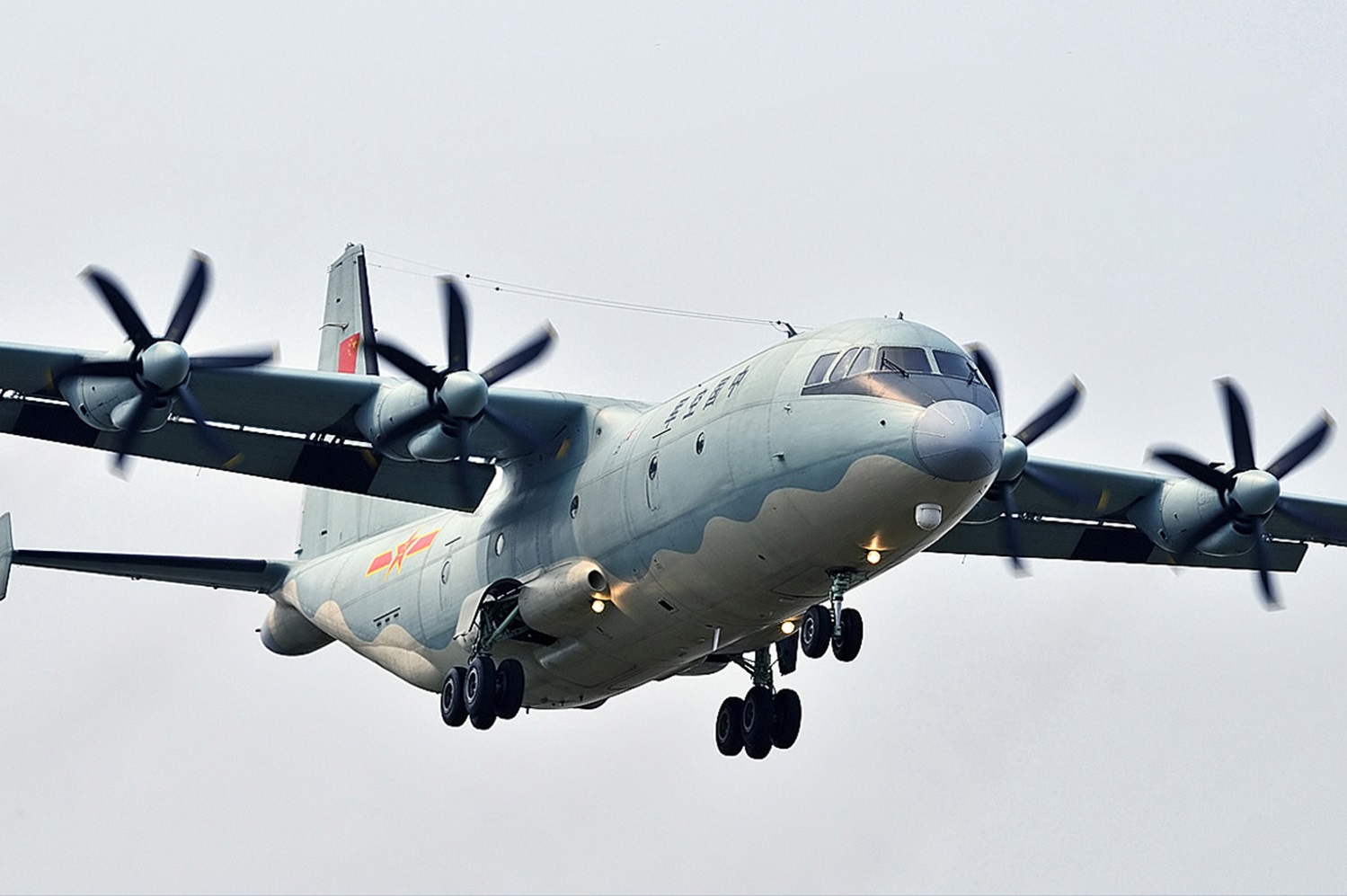
Y-8X Chinese Maritime Patrol Aircraft
Y-8X
Spotted an error? Sign in to suggest an edit.
Other
Basic Information
Name
Y-8X Chinese Maritime Patrol Aircraft
Designation
Y-8X
Alternate Designation
—
Equipment Type
—
Manufacturer
Shaanxi Aircraft Corporation
Date of Introduction
1984
Description
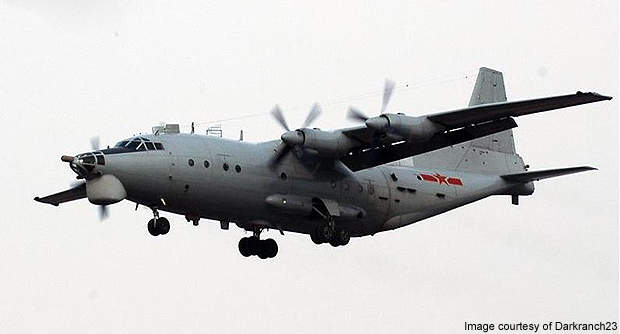
Y-8X: (Xun 巡 - surveillance) Maritime Patrol Aircraft with western avionics, radar, mission systems and defensive aids. Some aircraft have been known to carry ELINT packages. Equipped with Litton Canada AN/APS-504(V) search radar for maritime surveillance missions. This version is characterized by a larger cylindrical radar radome under the nose similar to that on H-6 bomber.
Air & Air Defense Specifications
Crew
6
Engine
Turboprop (4250 hp)
Max Speed
662.0 km/h
Cruise Speed
550.0 km/h
Range
5615.0 km
Endurance
10.50 hrs
Service Ceiling
10400 m
Variants
Note
Y-8
This was the original version. It was little different from the An-12 with a slightly modified glass nose copied from the design of the H-6 bomber. The cargo hold was not pressurized. Early production variants inherited the An-12 's tail turret, which mounts a twin 23-mm cannon, but this was later removed.
Y-8A
This variant was transformed into a helicopter carrier, serving as a general transport. It was designed to carry S-70C helicopters between their inland bases and the frontier airfields in Tibet. The airframe was specially modified to accommodate a single S-70C helicopter. The internal cargo handling system was determined to be unnecessary and was removed.
Y-8B
This is the civilian version. First flight took place in 1990 and it was certified in 1993.
Y-8C
This variant has the pressurized cabin volume increased from 1,000 cu ft (28.3 cu m) to 7,500 cu ft (212.4 cu m). Landing gear and air conditioning are upgraded. The original inward-open two-piece cargo loading doors were replaced by a single-piece flat loading ramp similar to that of the C-130 . First flight occurred on Dec. 17, 1990.
Shaanxi has also developed the Y-8CA radar testbed and Y-8CI export variant transport, the latter with Western avionics.
Y-8D
This is the export variant, fitted with Western avionics to meet the requirements for commercial flights. Onboard avionics include Collins flight director system (FDS), air data computer, VOR/ILS, comparing warning, TDR-90 air-traffic control receiver, VHF radio, Honeywell P-400 color weather radar, Litton LTN-311 Omega navigation system, Bendix/King HF communication, Sundsstrand universal flight data recorder (UFDR) and cockpit voice recorder (CVR). It is in service in Burma (Myanmar), Sri Lanka and Sudan.
Y-8D II
This is the latest export variant with avionics similar to those in the Y-8C.
Y-8E
This version is used for unmanned aerial vehicle (UAV) launch and control. Development began in October 1988 and the first prototype was completed in March 1990. The first UAV launch test was carried out successfully in October of that year. The aircraft entered service with the Chinese air force in late 1990.
Y-8F
This is a livestock transport. It was certified on Jan. 26, 1994.
Y-8F100
This is a commercial freighter version of the Y-8, featuring improved avionics. The aircraft features a redesigned cargo compartment, which can carry four international standard pallets of 88 in x 108 in, or eight pallets of 88 in x 54 in, or three pallets of 96 in x 125 in. The cargo compartment is also fitted with a modernized cargo handling system, allowing fast loading/unloading.
Y-8F200
This is a commercial freighter version of the Y-8C, with upgraded avionics and a redesigned cargo compartment. The cargo handling system and large flat ramp enable rapid loading and unloading.
Y-8F200W
This variant features a fuselage that is 7 ft 3 in (2.2 m) longer than the baseline aircraft. The aircraft can take off from gravel or snow-covered runways at altitudes up to 9,840 ft (3,000 m) above sea level. It can also operate from unprepared runways.
Y-8F400
This is a modernized freighter variant with upgraded avionics. It requires a three-man flight crew instead of the original five-man crew. The original glass nose was replaced by a solid nose. The cargo compartment is equipped with a 2,000-lb (1,000-kg) payload overhead cargo system, where the cargo can be suspended from an electrically powered rail. Rollers in the floor of the cargo compartment enable quick and easy handling of cargo pallets and can be removed to leave a flat surface. The compartment is fully pressurized.
Y-8F600
This is the latest variant. Developed with the assistance of Antonov in Ukraine and Pratt & Whitney Canada, the aircraft is configured as a platform for airborne early warning and other special missions. First flight on occurred on Jan. 14, 2005.
The aircraft has been extensively modified and upgraded with Western technologies including turboprop engine and avionics. Development began in 1999, with Antonov and Pratt & Whitney Canada joining the program in by 2002. Under a 2002 contract, Shaanxi and Antonov are responsible for the joint design and assembly of prototypes, certification and series production. Pratt & Whitney was responsible for providing its PW150B engine.
Antonov provided Shaanxi with aerodynamic research, as well as documents on aircraft maintainability and service life. The company also designed the new wing with fuel tanks.
The Y-8F600 features an advanced two-man glass cockpit. The aircraft is equipped with data link, flight management and control, and near ground warning system.The transport is powered by four P&W PW150B turboprop engines. All-composite six-blade R-408 propellers are fitted. The new propulsion system provides for improved takeoff performance at hot and high conditions and high-altitude cruise performance, extended engine service life and lower engine operating and maintenance costs. Noise levels are also reduced to meet airport noise restrictions. The Y-8F600's maximum takeoff weight is increased to 65 tons.
Y-8G
This variant was first revealed in April 2005. First flight took place in late 2004. Seven aircraft are known to be in service with the Chinese air force.
The aircraft features two large cheek fairings of an arch shape, which might house a large ECM antenna array for long-range electronic jamming purpose. It also has a redesigned solid nose with the undernose radome removed. A large tail fairing may provide 360-degree coverage. Another cylindrical fairing can be seen on top of the vertical tailfin.
Y-8H
This is an aerial survey and photography variant.
Y-8J maritime surveillance aircraft
These are Y-8C transports fitted with British Skymaster radars for maritime surveillance missions. China procured six to eight of the radars from Racal (now Thales) in 1996 deal worth US$66 million. At least two of the aircraft remain in Chinese naval service and are deployed at Dachang naval air base near Shanghai.
The original glass nose on the Y-8 is replaced by a large radome to accommodate the radar antenna on the Y-8J. The rear cargo door and loading ramp are also removed.
Y-8JB
This is an electronic intelligence (ELINT) variant first seen in mid-2004 near Shanghai. A prototype first flew on Aug. 26, 2003, and four aircraft are in service with the Chinese navy.
The aircraft has a large chin-mounted radome that could house a large ELINT antenna. Another SATCOM antenna may be installed inside a large semi-spherical dorsal fairing forward of the vertical tailfin providing real-time transmission to the ground base. Numerous smaller fairings can be seen on top of the cabin and along the upper sections of the aft fuselage, as well as at the nose tip. The loading ramp appears to have been sealed. The aircraft has been fitted with a BM/KZ800 ELINT system.
Y-8X maritime patrol aircraft (MPA)
This Y-8X is fitted with a Litton Canada APS-504 search radar, dual Litton LTN-72R inertial navigational system and a single LTN-211 Omega navigation set. The first example was delivered to the Chinese navy in late 1984, and the aircraft received national design certification in 1985. A small number have been in service since the mid-1980s.
The aircraft is equipped with search radar, navigation system, self-defense electronic countermeasures (ECM) suite, optical/infrared cameras, sonobuoys and sonar receiver. The rear cargo door was removed and replaced by a large mission equipment window for sonobuoys racks and cameras. The rear turret was also removed and replaced by the sonar operator seat.
A canoe-shaped fairing plus a couple of blade antennas appear to have been attached to the bottom of the middle and aft fuselage, suggesting the aircraft's electronic intelligence mission has been enhanced with a new synthetic aperture radar (SAR) capability.
Y-8XZ psychological operations aircraft
This version was unveiled publicly in April 2008, although it reportedly entered Chinese air force service in late 2007.
The aircraft features large fairings located forward of the main landing gear compartments as well as two large plate antennas on each side of the rear fuselage. Other features include two blade antennas on both sides of the vertical tailfin, a wire antenna underneath the rear fuselage and a large SATCOM antenna on top of the rear fuselage.
The Y-8XZ has high-power broadcast equipment covering AM, FM, SW, TV plus various civilian and military communication bands, and is able to jam enemy communications as well as deliver propaganda broadcasts.
KJ-200
This is an airborne early warning and control aircraft based on the Y-8F600 airframe. See separate record for more information.
Y-8 tanker
Flight Refueling Ltd. of the U.K. studied the possibility of converting the Y-8 into an in-flight refueling aircraft. No Y-8Ts are known to be in service.
Y-8 airborne early warning aircraft
This is a third Chinese airborne early warning aircraft program, following the KJ-2000 and KJ-200 (see separate records); it was revealed in 2005. Based on the Shaanxi Y-8F400 airframe, the aircraft features a conventional rotodome mounted above the fuselage. At least one prototype has been built and the program may be aimed at the export market.
Y-8CB
This is an electronic countermeasures (ECM) variant first seen publicly in July 2005. First flight was on Jan. 26, 2000. At least four are thought to be in air force service, replacing the obsolete HD-5 ECM aircraft. Some may have been upgraded with additional equipment, including a dorsal satellite communications (SATCOM) antenna.
The aircraft features a ventral canoe fairing underneath the forward fuselage, which may house a large ECM or synthetic aperture radar (SAR) antenna. An antenna array consisting of several rows of smaller ECM antennas can be seen protruding out of the rear loading ramp, which is thought to have been sealed. A few more antennas are located under the fuselage between the main landing gear cabins. The aircraft may carry the 300 and 308 systems to jam enemy communication networks and radar systems.
Y-8T command post aircraft
This is a command post aircraft. First flight occurred in August 2004. Three aircraft are in service with the Chinese air force.
The Y-8T features a redesigned fuselage with the loading ramp and tail gun turret removed. A dorsal fairing is located aft of the wing section, which may house a SATCOM antenna. Multiple antenna arrays can be seen along the top and bottom of the fuselage, as well as on the vertical tailfin.
ZDK-03
This variant, based on the Y-8F600, was designed specifically for the Pakistani air force for airborne early warning missions. It features an active electronically scanned array (AESA) radar. Islamabad has ordered four of the aircraft. The first unit was scheduled to be delivered by the end of 2010. See separate record for more information.
GX-7
This is a Y-8 aircraft modified for psychological warfare missions. It is designed to broadcast messages over radio and television signals and can jam enemy communications.
The GX-7 was first made public by Chinese media in July 2013.
Y-8Q/Y-8GX6
This variant was first revealed in November 2011 and was reported in service in mid-2015. The Y-8Q features a redesigned wing and pressurized fuselage with composite structures; WJ-6C turboshaft engines; and high-efficiency, six-bladed propellers.
It is distinguishable from other Y-8/Y-9 variants by a large chin-mounted sea search radar; electro-optical system behind the nose wheel; and a weapons bay just ahead of the main wheels. There is also a magnetic anomaly detector (MAD) boom and domed windows in the aft fuselage for observation.
A fuselage weapons bay, located ahead of the main landing gear, would likely carry torpedoes. It has been speculated that the Y-8Q has fuselage sonobuoy dispensers and hardpoints on the wings for anti-ship missiles.
System
Alternate Designation(s)
Y-8X
Primary Function / Type
Maritime Patrol Aircraft
Manufacturer
Shaanxi Aircraft Corporation
Crew
6
Passengers
96
Number of Engines
4
Number of Hard Points
INA
Dimensions
Length
34.02 m
Height
11.16 m
Width (Wing Span)
38.00 m
Wing Area
121.86 sq m
Cargo Area, Length
13.5 m
Cargo Area, Width
3.0 m
Cargo Area, Height
2.4 m
Empty Weight
35,500 kg
Maximum Payload Weight
20,000 kg
Maximum Takeoff Weight
61,000 kg
Automotive
Engine Name
4 x Wojiang-6 turboprop
Number of Engines
4
Engine Type
Turboprop
Engine Power
4,250 equivalent hp each
Maximum Range
5,615 km
Cruise Speed
550 km/h
Maximum Speed
662 km/h
Service Ceiling
10,400 m
Rate of Climb
600 m/min
Endurance
10.5 hours
Fire Control / Avionics
FCS Name
INA
Computerized FCS
No
Navigation Radar
LTN-72R inertial navigational system and a single LTN-211 Omega navigation set.
Search Radar
Litton Canada APS-504 search radar
Infrared Cameras
Yes
Sonobuoys
Equipped, amount: INA
Sonar Receiver
Yes
Synthetic Aperture Radar (SAR) Capable
Yes
Protection
Stealth Properties
No
Heat Signature Reduction
No
Add on Armor
No
NBC Protection
INA
EW Counter Measures
Yes, self-defense electronic countermeasures (ECM) suite.
Chaffs/Flares
INA
Details
Country of Origin
China
Category
Maritime Patrol
Air > Maritime Patrol
Filter Label
Y
Classification
Domain
Air & Air Defense
Equipment Status
Active
Dimensions
Length
34.02 m
Width
38 m
Height
11.16 m
Weight
61000 kg
Operators (1)
China
Something went wrong. Please reload the page.
Reload