Type 920 Class (Anwei Class) Chinese Hospital Ship
Type 920 Class
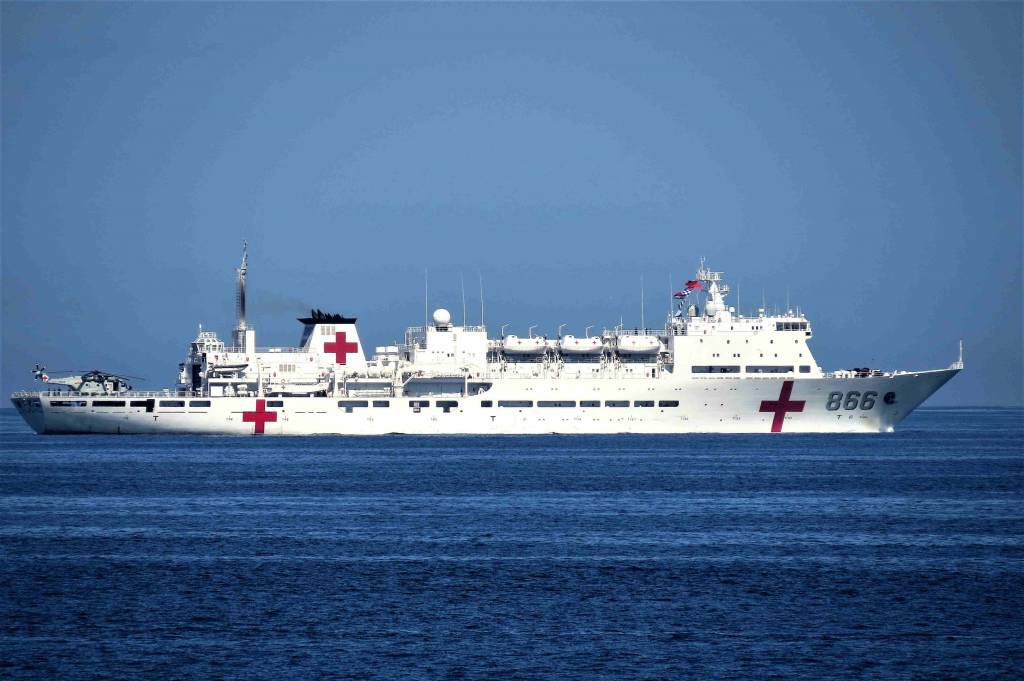
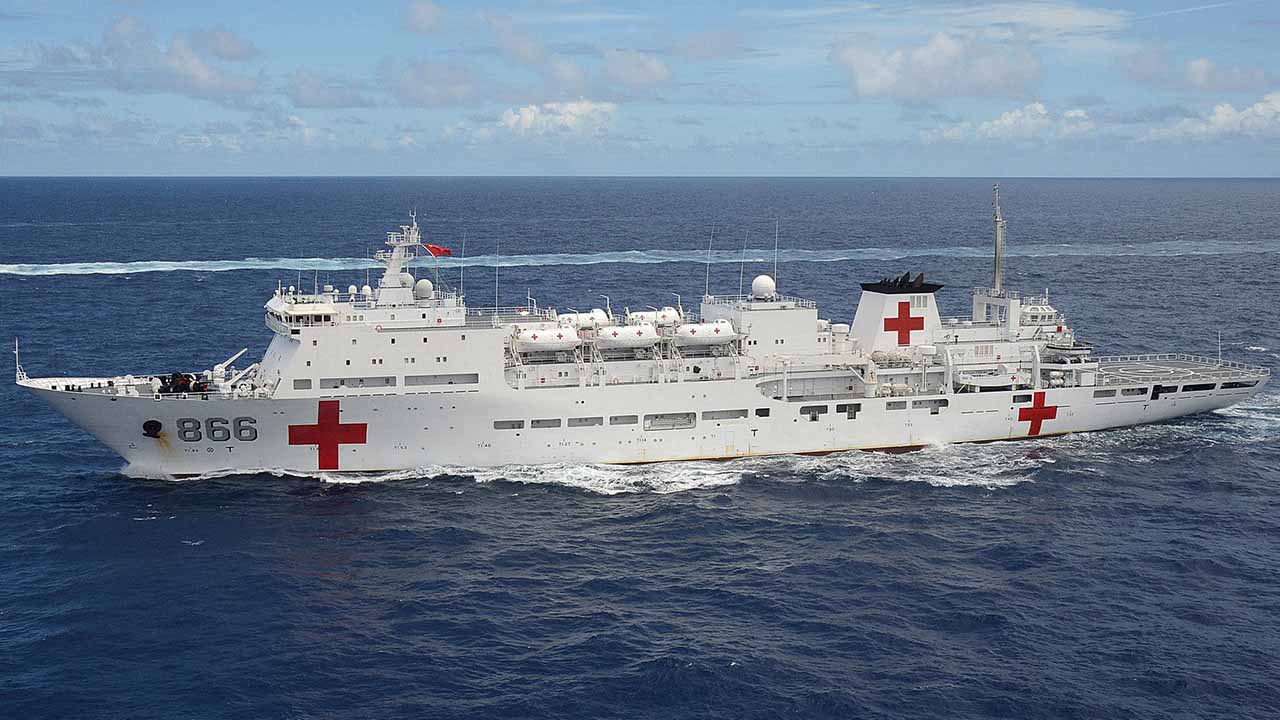
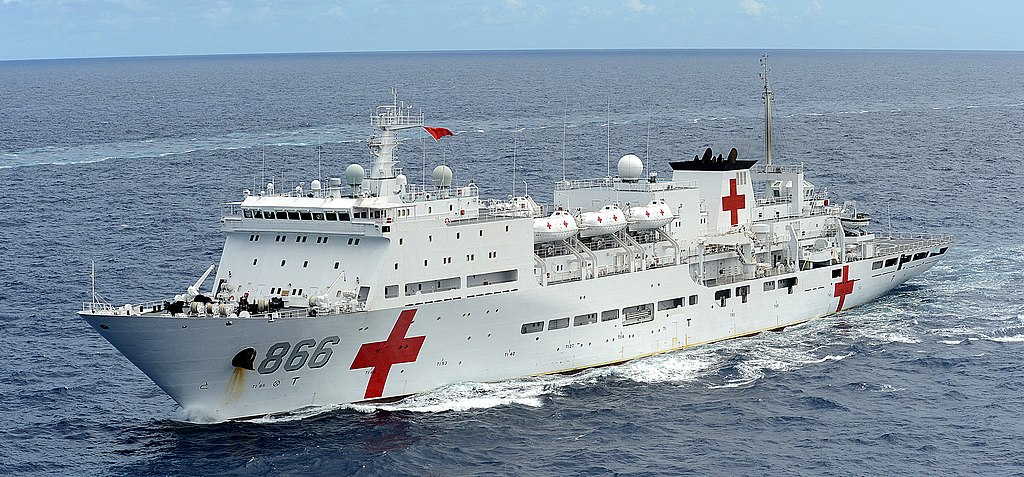
The Type 920 Class (Anwei Class) Chinese Hospital Ship is the PLA's first new large Hospital Ship, launched in Guangzhou on 29 August 2007. In August 2008, the Type 920 Hospital ship was reported to have successfully conducted a sea trial. The PLA Navy lists this ship as a "Type 920" hospital ship. The ship's name is “Yushan Island,” and the number is 866. Because of the ship's function, the media reports use the terms "Square Boat" and "Peace Ark" - Daishandao. This vessel was launched in the shipyard of CSIC (Guangzhou Shipyard International Company Limited), a CSSC subsidiary (China State Shipbuilding Corporation). The Type 920 Hospital Ship has a transom stem, a bulbous bow, and an extended deckhouse with a forward bridge. A helicopter landing deck is on the stern of the vessel. Six Large Red-crosses have been painted on the ship's body. The boat is approximately 170 meters long and 25 meters in beam, with about 20,000-23,000 tons of displacement [other estimates place the displacement at only 14,000 tons, while Xinhua reports 10,000 tons]. China did not give out any statistics, but based on Western hospital ships, the Type 920 probably has a ship crew of about 200 and a medical crew of about 600. A hospital ship would not seem necessary equipment in an amphibious invasion of Taiwan since the island is so close to the mainland. However, it would be essential for operations in the more distant waters of the South China Sea. The simultaneous appearance of the large Type 920 Hospital Ship and the Type 071 Yuzhao class amphibious transport seem to mark the beginnings of a significant buildup in China's ability to project power into the South China Sea. The primary mission of a U.S. Navy hospital ship is to provide rapid, flexible, and mobile acute medical care to support a Marine air/ground task force (MAGTF) deployed ashore, Army and Air Force units deployed ashore, and naval amphibious task forces and battle forces afloat. The Medical Treatment Facility provides a mobile, flexible, and rapidly responsive afloat medical capability for acute medical and surgical care in support of amphibious task forces, Marine Corps, Army, and Air Force elements, and forward deployed Navy elements of the fleet and fleet activities located in areas where hostilities may be imminent. As a secondary mission, they can provide complete hospital services for other government agencies supporting relief and humanitarian operations worldwide. During World War II, in the final phases of the Pacific campaign, the tactical doctrine for the employment of Navy hospital vessels changed, allowing them to function as mobile, definitive-care combat hospitals in direct support of amphibious operations rather than as transports only. Specially designed ships of the Haven (AH 12) class were built to support this concept. Driven by the development of China’s overall economic strength, naval equipment construction, and even the Chinese army, the team's entire equipment construction achieved rapid growth. At the same time, the development of the navy also significantly improved its concept. The Central Military Commission made a significant decision on the strategic transformation of the navy, that is, the navy's defense from the offshore to the defense of the sea. In the process of such a significant strategic change, the naval equipment construction, including the construction of the navy's medical service, has considerably developed and is reflected in this aspect of maritime medical care. In constructing marine medical equipment, the "one ship, five boats, four machines" marine, medical three-dimensional rescue equipment system includes China's first standard hospital ship. The Chinese Navy's 920 large medical vessel was designed and launched in 2005. In 2006, the 920 hospital ship was started and built by Guangzhou Shipyard International. In August 2007, the 920 hospital ship was launched. In October 2008, after a series of hull and shipboard medical equipment acceptances, 866 ships were delivered to the troops. The hospital ship is a 14,000-ton large-scale professional hospital ship designed and developed in China. The boat has a total length of 178 meters, a maximum width of 24 meters, and a full displacement of more than 14,000 tons. The ship has 10 departments and medical information centers, such as a rescue room, X-ray room, CT room, examination room, and blood preparation room. The medical facilities are advanced, the nursing system is complete, and the medical equipment configuration is equivalent to the level of domestic third-class hospitals. The hospital boat is the most advanced equipment in the entire medical system architecture. With the hospital ship, the whole chain of marine three-dimensional rescue is complete, and the capability level is rapidly developing, reaching a considerable level. As of 2013, only a few countries in the world, such as the United States, Japan, and the United Kingdom, have hospital boats with remote medical rescue capabilities, but most of these hospital ships have been converted from civilian boats. The birth of the first domestic 10,000-ton hospital ship marked a significant breakthrough in China's maritime medical support capacity building.