ARMSNET
Military Equipment Database
Initializing 0%

M1150 American Assault Breacher Vehicle

M1150
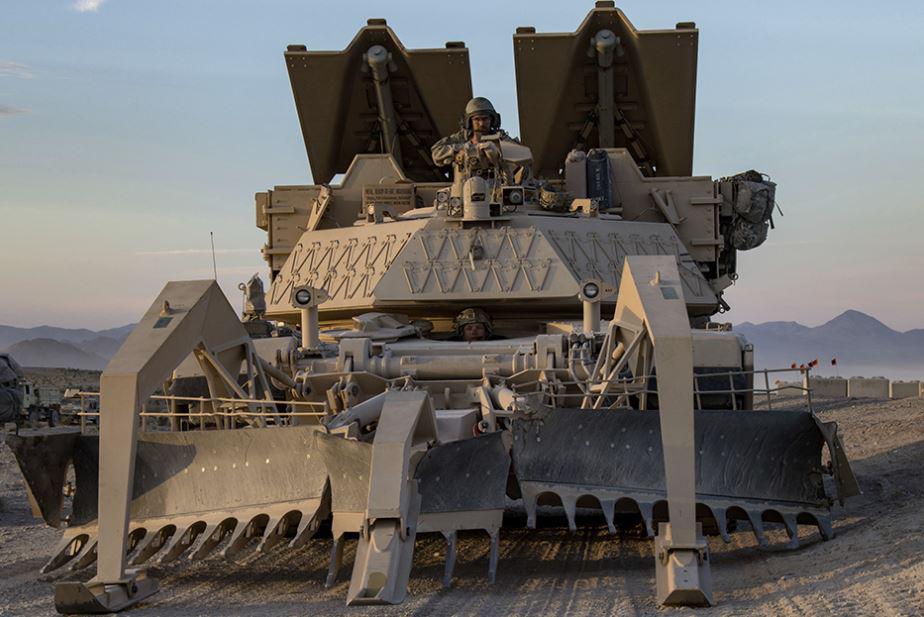
Assault Breacher Vehicle
Spotted an error? Sign in to suggest an edit.
Basic Information
Name
M1150 American Assault Breacher Vehicle
Designation
M1150
Alternate Designation
M1150
Equipment Type
Assault Breacher Vehicle
Manufacturer
US Army Anniston Depot
Date of Introduction
2010
Description

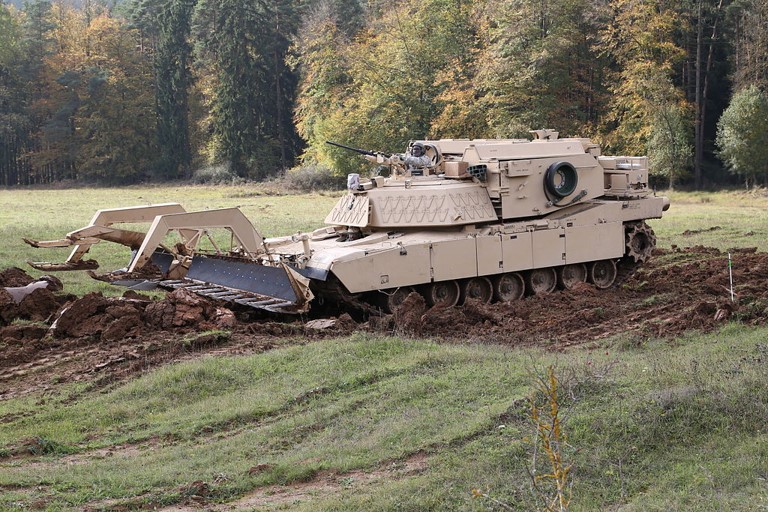
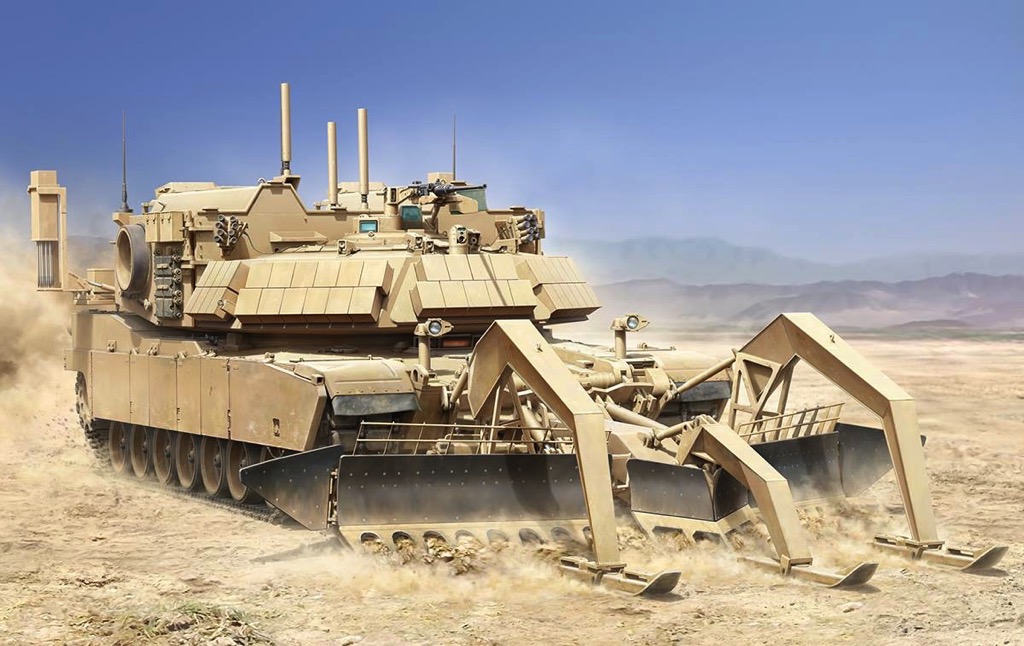
The M1150 Assault Breacher Vehicle (ABV) is a U.S. military mine- and explosives-clearing vehicle, based on the M1 Abrams-chassis, equipped with a mine-plow and line charges. Its first large-scale use by the US Marines was in the joint ISAF-Afghan Operation Moshtarak in southern Afghanistan during the War in Afghanistan in 2010 against the Taliban insurgency. These tracked combat vehicles were specially designed to clear pathways for troops and other vehicles through minefields and along with roadside bombs and improvised explosive devices. The 72-ton, 40 foot (15 m) long vehicles are based on the M1 Abrams with a 1,500 horsepower engine but fitted with a .50 cal machine gun and a front-mounted 15-foot (4.5 m) wide plow, supported by metallic skis that glide on the dirt and armed with nearly 7,000 lb (3,175 kg) of explosives. The Breachers are equipped with Linear Demolition Charge System (LDCS): rockets carrying C-4 explosives up to 100–150 yards forward, detonating hidden bombs at a safe distance, so that troops and vehicles can pass through safely. In the 1990s, the U.S. Army decided it could not afford to continue developing complicated, maintenance-heavy vehicles for this purpose. The Grizzly program was canceled in 2001, and the prototype developed never made it to the production lines. The Marine Corps however persisted and funded its own development and testing. The main body of the final model of the ABV is built on the General Dynamics chassis that is used for the M1A1 Abrams main battle tank. Pearson Engineering of the UK provided the specially designed plow and the other mine-clearing accessories. In the morning of December 3, 2009, for the first time breachers were used in combat, when Marines pushed into the Taliban stronghold Now Zad during Operation Cobra's Anger in Helmand province, on their way to another Taliban stronghold Marjah, 380 miles (610 kilometers) southwest of Kabul, that was to be assaulted in February 2010. On February 11, 2010, two breachers fired explosive line charges in the desert outside Sistani, to test Taliban defenses on the eve of Operation Moshtarak when closing off the enemy's escape route. On February 13, 2010, on the first day of the operation, breachers of the US Marines 2nd Combat Engineer Battalion succeeded in digging and blasting "safety lanes" through the numerous minefields laid by the Taliban around Marjah. According to a report in December 2009, there were then five ABVs in Afghanistan, and the U.S. Marines were said to have plans to field a total of 52 by 2012, of which about 34 have already had been produced. The U.S. Army was said to have ordered 187. By August 2013, six Assault Breacher Vehicles were brought to the Korean Peninsula. They are used by the 2nd Infantry Division to provide the capability for deliberate and in-stride breaching of minefields and complex obstacles. The ABVs would allow the 2ID to clear the heavily mined Korean Demilitarized Zone, believed to contain tens of thousands to millions of mines. A previous deployment of MRAP mine-resistant vehicles to Korea caused North Korea to accuse their presence as vehicles that would cross the DMZ for an attack of the country; the MRAPs were later withdrawn due to their unsuitability for the terrain. North Korea has not publicly responded to the ABVs’ arrival on the peninsula.

Ground Specifications
Crew 2
Mobility Type Tracked
Main Weapon M58 MICLIC
Engine Gas Turbine (1500 hp)
Max Speed 72.0 km/h
System
Alternative Designation M1150
Type Assault Breacher Vehicle
Manufacturer US Army Anniston Depot
Crew 2 ea
Chassis The ABV is builded on the same chassis as the General Dynamics-built M1A1 Abrams main battle tank.
Accessories Major components of the ABV include a Full-Width Mine Plow (FWMP), two linear demolition charges (LDC), a lane-marking system, a remote control system, and weapon station integration on a modified M1A1 tank chassis. ABV will fill the requirement to clear a lane of sufficient width and depth for the assault forces and will be operated by a two-man crew with an option for remote control. The ABV is equipped with a variety of specialized equipment supplied by Pearson Engineering of the UK that can be fitted. The HLA (High Life Adaptors), whilst providing an increased approach angle to the ABV, allows the rapid fitting and removal of the full suite of ABV front-end equipment and sub-systems. For clearing minefields, the FWMP (Full Width Mine Ploughs) can be swiftly installed at the front of the vehicle which can be rapidly replaced by the CDBB (Combat Dozer Blades) that, in addition to clearing battlefield obstacles, can also be used to prepare firing positions. Another alternative installation at the front of the vehicle is the Pearson Engineering ROBS (Rapid Ordnance Removal Systems) or an SMP (Lane Marking Systems). The plow mounted on the front of the ABV lets it construct hasty earthworks for cover and to barrel through enemy obstacles. Mounted on the rear of the ABV turret structure is the Linear Demolition Charge System containing two launchers with an updated firing system. Each of these launchers is fitted with a MK 2 solid-propellant rocket attached to an M58 linear charge. The ABV included the same communications system and a deep fording capability as the M1A1 Abrams MBT.
Dimensions
Length 7.9 m
Width 3.6 m
Height 2.4 m
Weight 50,000 kg
Automotive
Engine Name Honeywell AGT 1500
Engine Type Gas Turbine
Engine Power 1,500 hp
Transmission Allison X-1100-3B Hydro-Kinetic automatic transmission
Maximum Speed, Road 72 km/h
Maximum Speed, Cross-Country 48 km/h
Range INA
Suspension The suspension of the ABV is composed on each side with 7 road wheels and 2 track-return rollers, on each side of the chassis.
Main Weapon System
Name M58 MICLIC
Type Mine Clearing Line Charge (MICLIC)
Note The M58 Mine Clearing Line Charge (MICLIC) is a rocket-projected explosive line charge which provides a "close-in" demining capability for maneuver forces of the United States Army and Marine Corps. It is effective against conventionally fuzed land mines and, when detonated, it provides a lane 8 meters by 100 meters. The MICLIC system consists of an M353 3½ ton or M200A1 2½ ton trailer (or M200 tracked trailer) chassis, a launcher assembly, an M147 firing kit, an M58A3 line charge, and a 5-inch MK22 Mod 4 rocket. The line charge is 350 feet long and contains 5 pounds per linear foot of C-4 explosive. In the event a MICLIC fails to detonate normally, it can be manually activated by time-delay fuses every few feet along the length of it. The M147 Firing Kit can also be employed from other combat engineer vehicles, namely the M60AVLB and the M1150 Assault Breacher Vehicle.
Auxiliary Weapon System
System
Name 1 x M2 Browning
Type Heavy Machine Gun
Caliber 12.7 mm
Length 1,654 mm
Barrel Length 1,143 mm
Weight 38 kg
Action Short recoil-operated
Rate of Fire 450–600 rounds/min
Muzzle Velocity 890 m/s
Maximum Firing Range 7,400 m
Effective Firing Range 1,800 m
Feed System Belt-fed (M2 or M9 links)
Ammunition
Type Rifle
Caliber 12.7 mm
Cartridge 12.7×99mm
Basic Load 1,200 Rounds
Protection
Hull Armor The ABV is built on the same chassis as the General Dynamics-built M1A1 Abrams main battle tank. The ABV will provide crew protection and vehicle survivability while having the speed and mobility to keep pace with the maneuver force. For the ABV role, the turret of the M1A1 Abrams MBT has been removed and replaced by a new all-welded steel structure to which has been added the latest explosive reactive armor (ERA) package. This provides a higher level of protection against anti-tank weapons fitted with a High Explosive Anti-Tank (HEAT) warhead fitted to weapons such as the RPG-7 (Rocket Propelled Grenade).
Applique Armor INA
Mine Clearing Yes
NBC Protection INA
Smoke Equipment INA
Details
Country of Origin United States
Category Mobility
Land > Combat Support Vehicles > Mobility
Filter Label
M
Classification
Domain
Ground
Equipment Status
Active
Dimensions
Length
7.9 m
Width
3.6 m
Height
2.4 m
Weight
50000 kg
Operators (4)
United States
United Kingdom
Australia
Austria
Something went wrong. Please reload the page. Reload