M-46 (M1954) Russian 130mm Towed Howitzer
M-46
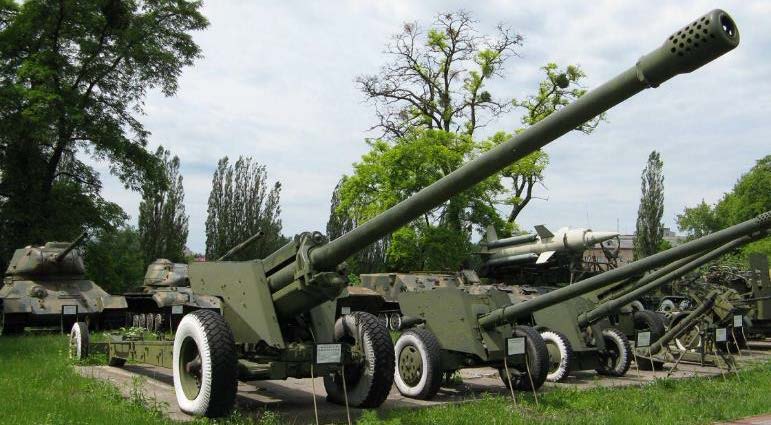
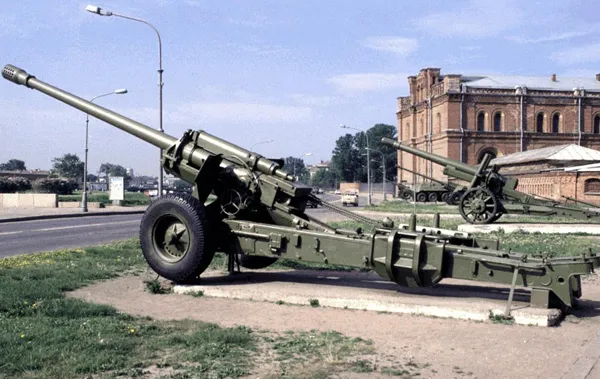
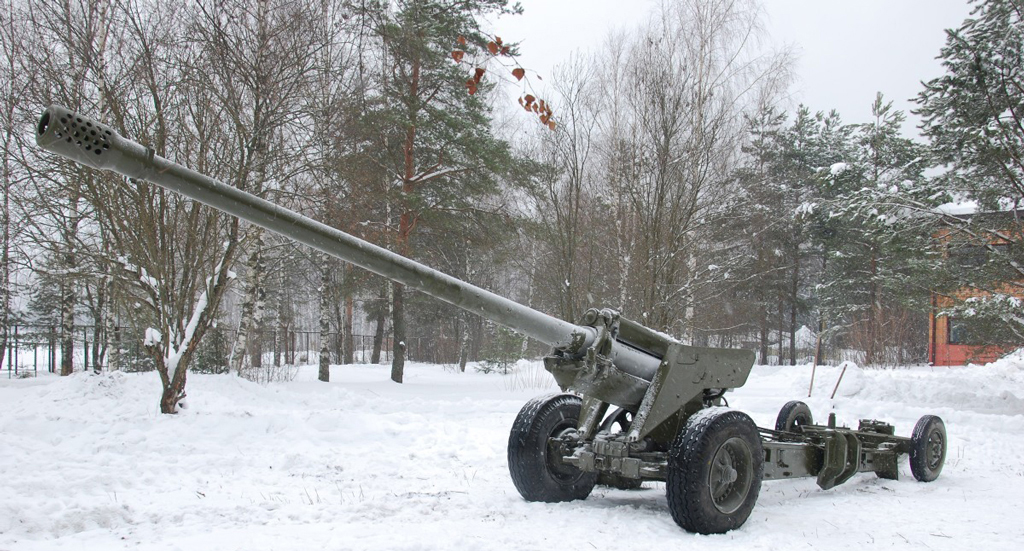

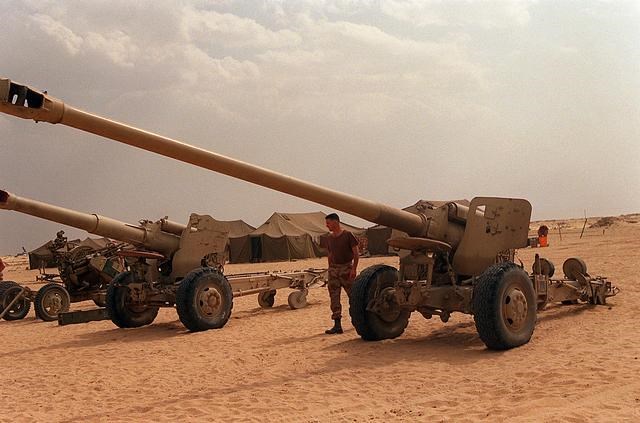
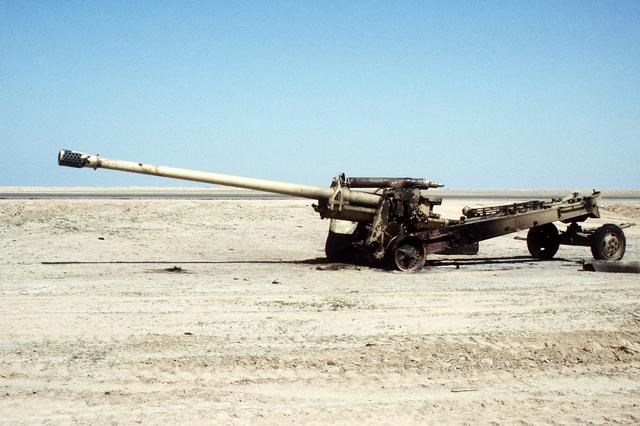
The 130mm towed field gun M-46 (Russian: (130мм пушка M-46) is a manually loaded, towed 130mm artillery piece, manufactured in the Soviet Union in the 1950s. It was first observed by the West in 1954. There is also a Chinese copy, called Type 59. For many years, the M-46 was one of the longest-range artillery systems around, with a range of more than 27 km. The M-46 was developed from the M-36 130 mm naval gun used on ships and for coast defense. It is a true gun, being unable to fire much above 45° and having a long barrel and a single propelling charge. In contrast, most Western field guns of this period had a dual high and low-angle fire capability, a gun-howitzer. It has a 39 caliber barrel with a tied jaw horizontal sliding-block breach and a 'pepperpot' muzzle brake. The latter is not notably efficient, but subjective reports suggest that it is quite effective in reducing muzzle flash. The hydro-pneumatic recoil system comprises a buffer below the barrel and a recuperator above the barrel. The long barrel enables a substantial propelling charge by providing more length in which to achieve 'all burnt and hence projectile acceleration space and thus achieve its 930 m/s muzzle velocity. The barrel is mounted on a split-trail carriage, with deep box section trails and foam-filled road wheels on the ground when firing and 50° of the top traverse. The small shield protects little more than the sights, possibly including from the effects of muzzle blast, and some protection from machine-gun fire in anti-tank engagements. The gun has long and robust trails to provide stability when firing and a large detachable spade is fitted to the end of each when the gun is brought into action. Non-reciprocating sights are standard Soviet patterns, designed for one-man laying. Included are a direct-fire anti-tank telescope, a panoramic periscopic indirect-fire sight (a dial sight) in a reciprocating mounting, an angle of sight scale, and a range drum engraved with the range (distance) scale, coupled to a mounted elevation leveling bubble. The range drum enables the standard Soviet technique of semi-direct fire when the piece is laid visually on the target and the range set on the range drum. An APN-3 was later provided for direct fire at night in place of the day telescope. For travel, the gun is towed via a two-wheeled limber fitted to the end of the closed trails, with the spades removed and carried on each trail. Simple jacks on the trails just behind the main wheels are used to lift and support the closed trails so that the limber can be connected. The barrel and recuperator are pulled back between the closed trails and locked in a traveling position. There is a large bicycle chain arrangement on the right trail for this, and a compressed air cylinder, charged by the gun firing, is used to bring the barrel forward when the gun is brought back into action. It takes about four minutes to bring the gun into action, the normal detachment is eight strong. Propelling charges are in metal cartridge cases and loaded separately from the projectile. Projectiles originally included HE fragmentation, Armor Piercing solid shot, smoke, illuminating, and chemicals. HE shells weigh some 33 kg. Illuminating shells have a substantially lower muzzle velocity. APHE and extended-range shells were introduced later. The maximum rate of fire is probably 6-7 rounds/minute, and about 70 rounds/hour. The standard Soviet unit of fire was 80 rounds.
System
Ammunition (Option 1)
Ammunition (Option 2)
Ammunition (Option 3)
deagel.com: https://www.deagel.com/x/x/a000721