ARMSNET
Military Equipment Database
Initializing 0%

Husky 2G South African 4x4 Vehicle-Mounted Mine Detection (VMMD)

Husky 2G
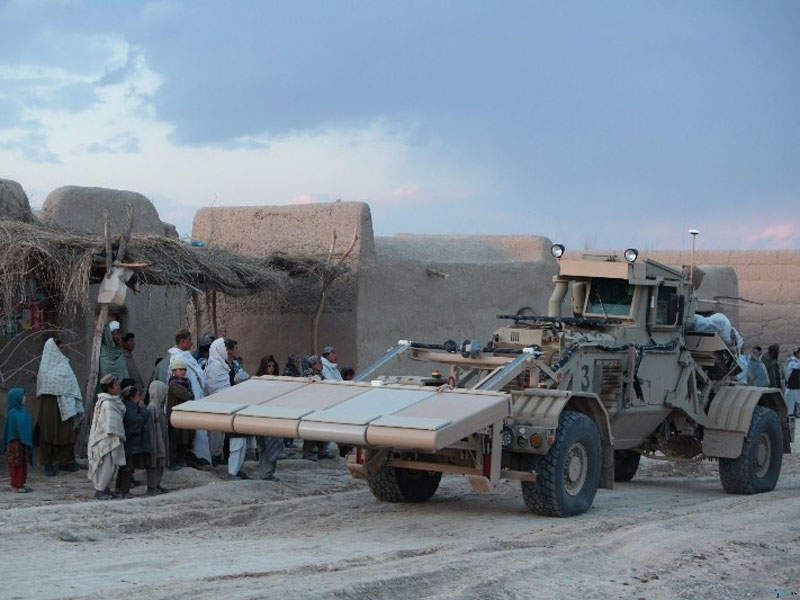
Vehicle-Mounted Mine Detection (VMMD)
Spotted an error? Sign in to suggest an edit.
Basic Information
Name
Husky 2G South African 4x4 Vehicle-Mounted Mine Detection (VMMD)
Designation
Husky 2G
Alternate Designation
Husky 2G
Equipment Type
Vehicle-Mounted Mine Detection (VMMD)
Manufacturer
VMMD vehicle is marketed in the US by Critical Solutions International (CSI), who are also responsible for the international marketing and field support of the vehicle.
Date of Introduction
2011
Description

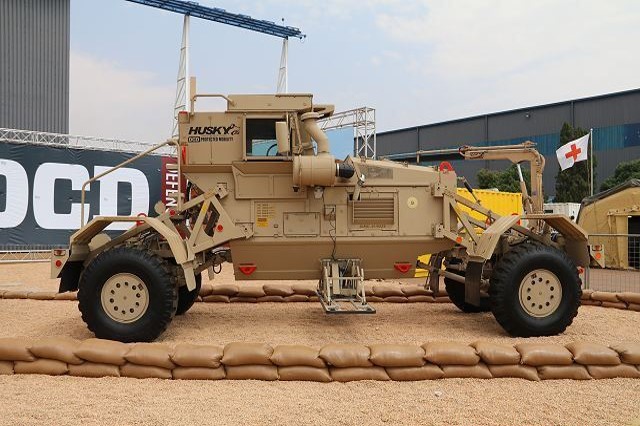
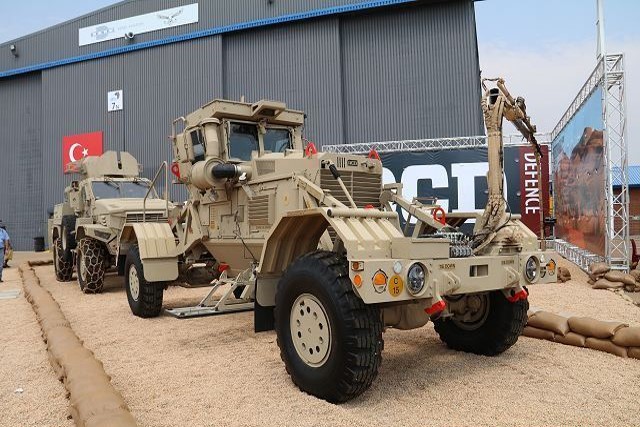
This variant has an enlarged driver's cab that can accommodate two people. The driver focuses on maneuvering the vehicle and spotting IEDs visually, while the commander handles the sensors. The driver's workload is reduced two ways. First, several functions are transferred to the commander, who oversees both the ground-penetrating radar as well as the sensor systems. In addition to vision system upgrades, the driver can use a back-up camera. The Husky 2G features the FASCAN interrogation arm, which is used to investigate suspected mines and roadside bombs. The upgraded system has additional power to operate additional sensors and enhancements, such as the NIITEK ground-penetrating radar. It is also equipped with the TORC Robotics 360 situational awareness camera system and the QinetiQ North America QNET system, which provides lightweight protection against rocket-propelled grenades. Active self-defense is available from the Common Remotely Operated Weapon Station (CROWS), which is handled by the commander from within the cab. In addition to the machine gun, the CROWS includes a large 15-inch (381-mm) color monitor that shows live video from the turret's cameras in the daytime and a second-generation forward-looking infrared (FLIR) camera at night. The commander can operate the cameras and a built-in laser rangefinder without having to use the gun. The Husky VMMD (vehicle-mounted mine detection) family of vehicles are blast-survivable, mission-configurable wheeled platforms employed around the world by specialized route clearance teams operating in high-explosive threat areas. Defined by their unique design characteristics of survivability, frangibility, and reparability, Husky vehicles enable personnel and payloads to safely operate in close proximity to sub-surface explosive hazards. The Husky is manufactured in South Africa by DCD Protected Mobility and then integrated with clearance payloads, provided, and supported by U.S.-based C-IED solutions company, Critical Solutions International. The current iteration of the Husky is part of a class of MRAP vehicles developed from a South African blast protection design. The basic v-hull concept of modern MRAP vehicles, and the Husky, was an architectural innovation that fundamentally recast the nature of the vehicle’s resistance to explosive threats. As clearance techniques matured along with emerging technologies in order to respond to evolving threats, the unique tenants of the Husky design have endured. Survivability: The sharp V-hull of the Husky dramatically reduces blast effect by increasing ground clearance and standoff from the blast, increasing structural hull rigidity, and diverting blast energy and fragmentation away from the platform and its occupants. Frangibility: With three main components (a center cab with front and rear wheel modules) connected by sheering pins, the Husky is designed to break apart in a blast event, allowing energy to transfer to the detachable front and rear modules rather than transferring stress to the critical components of the vehicle or the occupants located in the cab. Repairability: Critical components have been engineered to break apart in a predictable fashion, preventing catastrophic damage and enabling users to quickly replace modules on site. This approach increases the lifespan of the vehicle, maintains mission readiness, and limits the need for recovery teams to evacuate the vehicle to intermediate- or depot-level maintenance facilities. The Husky VMMD Mk III and 2G are powered by a Mercedes Benz OM 906 LA 6.4L six-cylinder turbo diesel engine coupled with an Allison 2500 SP 5-speed automatic transmission. The operating weight of vehicle is 8,350kg, and the Husky can reach a maximum speed of 72km/h and has a range of 400km or 200km when equipped with mine-detonation trailer (MDT). The cabin of the Husky is fitted with bullet-proof glass windows and an entry hatch on the roof. The Husky’s versatility for application in dynamic clearance missions comes from both the vehicle design and the modularity provided by easy integration of tailored payloads.

Ground Specifications
Crew 2
Engine Diesel (201 hp)
NBC Protection Yes
Variants
Husky Mk I The Husky Mk I was developed in the 1970s, for land mine detection.
Husky Mk II DCD introduced Husky Mk II and Husky Mk III as upgraded versions of the basic variant.
Husky Mk III The current Program of Record (M1231) for the U.S. Army. The Mk III is the modern single-occupant Husky model. The platform is integrated with pulse induction metal detector panels and overpass tires that enable operators to regulate tire air pressure in order to reduce the risk of initiating victim-operated, pressure-fused, anti-vehicle landmines without causing detonation. As with all Husky platforms, the Mk III has been engineered in a unique modular, frangible configuration. In the event of a mine or improvised explosive device detonation, vehicle components break apart in a predictable fashion, reducing damage to the platform and occupants, as well as facilitating fast in-field repairs using the system’s RedPack, a towable asset comprising front and rear modules as well as a battle damage repair tool kit.
Husky 2G A two-occupant version of the Husky MK III vehicle. Development of the Husky 2G was prompted by the need to effectively conduct longer missions and employ multiple advanced detection systems. The Husky 2G was designed with the same protection, survivability, and mobility characteristics as the original Husky MK III, but integration of more sophisticated high sensitivity detectors, ground-penetrating radar, and video optics suites, and remote weapon stations created the need for a second operator to manage the additional workload.
System
Alternative Designation Husky 2G
Type Vehicle-Mounted Mine Detection (VMMD)
Family Husky
Manufacturer VMMD vehicle is marketed in the US by Critical Solutions International (CSI), who are also responsible for the international marketing and field support of the vehicle.
Crew 2
Hull The Husky VMMD incorporates a V-shaped hull offering optimum protection against blasts.
Cabin The cabin is fitted with a bullet-proof glass window and a single hatch is provided on the top.
Mission The vehicle is designed to detect landmines and improvised explosive devices (IEDs) with high probability of detection (Pd) and low false alarm rate (FAR). The height of the sensor installed on the Husky can be controlled automatically to adjust in various terrains. The Husky is also attached with the Mine Detonation Trailer (MDT) set to detonate any left out mines.
Backup Camera Yes
Dimensions
Length 7.34 m
Width 2.53 m
Height 3.54 m
Wheel Base 5.23 m
Curb Weight 8,350 kg
Operating Weight 8,700 kg
Gross Overpass Mode Weight 8,700 kg
Gross Non-Overpass Weight 12,000 kg
Ground Clearances, Hull 590 mm
Ground Clearances, Overpass Mode 360 mm
Ground Clearances, Non-Overpass Mode 415 mm
Automotive
Engine Name 1 x MTU 6R106TD20 6-liter (366 cu in), 6-cylinder,water-cooled, direct-injection diesel
Engine Type Diesel
Engine Power 201 hp (150 kW)
Transmission Allison 2500 SP 5-speed automatic (4 x 4)
Fuel Capacity 40 gallons (150 liters)
Tire Size 450/80 R20
Maximum Speed, Detection 50 kph
Maximum Sustaned Road Speed 72 kph
Maximum Speed, on 20% Grade 17 kph
Maximum Speed, on 60% Grade 7 kph
Maximum Speed, on 70% Grade 5 kph
Angle of Approach 50 deg
Angle of Departure 43 deg
Range, Daily Operating 200 km
Range, Max Fuel 800 km
Endurance 6 hours
Radar
Radar Name The Husky vehicle is equipped with NIITEK’s VISOR™ 2500 Ground Penetrating Radar (GPR), with four panelled 3.2m array at the front.
Detection The Husky is most commonly configured with payloads that enable operators to identify threats through visual scans and the focused application of optics and sensors.
Pulse Induction Metal Detectors Yes
Non-Linear Junction Detectors Yes
Gunshot Detection Yes
Interrogation
Attachments Husky vehicles are frequently integrated with attachments that enhance clearance units’ ability to confirm and classify a detected threat using remote, mechanical, or explosive means.
Interrogation Arm Yes
Blowers Yes
Water Diggers Yes
Thermal Cameras Yes
Optics Suite Yes
Disruption The Husky can be equipped with payloads to deliberately initiate or interrupt a suspected threat systems’ ability to function as intended by mechanical, electrical, or explosive means. Launched line charges Mine-clearing line charge
Mitgation The Husky are often equipped with payloads designed to limit the severity of damage caused by undetected threats on friendly follow on elements through standoff subsystems and disruptive proofing *Mine Roller Mine rollers *Passive Infrared Disruption Rhino *Passive Infrared Defeat System *Rake *Proofing Roller *Electrostatic Discharge
Interrogation Arm The Husky 2G features the FASCAN interrogation arm, which is used to investigate suspected mines and roadside bombs.
Situational Camera TORC Robotics 360 situational awareness camera system and the QinetiQ North America QNET system, which provides lightweight protection against rocket-propelled grenades.
Protection
Hull Armor The v-shaped hull of Husky VMMD can protect the vehicle and crew from blasts.It can withstand up to STANAG 4569 level 4a & 4b blasts on field and is also capable of withstanding STANAG 4569 level 3 (standard) ballistic explosion. The vehicle is designed to withstand high detonation and can be brought to operating conditions within two hours after an explosion.
Cabin Armor The cabin is fitted with a bullet-proof glass window and a single hatch is provided on the top.
Applique Armor INA
EFP Armor Yes, Explosively Formed Penetrator
RPG Netting Rocket-propelled grenade
RPG Bare Armor Yes
Smoke Launchers Yes
NBC Protection Yes
Electronic Countermeasures Yes
Details
Country of Origin South Africa
Category Mobility
Land > Combat Support Vehicles > Mobility
Filter Label
H
Classification
Domain
Ground
Equipment Status
Active
Dimensions
Length
7.34 m
Width
2.53 m
Height
3.54 m
Weight
8700 kg
Operators (2)
United States
South Africa
Something went wrong. Please reload the page. Reload