Heckler and Koch MG4 German 5.56mm Light Machine Gun
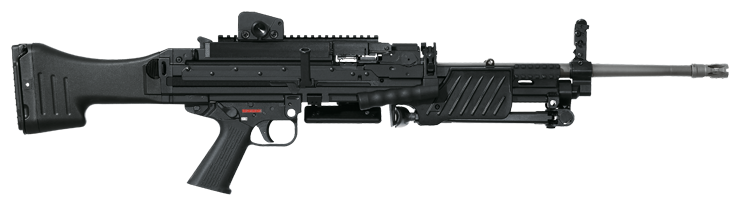
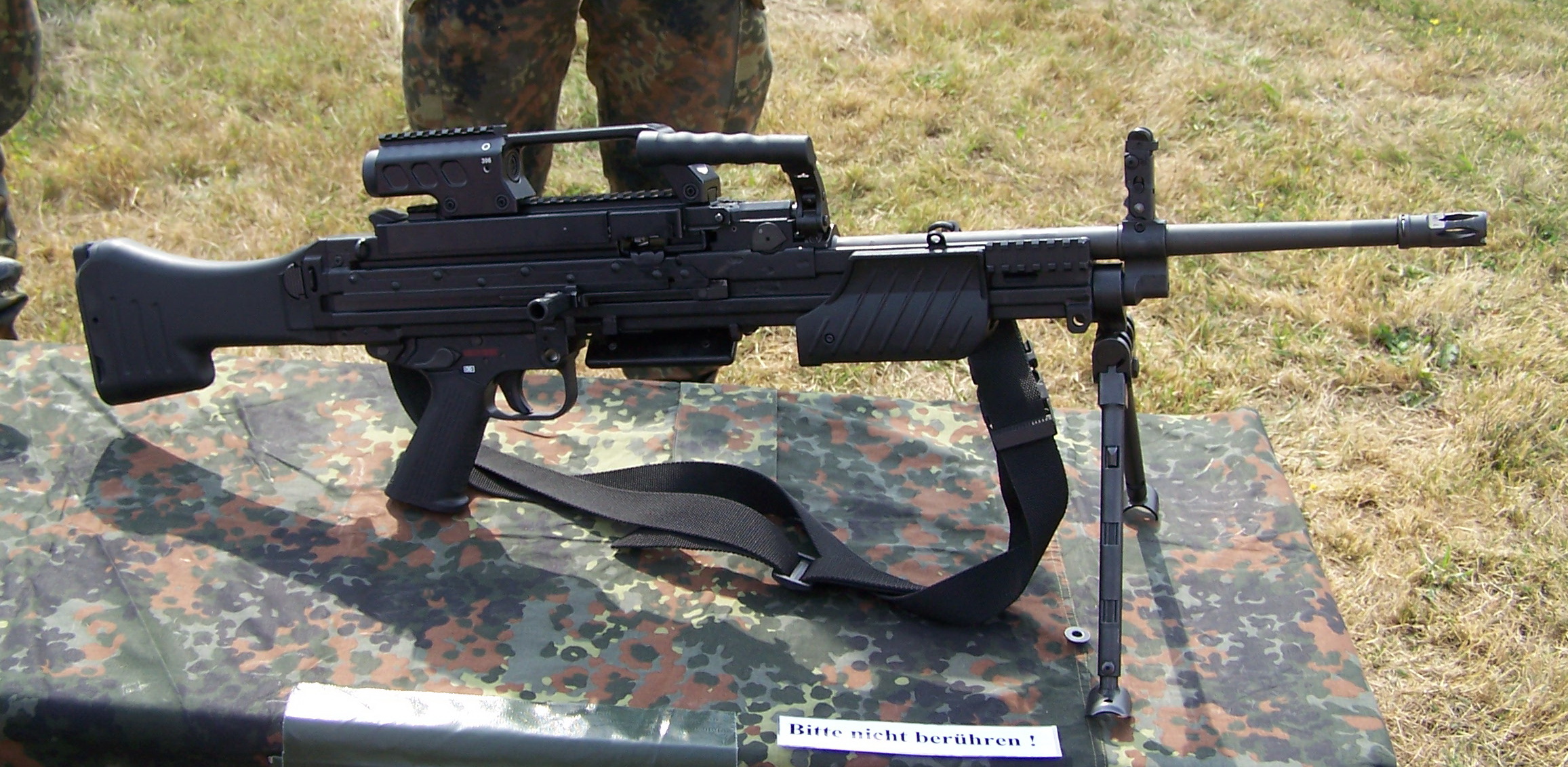

The Heckler & Koch MG4 (also known as the HK123) is a belt-fed 5.56 mm light machine gun designed and developed by German firearm manufacturer Heckler & Koch. The weapon was developed in the late 1990s and was first seen publicly in September 2001. It has been selected to replace the 7.62 mm MG3 general-purpose machine gun in the Bundeswehr at the squad support level; it will complement the MG3 in other roles. The MG4 will also be the secondary armament of the new Puma infantry fighting vehicle. Overall, it is designed to be light, provide maximum safety to the user and function reliably under adverse conditions using a wide range of ammunition from different manufacturers, without the need to adjust the gas system. The machine gun was initially known as the MG43 prior to its adoption by the Bundeswehr. The MG4 is an air-cooled, belt-fed gas-operated light machine gun with a positively locked rotary bolt and is somewhat similar in concept to the Belgian Minimi light machine gun. Safety mechanisms on the machine gun includes a manual safety incorporated into the fire mode selector toggle; setting the fire selector lever on the "safe" position blocks the trigger mechanically and locks the bolt in the cocked position. When the bolt is not pulled back completely, accidental firing is prevented by an integral, automatic mechanism that prevents the bolt from traveling forward. In addition, the firing pin cannot reach the cartridge primer until the cartridge has been fully chambered. The machine gun is fed from a disintegrating belt and is carried out in two stages from the top left using an enhanced pawl mechanism. As on the MG42 family of machine guns, the belt is expelled to the right and spent cases are ejected downwards, although sideways ejection to the right is an option. The MG4 has a hammer-forged quick-change barrel that can be safely exchanged when hot without the need for protective gloves; the carrying handle serves as the barrel change grip. The barrel assembly weighs 1.80 kg (3.97 lb). To reduce the overall length of the weapon for transport, the butt stock can be folded to the left side of the receiver. With the buttstock folded the MG4 remains fully operable. A field cleaning kit is housed within the stock. The MG4 takes zero shifts between barrel assemblies into account by making the front sight of the assemblies mechanically adjustable. In its standard form, the MG4 is equipped with closed type iron sights with range settings up to 1,000 m (1,094 yd) in 100 m (109 yd) increments. The folding front sight element is mounted on the barrel assembly and is adjustable mechanically for both windage and elevation. The sight line radius is 602 millimeters (23.7 in). Optical or night sights or laser pointers can be mounted on a length of MIL-STD-1913 Picatinny rail located on the receiver feed tray cover. Bundeswehr models are equipped with telescopic sights with 3× magnification. A folding bipod weighing 0.70 kg (1.54 lb) is provided. Supporting interfaces are integrated into the receiver to allow the MG4 to be mounted on the standard American M122A1 tripod for increased accuracy and stability.