Browning Hi-Power Mark III American 9mm Semi-Automatic Pistol
Browning Hi-Power Mark III
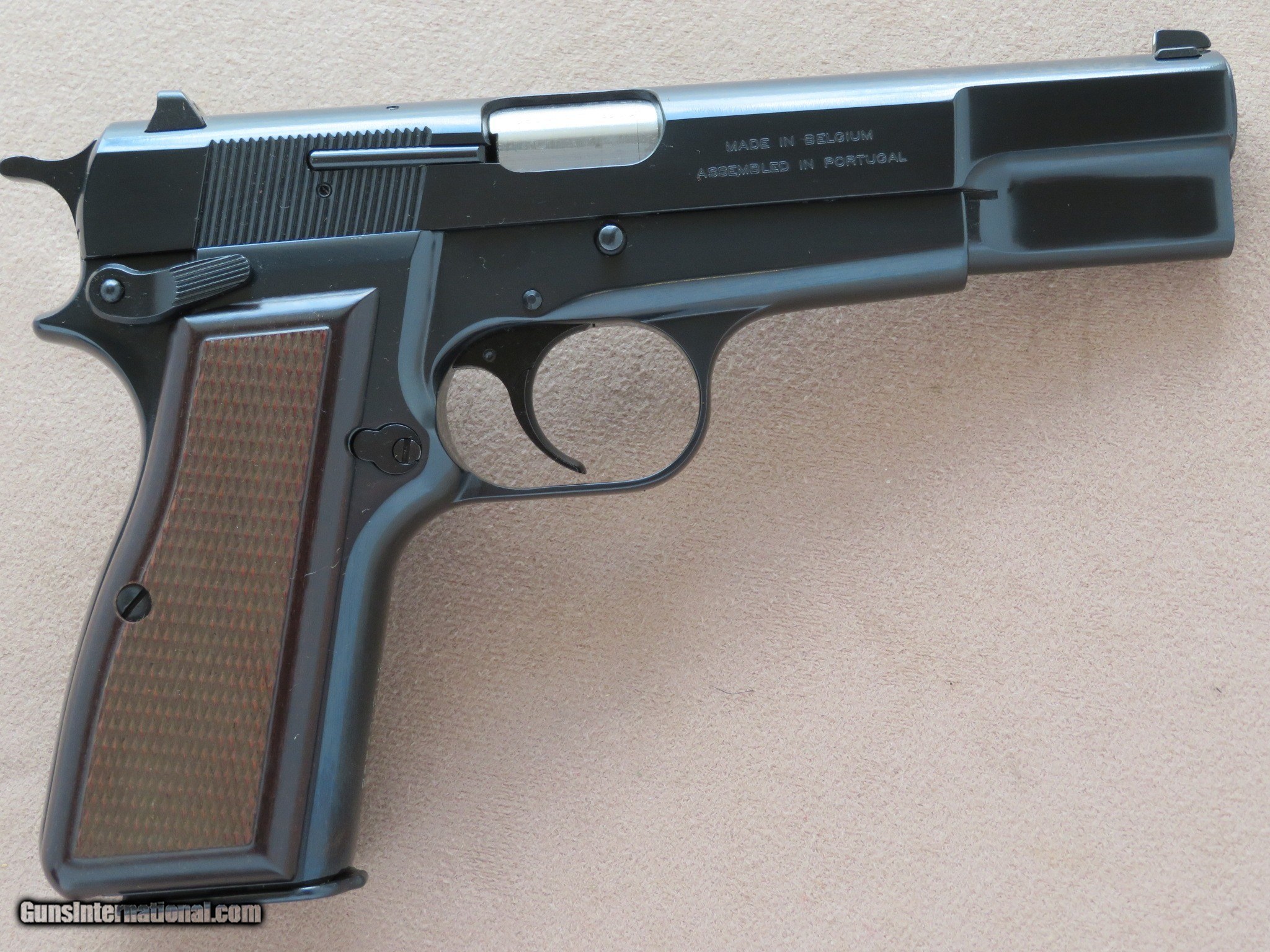
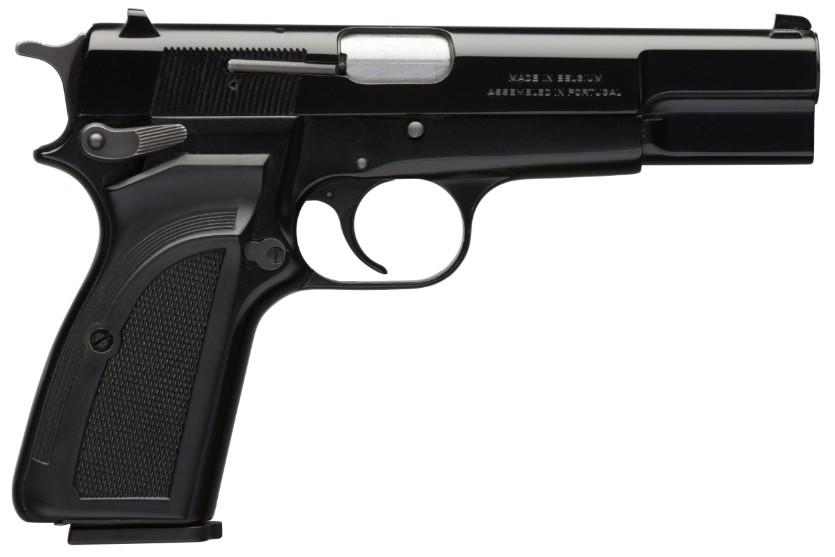
The Mark III was another advancement over the Mark II released in 1988, which featured a firing pin safety and a black epoxy finish. The main distinguishing (visual) feature of the Mark III is the absence of the water drain hole below the muzzle on the forward face of the slide. The classic John Browning design in an all-business matte black, steel slide with epoxy finish, composite grip panels. Proven. This is something that sets the Browning Hi Power apart. Like it's big brother, the 1911 pistol (also designed by John Moses Browning) the Hi Power has been used for over three-quarters of a century in real world conditions. And it has done it with an exceptional record of success. As the original high capacity 9mm pistol, the Browning Hi Power set the standard for all others. On the mark. The Mark III has a great feature set: a receiver of machined steel with a black epoxy finish, a 4 5/8" barrel, high profile fixed sights. The design is superlative with it's locked breech design, single-action trigger, ambidextrous thumb safety and composite grip panels. Extra magazine included. The Browning Hi Power is a single-action, semi-automatic handgun available in the 9mm and .40 S&W calibers. It was based on a design by American firearms inventor John Browning, and completed by Dieudonné Saive at Fabrique Nationale (FN) of Herstal, Belgium. Browning died in 1926, several years before the design was finalized. The Hi-Power is one of the most widely used military pistols in history, having been used by the armed forces of over 50 countries. After 82 years of continuous production, the Hi-Power was discontinued in 2017 by Browning Arms, but it remained in production in some countries, under license. The Hi Power name alludes to the 13-round magazine capacity, almost twice that of contemporary designs such as the Luger or Colt M1911. The pistol is often referred to as an HP (for "Hi-Power" or "High-Power"), GP (for the French term, "Grande Puissance"), BAP (Browning Automatic Pistol), or BHP (Browning High-Power). The terms P-35 and HP-35 are also used, based on the introduction of the pistol in 1935. Several sources indicate that the official name was initially "High Power", while it was manufactured in Belgium by Fabrique Nationale prior to the German occupation in World War II. Production of the weapon then moved to a John Inglis and Company plant in Canada; at some date afterwards, the name was changed to "Hi Power". (Some sources indicate that the name change was not until the 1950s.) Production returned to Belgium after the war, in 1944 or 1945. Nonetheless, the term Hi Power has been the most commonly used in articles over the past decades, regardless of the year of manufacture. Versions of the handgun continued to be made at the FN factory in Belgium under Wehrmacht control, with the designation "9mm Pistole 640(b)". The Browning Hi-Power has undergone continuous refinement by FN since its introduction. The pistols were originally made in two models: an "Ordinary Model" with fixed sights and an "Adjustable Rear Sight Model" with a tangent-type rear sight and a slotted grip for attaching a wooden shoulder stock. The adjustable sights are still available on commercial versions of the Hi-Power, although the shoulder stock mounts were discontinued during World War II. In 1962, the design was modified to replace the internal extractor with an external extractor, improving reliability. Standard Hi-Powers are based on a single-action design. Unlike modern double-action semi-automatic pistols, the Hi-Power's trigger is not connected to the hammer. If a double-action pistol is carried with the hammer down with a round in the chamber and a loaded magazine installed, the shooter may fire the pistol either by simply squeezing the trigger or by pulling the hammer back to the cocked position and then squeezing the trigger. In contrast, a single-action pistol can only be fired with the hammer in the cocked position; this is generally done when a loaded magazine is inserted and the slide cycled by hand. In common with the M1911, the Hi-Power is therefore typically carried with the hammer cocked, a round in the chamber and the safety catch on (a carry mode often called cocked and locked in the United States or "made ready" in the UK, or sometimes called condition one). The Hi-Power, like many other Browning designs, operates on the short-recoil principle, where the barrel and slide initially recoil together until the barrel is unlocked from the slide by a cam arrangement. Unlike Browning's earlier Colt M1911 pistol, the barrel is not moved vertically by a toggling link, but instead by a hardened bar which crosses the frame under the barrel and contacts a slot under the chamber, at the rearmost part of the barrel. The barrel and slide recoil together for a short distance but, as the slot engages the bar, the chamber and the rear of the barrel are drawn downward and stopped. The downward movement of the barrel disengages it from the slide, which continues rearward, extracting the spent case from the chamber and ejecting it while also re-cocking the hammer. After the slide reaches the limit of its travel, the recoil spring brings it forward again, stripping a new round from the magazine and pushing it into the chamber. This also pushes the chamber and barrel forward. The cam slot and bar move the chamber upward and the locking lugs on the barrel re-engage those in the slide.