K1 ARV South Korean Armored Recovery Vehicle
K1 ARV
Armored Recovery Vehicle
Spotted an error? Sign in to suggest an edit.
Other
Basic Information
Name
K1 ARV South Korean Armored Recovery Vehicle
Designation
K1 ARV
Alternate Designation
K1 ARV
Equipment Type
Armored Recovery Vehicle
Manufacturer
Hyundai Rotem
Date of Introduction
1993
Description
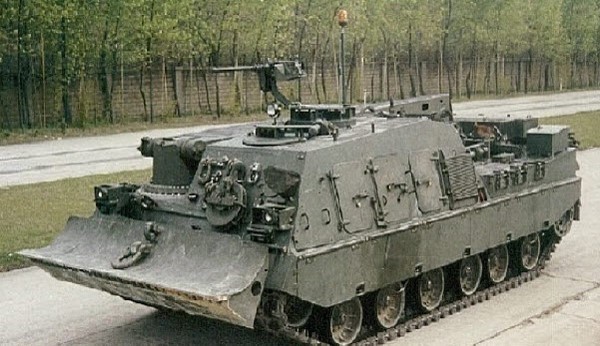
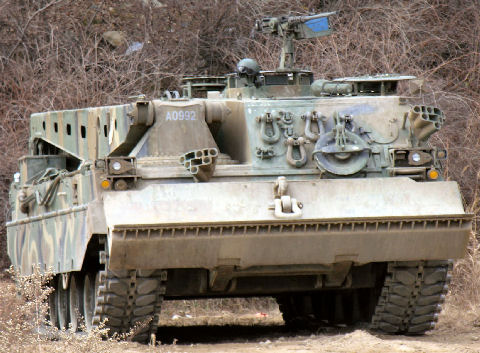
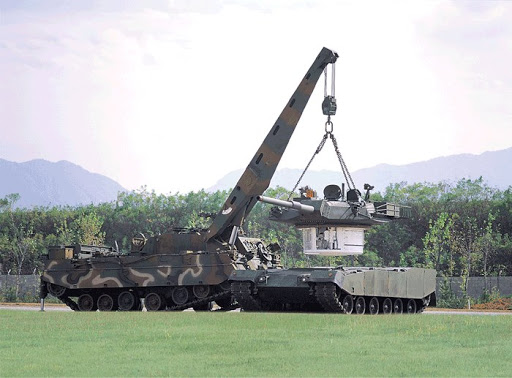
The K1 ARV operated by a crew of four is equipped with the latest recovery equipment. Its advanced crane, winch and dozer systems allow it to perform damaged vehicle recovery missions, and to provide maintenance service for armored vehicles. The K1 ARV uses common components of the K1 MBT to the maximum extent which provides for effective maintenance and logistic support. It has the same mobility performances to keep up with the K1 main battle tanks so that overturned or partly destroyed armored vehicle can be rapidly recovered or towed to the maintenance units.
Ground Specifications
Crew
4
Mobility Type
Tracked
Engine
1,934-cu in (31.7-liter) liquid-cooled, 8-cyl, multifuel diesel (1200 hp)
Max Speed
65.0 km/h
Range
500.0 km
Variants
XK1
Experimental model under the ROKIT (Republic of Korea Indigenous Tank) project.
K1
First production variant. 1,027 units built between 1985 and 1998. To be upgraded to K1E1 by 2026.
K1M
Proposed export variant for Malaysia. In 1997, Malaysia expressed great interest in obtaining the K1, and the ROK responded by showing them the concept for K1M, which had several features not present in the baseline K1, including a laser warning system and an air conditioning unit. It was to weigh 49.7 tons, while the total ammunition capacity would have been reduced to 41 rounds. The ROK offered a contract for 210 K1M's, but Malaysia responded that it was too many, and chose to go with Polish PT-91M in 2003.
K1 PIP
Upgraded K1. PIP includes changes in SAP to KSAP, GPS to GPTTS, and Nd-Yag to CO2 rangefinder.
K1E1
Further upgraded K1. Production began in December 2013, and the first K1E1 rolled out on 7 July 2014. The upgrade will be similar to that of K1A2. All K1 will be upgraded to K1E1 by 2026.[9] The name was inherited from the K1A1 prototype, the K1E1.
K1E2
As of August 2018, the K1E2 type is planned to be improved. It is expected to be upgraded to a large-scale repair (renovation) in 2024. The main improvement point is the replacement of the new armored upgrading of the protection, installation of the positive pressure device, acceleration of 10% upgrade (1200 hp engine to 1320 hp) or change 1500 hp engine, Introduction of RWS, etc.
K1A1
First major enhanced variant. 484 units built between 1999 and 2010. To be upgraded to K1A2 by 2022.
K1A2
Upgraded K1A1. Originally named as K1A1 PIP. Developed from 2008 to 2010, and mass-production started in 2012. First upgraded vehicle was rolled out on 20 December 2013. Technology benefit from K2 Black Panther has been applied to this model. Upgrades include buoyancy tubes, automatic commanding control with identification friend or foe, GPS and INS position recognition, and digital wireless communications and displays. It also has air conditioning and a soft-kill active protection system to defend against missiles and rockets. The K1A2 project provides upgrade kits for South Korean Army and Marines Corps K1 and K1A1 tanks. All K1A1 will be upgraded to K1A2 by 2022.
K1 ARV
The K1 Armored Recovery Vehicle is based on the K1 tank. It has a crane, winch and dozer system built on the vehicle. It was developed with assistance from Krupp Maschinenbau Kiel GmbH (now Rheinmetall Landsysteme GmbH) between 1988 and 1992, with first deployment in 1993.
K1 AVLB
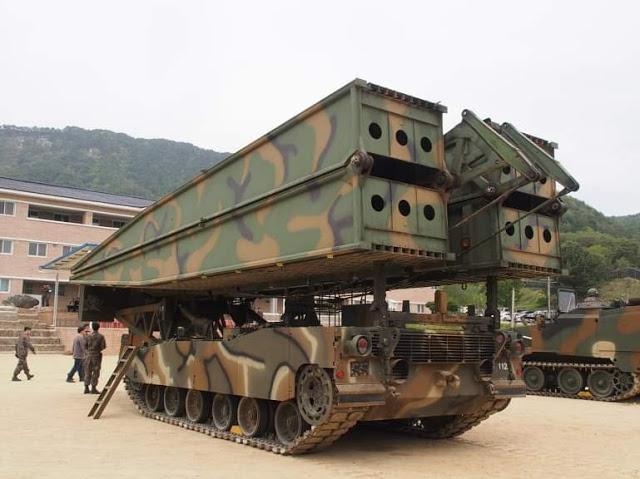
The K1 Armored Vehicle-Launched Bridge variant uses a scissor-type bridge system mounted on the chassis. It was developed from 1988 to 1992 with help from Vickers Defense Systems
K1 CEV
The K1 Combat Engineer Vehicle is based on the K1A1/A2 chassis, mounting a mine plough, an excavator arm on the right side, and a lane marking system. Development is expected to be completed in June 2018 and begin production in 2019.
System
Alternative Designation
K1 ARV
Type
Armored Recovery Vehicle
Manufacturer
Hyundai Rotem
Crew
4
Winch
35,000-kg winch with 150 m of cable.
Crane Capacity
25,000-kg crane
Crane Traverse
270 deg
Crane Elevation
+70 deg
Dozer Blade
A front-mounted dozer blade can move 170 cu m of soft soil per hour with a traction force of 71,120 kg.
Dimensions
Hull Length
7.48 m
Length, Gun Forward
9.67 m
Width
3.59 m
Height
2.25 m
Combat Weight
51,100 kg
Ground Clearance
460 mm
Ground Pressure
0.87 kg/sq cm
Automotive
Engine Name
1 x MTU MB871
Engine Type
1,934-cu in (31.7-liter) liquid-cooled, 8-cyl, multifuel diesel
Engine Power
1,200 hp at 2,600 rpm
Power-to-Weight Ratio
23.53 hp/metric ton
Transmission
ZF LSG 3000 automatic transmission w/mechanical lock-up and 4 forward/2 reverse gears
Suspension
Hybrid (torsion bar at wheel stations 3, 4 and 5 and hydro-pneumatic units at wheel stations 1, 2 and 6); 6 road wheels with 19.7-in (500-mm) travel
Maximum Road Speed
65 kph
Cross-Country Speed
40 kph
Maximum Range
500 km
Vertical Obstacle
1.1 m
Trench
2.7 m
Fording without Preparation
1.2 m
Fording with Preparation
2.2 m
Gradient
60 percent
Side Slope
30 percent
Main Weapon System
System
Name
K6
Type
Heavy Machine Gun
Caliber
12.7 mm
Quantity
1
Manufacturer
Daewoo
Length
1,654 mm
Barrel Length
1,143 mm
Action
Short recoil-operated
Rate of Fire
1,200–1,300 rounds/min
Muzzle Velocity
890 m/s
Maximum Firing Range
7,400 m
Effective Firing Range
1,800 m
Feed System
Belt-fed
Ammunition
Type
Rifle
Caliber
12.7mm
Cartridge
.50 BMG (12.7×99mm NATO)
Basic Load
INA
Protection
Hull Armor
Chobham-type Special Armor Plate (SAP)
Turret Armor
Chobham-type Special Armor Plate (SAP). Chobham-type armor is fitted over the frontal arc, turret front and sides. This provides protection against both kinetic and chemical energy attacks.
Applique Armor
Available
Explosive Reactive Armor
INA
Active Protection System
INA
Mine Clearing
INA
Self-Entrenching Blade
Yes
NBC Protection
collective: M13A1 gas-particulate filter
Smoke Equipment
2 x 6 smoke grenade launchers on either side of turret
Details
Country of Origin
South Korea
Category
Survivability
Land > Survivability
Filter Label
K
Sources
deagel.com: https://www.deagel.com/x/x/a000387
Classification
Domain
Ground
Equipment Status
Active
Dimensions
Length
—
Width
3.59 m
Height
2.25 m
Weight
51100 kg
Related Equipment (1)
Operators (1)
South Korea
Something went wrong. Please reload the page.
Reload