Kommuna Class Russian Submarine Salvage Ship
Kommuna Class

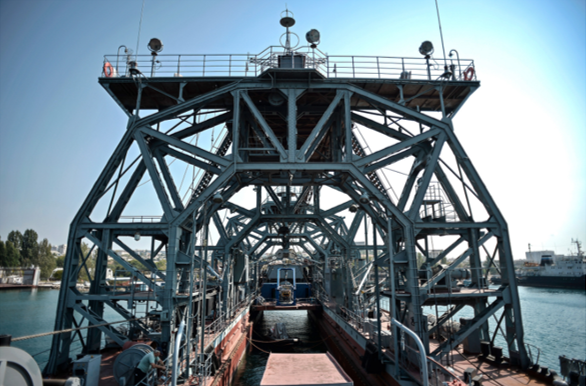
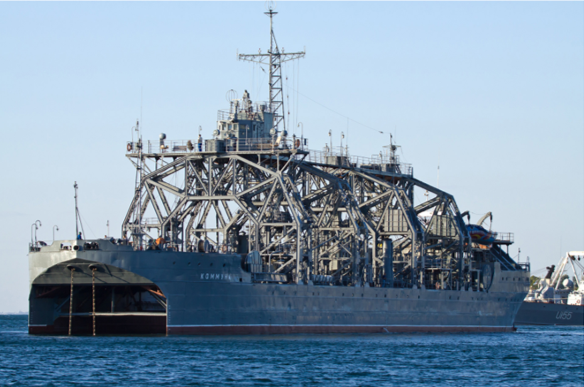
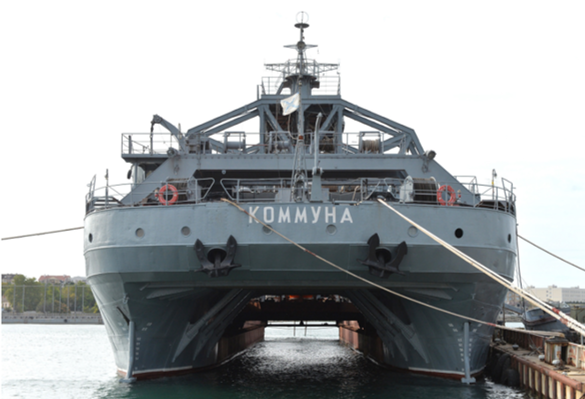
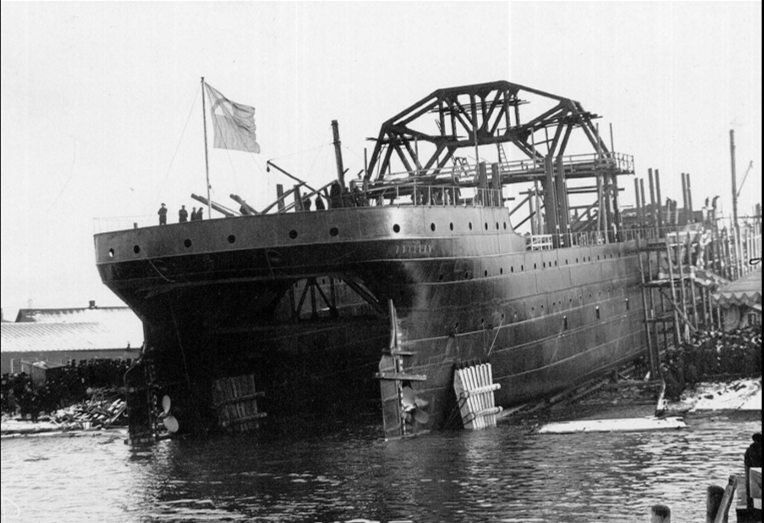
The Kommuna Class Russian Submarine Salvage Ship is a submarine salvage ship in service with the Russian Navy's Black Sea Fleet. A double-hulled catamaran, she was laid down at the Putilov Factory (now the Kirov Factory) in St. Petersburg in November 1912 as Volkhov. The ship was launched the following year and commissioned on 14 July 1915. She was renamed Kommuna on 31 December 1922. Kommuna has served in the Russian Imperial, Soviet, and Russian Federation navies through the Russian Revolution and two World Wars. This specialized ship is the oldest operational warship in the World. HISTORY: The ship was the first Russian double-hulled vessel and was developed by order of the Naval General Staff. SMS Vulkan was used as a prototype. The contract to build the ship was won by the Putilov company, who received Order No. 3559 from the General Directorate of Shipbuilding on 30 December 1911, and the contract for construction was signed on 5 May 1912. The ship was laid down on 12 November 1912 under the supervision of naval architect N.V. Lesnikova. On 17 November 1913, the ship was launched under the name Volkhov and was commissioned into the Baltic Fleet on 15 July 1915. Volkhov was initially based at Reval where she served as a submarine tender, capable of carrying 10 spare torpedoes and 50 tons of fuel, as well as accommodation for 60 submariners. She serviced Russian submarines, and also British E and C-class submarines. Volkhov made her first successful salvage of a submarine in the summer of 1917, raising the Amerikanskiy Golland (Holland)-class submarine AG 15, which had sunk off the Åland Islands. On 24 September 1917, Volkhov refloated the Bars-class submarine Edinorog from a depth of 13.5 meters (44 ft). From late 1917 Volkhov participated in the Civil War, serving the submarines of the Soviet Baltic Fleet, and on 31 December 1922 (just days after the founding of the USSR), she was renamed Kommuna. Under her new name, she continued in service in the Baltic, extinguishing a fire aboard the submarine Zmeya, and raising the despatch boat Kobchik, and the boat Krasnoarmeyets. In mid-1928 Kommuna raised the British submarine HMS L55, which had been sunk in the Gulf of Finland in June 1919, from a depth of 62 meters (203 ft), and which then served as the prototype for the Leninets class. Kommuna continued to serve as a salvage and repair ship, also raising a tug, a torpedo boat, and a crashed aircraft. Following the German invasion in June 1941 Kommuna was based at Leningrad, and although damaged by bombing continued to serve throughout the siege. In March 1942 she recovered four KV tanks, two tractors, and 31 vehicles from Lake Ladoga, which had fallen through the ice road, called the "Road of Life", which was Leningrad's only supply route. That year she also repaired six M-class submarines, as well as salvaging the Shchuka class 411, the tugboat Austra, the schooners Trud and Vodoley-2, and several other vessels. In February 1943, the crew of Kommuna was sent to the Volga where they recovered the tug Ivan and an Ilyushin Il-2 aircraft. In 1944, Kommuna recovered 14 wrecks, totaling 11,767 tons, and repaired 34 ships. Following the end of the siege, the entire crew was awarded the Medal "For the Defence of Leningrad". The ship continued to serve after the war, and in 1954 she was refitted and her engines were replaced by more modern Dutch ones. In November 1956 she located the submarine M-200, and in October 1957 raised the M-256. In 1967, the ship sailed from the Baltic to the Black Sea and was refitted at a cost of 11 million rubles to carry submersibles. In 1974 she was equipped with a Type AS-6 Poisk-2 submersible, which on 15 December 1974 made a record dive to a depth of 2,026 meters (6,647 ft). In 1977 it was used in the search for a Sukhoi Su-24 aircraft that crashed and sank off the Caucasus at a depth of 1,700 meters (5,600 ft). In 1984 the ship was laid up for transfer to the Russian Academy of Sciences. However, the transfer was canceled, and she was thoroughly looted and had to be completely refitted before returning to Naval service. In 1999 she was re-designated from "salvage ship" to "rescue ship". In October 2009 she received a British-built submarine rescue submersible Pantera Plus, capable of operating to depths of up to 1,000 meters (3,300 ft). As of January 2012, she forms part of the detachment of rescue vessels based at Sevastopol.