Mohajer-2 Iranian Unmanned Aerial Vehicle (UAV)
Mohajer-2
Tactical Unmanned Aerial Vehicle (UAV)
Spotted an error? Sign in to suggest an edit.

Other

Basic Information
Name
Mohajer-2 Iranian Unmanned Aerial Vehicle (UAV)
Designation
Mohajer-2
Alternate Designation
Mohajer-2
Equipment Type
Tactical Unmanned Aerial Vehicle (UAV)
Manufacturer
Qods Aviation
Date of Introduction
1996
Description
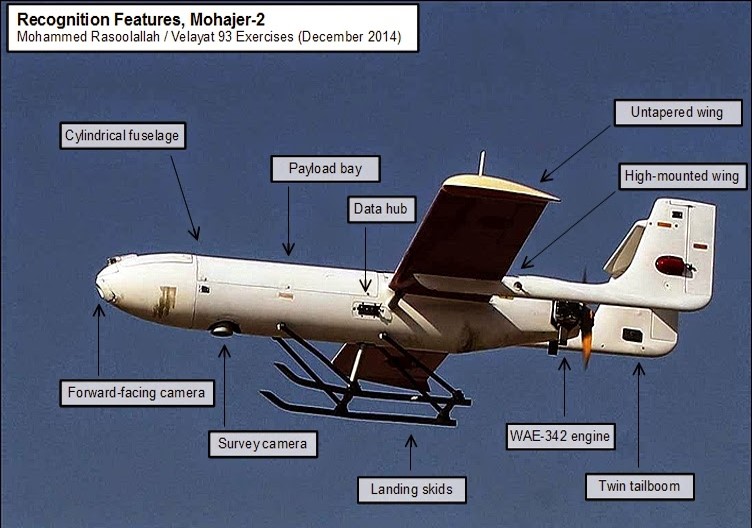
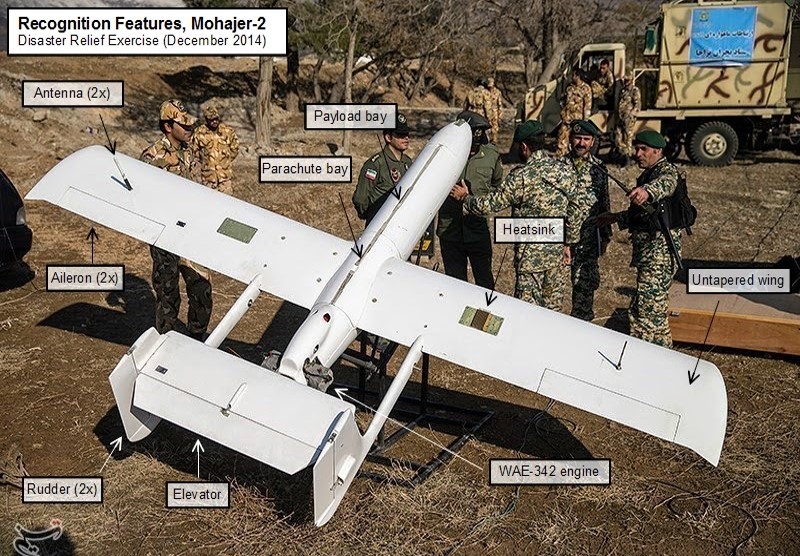
The Mohajer-2 Iranian Unmanned Aerial Vehicle (UAV) The Mohajer-2 has a bullet-shaped fuselage, mid-mounted, untampered wings, twin tail booms, twin rudders, belly skids, and a horizontal tail.
Air & Air Defense Specifications
Engine
Twin-cylinder piston engine (25 hp)
Max Speed
200.0 km/h
Range
50.0 km
Endurance
1.50 hrs
Wingspan
3.80 m
Payload Capacity
15 kg
Variants
Raad-85
Comparable to the similarly equipped Ababil-2 variant.
Mohajer-2N
The M2N (the 'N' stands for 'new') was unveiled during the 2014 Kish Airshow.
Arpia
Venezuela version of the Mohajer-2.
System
Alternate Designation
Mohajer-2
Type
Unmanned Aerial Vehicle (UAV)
Manufacturer
Qods Aviation Industry Company, Tehran
Autonomy
Manual: The operator controls all aspects of UAV flight by using the real-time feed from the onboard cameras. This mode relies on high and low bandwidth communication between the UAV and GCS.
Semi-automatic: The operator determines the UAV's flight path, but does not control the flight itself. This mode relies on the lower bandwidth control and telemetry channels, which have a longer range than the higher frequency channels used for imagery downlinks.
Automatic: The UAV follows a preset flight path and executes commands using GPS and INS-cued waypoints. This mode does not require any uplink/downlink between the UAV and the GCS.
Crew
Unmanned
Payload Capacity
15 kg
Reconnaissance Equipment
The Mohajer-2 can be fitted with three different optical payloads: a) a gimbaled EO-system for surveillance, b) a fixed downward-facing still camera for aerial surveying, and c) a fixed forward-facing camera in the nose for flight. The gimbaled imager is used for real-time surveillance and is limited to light-weight models by the M2's relatively small payload. In practice, only daylight cameras, such as the IEI's Oghab 11, have been fitted. Early-production M2s lacked the forward-facing camera.
Launching System
The Mohajer-2 is dependent on pneumatic or rocket assisted launch (usually the former).
Recovery System
skid landing gear only.
Dimensions
Length
2.91 m
Wingspan
3.8 m
Height
INA
Empty Weight
70 kg
Maximum Takeoff Weight
85 kg
Automotive
Engine Name
WAE-342
Engine Type
Twin-cylinder piston engine
Engine Power
25 hp
Propellers
2 bladed
Maximum Speed
200 km/h
Ceiling
3,500 m
Maximum Range
50 km
Endurance
1.5 hours
Communications
Note
The Mohejer-2 is fitted with two stub antenna, one on either wing. These support the higher frequency datalinks that allow for real-time control (under 10 ghz).Like the Ababil family, the lack of OTOH control is unlikely to be a significant problem given its short range. Although exact details are scant, export brochures indicate that it is fitted with control software that allows the Mohajer to be flown in one of three modes: manual, semi-automatic, and automatic.
Armament
Note
The Mohajer-2 Iranian Unmanned Aerial Vehicle (UAV) is not equipped with any weapon systems.
Details
Country of Origin
Iran
Category
UAVs
Air > UAVs
Filter Label
M
Classification
Domain
Air & Air Defense
Equipment Status
Active
Dimensions
Length
2.91 m
Width
3.8 m
Height
—
Weight
85 kg
Operators (4)
Iran
Libya
Syria
Venezuela
Something went wrong. Please reload the page.
Reload