ARMSNET
Military Equipment Database
Initializing 0%

Firtina Turkish 155mm Self-Propelled Howitzer (SPH)

Firtina

Self-Propelled Howitzer (SPH)
Spotted an error? Sign in to suggest an edit.
Basic Information
Name
Firtina Turkish 155mm Self-Propelled Howitzer (SPH)
Designation
Firtina
Alternate Designation
Firtina; T-155 K/M Obüs
Equipment Type
Self-Propelled Howitzer (SPH)
Manufacturer
First Main Maintenance Factory Directorate and ASFAT
Date of Introduction
2003
Description

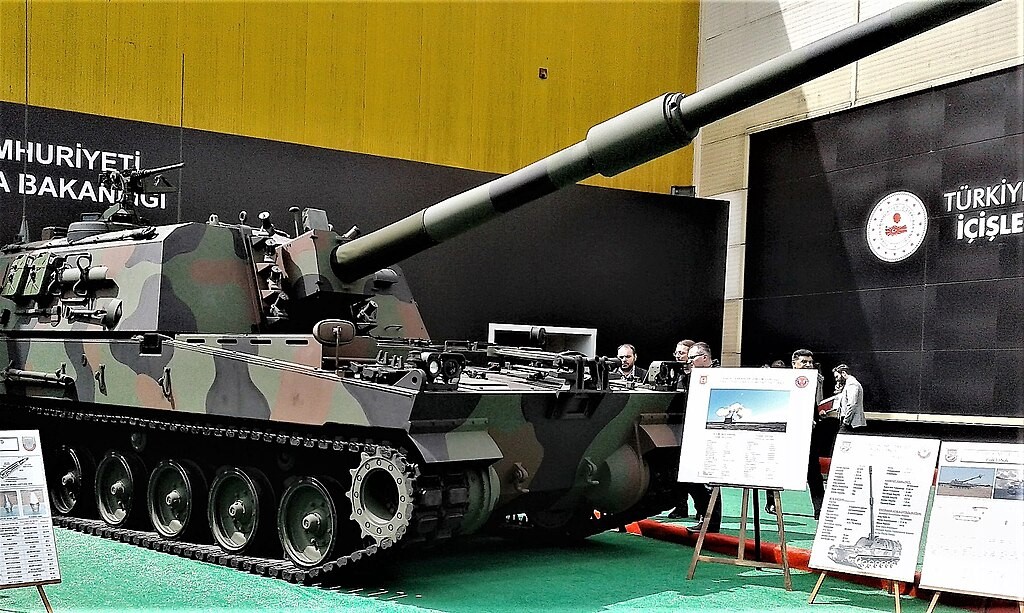
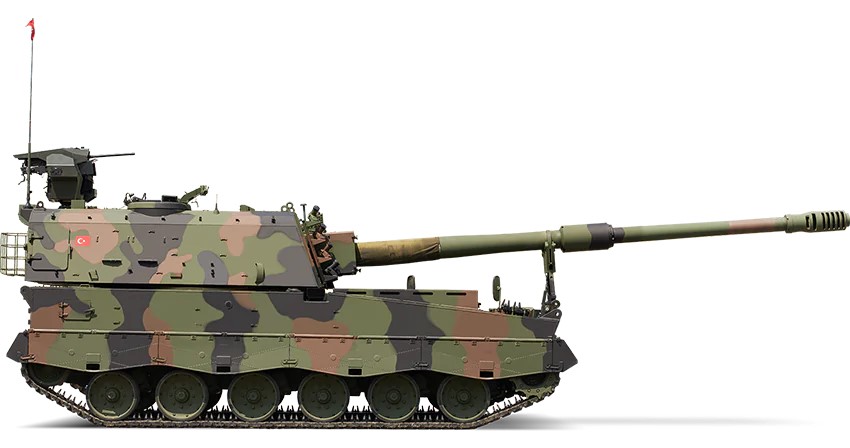
The Firtina Turkish 155mm Self-Propelled Howitzer (SPH) is part of an artillery system that includes an ammunition resupply vehicle and C4 systems for target detection and fire direction. Both the hull and turret are made of all-welded steel armor, providing protection for the occupants against small arms fire and shell splinters. The driver is seated at the front of the hull on the left side, with the power pack compartment to the right. The crew and turret compartment extends to the rear of the hull. The driver has a single-piece hatch cover with three day periscopes positioned in front for visibility. The turret crew, consisting of four personnel, enters the vehicle through a large door located in the lower half of the hull, which opens to the right. Additionally, there is a hatch cover on the left side of the turret roof, and the commander's cupola is situated on the right side. The ordnance is mounted in the center of the turret and features a central bore evacuator and a multi-baffle muzzle brake. A travel lock is also provided, mounted at the front of the hull. The vehicle has six road wheels on each side, with the idler wheel located at the rear and the drive sprocket at the front. The tracks are supported by three return rollers.

Ground Specifications
Crew 5
Mobility Type Tracked
Main Weapon 155 mm
Engine Diesel (1000 hp)
Max Speed 65.0 km/h
Range 225.0 km
Variants
Poyraz The Poyraz is an armored ammunition resupply vehicle designed to support the Firtina during operations. It shares the same mobility platform as the Firtina but lacks armament systems. With a combat weight of 47 tons, it is typically operated by a crew of three, with the driver located at the front left and the diesel power pack to the right. As a resupply vehicle, the Poyraz does not have primary armament but can accommodate a secondary machine gun if needed. It is powered by a VDS-1790 series V-12 diesel engine producing 750 horsepower, allowing it to reach a maximum road speed of 50 km/h and an operational range of up to 360 km. The Poyraz features armor protection against small arms fire up to 14.5 mm AP rounds and anti-personnel mines, with a maximum armor thickness of 19 mm. Its primary mission is to carry and transfer 96 rounds of 155 mm ammunition to the Firtina in two stages—automatically for projectiles and semi-automatically for charges. Equipped with a Fire Control System (FCS), Global Positioning System (GPS), and battle management system, the Poyraz can locate friendly units. It can transfer 48 complete rounds of ammunition to the Firtina in just 20 minutes, enabling quick resupply and relocation after fire missions.
Firtina NG The Firtina NG is an upgraded Turkish 155mm Self-Propelled Howitzer (SPH), designed to enhance Turky's ground forces by incorporating lessons learned from operations in Iraq and Syria. This version retains the basic structure of the standard Firtina but features an automatic loading system and a direct-fire capability, with the Aselsan SARP remote weapon station (RWS) as a key external differentiator. Constructed with all-welded steel armor, the Firtina NG protects occupants against small arms fire and shell splinters. The driver is positioned on the left front side of the hull, while the crew enters through a large rear door. The turret houses the ordnance in the center, complete with a bore evacuator, multibaffle muzzle brake, and a travel lock on the front. Notable modifications include a large grill panel at the turret front, an electric air conditioning system, improved fume extraction, a new auxiliary power unit (APU) at the rear right, and a modern nuclear, biological, and chemical (NBC) system.
E Firtina The E-Firtina is essentially the Firtina NG equipped with a hybrid electric power pack. Details about the Elektrik 2P2S Power Pack were revealed by MKEK during IDEF 2023. It is understood that the E-Firtina will maintain the same layout, structure, protection, and mission systems as the Firtina NG, but will be powered by a hybrid power pack.
System
Alternative Designation Firtina; T-155 K/M Obüs
Type Self-Propelled Howitzer (SPH)
Manufacturer First Main Maintenance Factory Directorate and ASFAT
Configuration Track
Caliber 155 mm
Crew 5 ea
Dimensions
Length, Overall 12 m (472.4 in)
Length, Hull 7.42 m (292.1 in)
Width 3.40 m (133.9 in)
Height to Turret Roof 2.85 m (112.2 in)
Height to Top of Roof-Mounted Weapon 3.43 m (135 in)
Ground Clearance 0.42 m (16.5 in)
Track Width 547 mm (21.54 in)
Length of Track on Ground 4.72 m (185.8 in)
Weight, Combat 47,500 kg (104,719 lb) (47.5 t)
Automotive
Engine Name MTU-881 Ka-500
Engine Type Diesel
Engine Power 1,000 hp (735 kW)
Fuel Capacity 850 litre (224.55 US gal)
Power-to-Weight Ratio: 21.05 hp/t
Electrical System 28 V
Maximum Speed 65 km/h (40.4 mph)
Maximum Range 225 km (139.80 miles)
Amphibious No
Fording 1.50 m (59.1 in)
Gradient 60%
Side Slope 30%
Vertical Obstacle 0.75 m (29.5 in)
Trench 2.8 m (110.2 in)
Main Weapon System
Note The Firtina is equipped with a 155 mm/L52 artillery piece, supplied by MKEK, that uses a semi-automatic loading system. The turret, which houses the weapon, can continuously traverse and has an elevation range from -2.5° to +70°. Both the turret and the gun are powered hydraulically, with manual backup options available. The barrel is autofrettaged and has a chamber volume of 23 liters. The 155 mm/52-caliber ordnance complies with the NATO Joint Ballistic Memorandum of Understanding (JBMOU). It features a vertically opening sliding breech and is equipped with an automatic primer mechanism. The gun is capable of firing at a burst rate of three rounds in 15 seconds, an intense rate of six to seven rounds per minute, and a sustained rate of two rounds per minute. A standard 155 mm high-explosive (HE) projectile can be fired to a maximum range of 18 km, while a rocket-assisted high-explosive projectile can reach a maximum range of 30 km. The maximum range varies depending on the projectile and charge combination, but when using a 155 mm extended-range full-bore base-bleed (ERFB-BB) projectile, a range of over 40 km is claimed. The primary long-range round used by Turkish forces is the HE round from MKEK. This round is a base-bleed type armed with a TNT explosive filler, achieving a maximum range of 39 km and an initial muzzle velocity of approximately 945 m/s. Both conventional bag-type charges and modular charges can be utilized with this artillery system.
Basic Load 48 ea
Auxiliary Weapon System
Note For local defense, the commander is equipped with a 12.7 mm M2 heavy machine gun, which is mounted on a pintle on the left side of the turret roof. The weapon is not stabilized, and it must be aimed and fired manually, requiring the commander to be exposed during operation.
Basic Load 500 ea
Fire Control System
Note Turkish company Aselsan has developed an onboard computerised fire control system (FCS) for the Firtina howitzer, allowing it to receive target information from the battery command post, forward observers, or the battalion fire direction center (FDC). Key components of the FCS include: - A ballistic computer - A gunner's interface unit - Power control and conditioning units - An inertial navigation system with GPS - An assistant gunner's display unit - A tactical data/internet communications system for autonomous operation The hybrid navigation system accurately determines the Firtina's position in Universal Transverse Mercator (UTM) coordinates, enabling precise ballistic trajectory calculations. The onboard ballistic computer ensures autonomous artillery fire control and integrates with external command posts. Developed using NATO Artillery Ballistic Kernel (NABK) software, it features a Graphical User Interface (GUI) and coordinates with the AN/TPQ-36 Firefinder radar. When engaged, the gun laying system uses firing quadrant elevation (QE) and azimuth (AZ) values from the ballistic computer for automatic targeting. It also offers semi-automatic and manual modes. A muzzle velocity radar provides additional information to the FCS. The Firtina can integrate with the TLFC Fire Support Automation Project 2000, also developed by Aselsan. After receiving a fire command, the Firtina can target within 30 seconds and relocate in 90 seconds. It can fire three 155 mm projectiles simultaneously at the same target using various elevation angles and charge zones. The system is equipped with a 5 W and 50 W VHF radio system, with the former for voice communications and the latter for data transfer.
Protection
Armor As stated by the Turkish Army, the steel armor offers protection against penetration from small arms fire up to 14.5 mm armor-piercing (AP) rounds, as well as against anti-personnel mines. The maximum armor thickness is estimated to be 19 mm.
Applique Armor INA
NBC Protection An NBC system is fitted as standard.
Smoke Equipment INA
Details
Country of Origin Turkey
Category Self-Propelled Gun/Howitzer Artillery Systems
Land > Artillery > Self-Propelled Gun/Howitzer Artillery Systems
Filter Label
F
Classification
Domain
Ground
Equipment Status
Active
Dimensions
Length
0.3 m
Width
0.09 m
Height
Weight
47500000 kg
Operators (1)
Turkey
Something went wrong. Please reload the page. Reload