Misagh-1 Iranian Man-Portable Surface-to-Air Missile System (MANPADS)
Spotted an error? Sign in to suggest an edit.

Other
Basic Information
Name
Misagh-1 Iranian Man-Portable Surface-to-Air Missile System (MANPADS)
Designation
—
Alternate Designation
—
Equipment Type
—
Manufacturer
Shahid Shah Abhady Industrial Complex
Date of Introduction
1995
Description
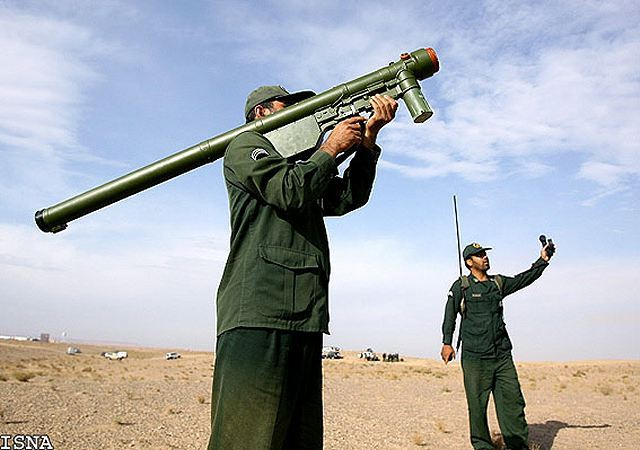
Hezbollah and Houthi Proliferation. The Misagh 1 (also Mithaq-1, etc.) is an Iranian man-portable surface-to-air missile. It was developed by the Shahid Kazemi Industrial Complex in Tehran. It is a variant or reverse-engineered clone of the Chinese QW-1 Vanguard missile system and is comparable to the Soviet SA-16 Gimlet missile. It is used by Iran and has been exported to Hezbollah in Lebanon and to the Popular Mobilization Forces in Iraq and to Syria as well. The MANPADS was supplemented by the newer Misagh-2 missile system. Visually, the Misagh-1 is virtually indistinguishable from the QW-1 it is cloned from, other QW-series missiles, the Misagh-2 upgrade, and Pakistan's Anza missiles.
Ground Specifications
Crew
1
Main Weapon
surface-to-air missile
Max Speed
2160.0 km/h
Range
0.5 km
Variants
Misagh-2
The Misagh-2 is an Iranian man-portable infrared-guided surface-to-air missile. The Misagh-2 is the successor to the Misagh-1. Like its predecessor, the Misagh-2 is based on Chinese technology.[1] Iran’s defense minister launched the domestic mass production of the Misagh-2 on 5 February 2006. This missile destroys its target within 5 second and has an operation temperature of -40°C to +60°C. Near the target its speed reaches 2.7+ Mach.
System
Note
.
Missile System
Name
Misagh-1
Type
Man-Portable Surface-to-Air Missile System (MANPADS)
Proliferation
HEZBOLLAH
Manufacturer
Shahid Shah Abhady Industrial Complex
Crew
1 ea
Engine
Solid Rocket Motor
Guidance System
Passive infrared homing
Navigation System
The missile is guided by proportional navigation to the impact point with the target, whereupon a target adaptive homing circuit cuts in just before impact to ensure maximum damage is caused. Once the missile is launched, the gunner is free to seek protective shelter or make ready for the next engagement.
Operation
Normally operated as part of a two-man team the gunners can, on the march, carry the system on their backs by means of a harness. The operating sequence is as follows. The gunner is alerted by visual detection of a target. The assistant then selects a firing site and removes the front and rear covers of the launcher tube and raises it to the shoulder firing position. If identified as hostile, the firing trigger is depressed part way to activate the electric battery and coolant bottle to provide power and gas to the missile's systems. The gunner then aims at and tracks the target until continuous audio and visual signals are received. These indicate seeker lock on. The gunner then sets the lead angle and depresses the firing trigger all the way. Between 0.3 and 0.8 seconds later, the booster motor sends the missile out of the firing tube to a safe point where it is jettisoned and the dual-thrust sustainer motor kicks in to power the missile in flight.
Reaction Time
5 to 10 sec
Speed
600 m/s
Maximum Engagement Altitude
4,000 m
Minimum Engagement Altitude
30 m
Maximum Engagement Range
500 m
Minimum Engagement Range
5,000 m
Warhead Type
HE-fragmentation
Fuze
Impact
Dimensions
Length
1.477 m
Diameter
0.71 m m
Height
INA
Weight
16.9 kg
Warhead Weight
1.42 kg
Image Sources
Notes
https://armyrecognition.com/iran_iranian_army_missile_systems_vehicles_uk/misagh-1_man_portable_air_defence_missile_system_technical_data_sheet_specifications_pictures.html; https://freebeacon.com/national-security/iran-details-new-shoulder-fired-missiles/; https://www.armyrecognition.com/index.php;
Details
Country of Origin
Iran
Category
Man-Portable Air-Defense Systems (MANPADS)
Land > Air Defense > Man-Portable Air-Defense Systems (MANPADS)
Filter Label
M
Classification
Domain
Ground
Equipment Status
Active
Dimensions
Length
1.48 m
Width
0.71 m
Height
—
Weight
16.9 kg
Operators (6)
Iran
Iraq
Lebanon
Syria
Yemen
Non-State Actors
Something went wrong. Please reload the page.
Reload