Su-33 (Flanker-D) Russian Carrier-Based Air Superiority Fighter
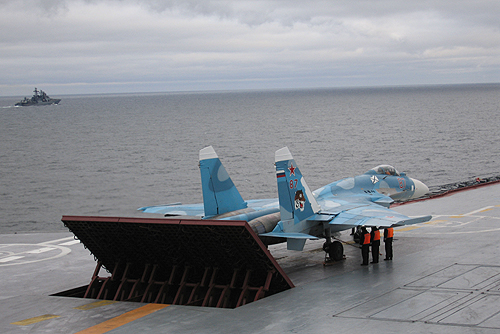
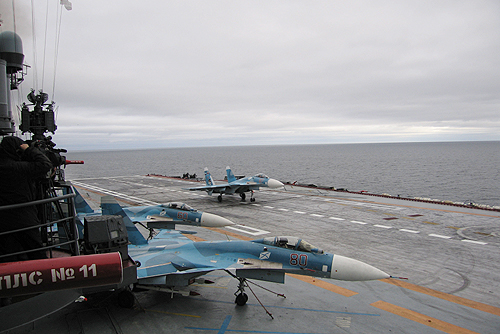
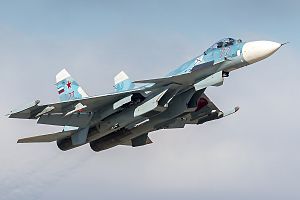
The Su-33 (Flanker-D) Russian Carrier-Based Air Superiority Fighter is an all-weather carrier-based twin-engine air superiority fighter designed by Sukhoi and manufactured by Komsomolsk-on-Amur Aircraft Production Association, derived from the Su-27 and initially known as the Su-27K. Compared with the Su-27, the Su-33 has a strengthened undercarriage and structure, folding wings, and stabilators, all for carrier operations. The Su-33 has canards and its wings are larger than the Su-27 for increased lift. The Su-33 has upgraded engines and a twin nose wheel and is air refuelable. First used in operations in 1995 aboard the aircraft carrier Admiral Kuznetsov,[N 1] the fighter officially entered service in August 1998, by which time the designation "Su-33" was used. Following the break-up of the Soviet Union and the subsequent downsizing of the Russian Navy, only 24 aircraft were produced. Attempted sales to China and India fell through. With plans to retire the Su-33 once they reach the end of their service life, the Russian Navy ordered the MiG-29K as a replacement in 2009. Design: To adapt the original Su-27 for naval operations, Sukhoi first incorporated a reinforced structure and undercarriage to withstand the great stress experienced upon landing, particularly quick descents and non-flare landings (landings where the aircraft does not 'float' and slow its descent rate just prior to touchdown). The leading edge slats, flaperons, and other control surfaces are enlarged to provide increased lift and maneuverability at low speeds, although the wingspan remains unchanged. The wings feature double-slotted flaps and outboard drooping ailerons; in total, the refinements enlarge the wing area by 10–12%. The wings and stabilators are modified for folding to maximize the number of aircraft the carrier can accommodate and to allow ease of movement on deck. The aircraft is outfitted with more powerful turbofan engines to increase the thrust-to-weight ratio, as well as an in-flight refueling probe. The Su-33 sports canards shorten the take-off distance and improve maneuverability, but have required reshaping of the leading edge root extensions (LERX). The rear radome is shortened and reshaped to prevent striking the deck during high-Alpha (angle of attack) landings. Compared with the rival MiG-29K, the Su-33's maximum takeoff weight (MTOW) is 50% higher; fuel capacity is more than double, allowing it to fly 80% further at altitude (or 33% at sea level). The MiG-29K can spend as much time as the Su-33 on station by using external fuel tanks, but this limits its ordnance capacity. The Su-33 can fly at speeds as low as 240 km/h (150 mph), in comparison the MiG-29K needs to maintain a minimum of 250 km/h (160 mph) for effective control. However, the MiG-29K carries more air-to-ground munitions than the Su-33. The Su-33 is more expensive and physically larger than the MiG-29K, limiting the numbers able to be deployed on an aircraft carrier. The Su-33 carries guided missiles such as the R-73 (four) and R-27E (six) on twelve hardpoints, supplemented by the 150-round 30 mm GSh-30-1. It can carry an assortment of unguided rockets, bombs, and cluster bombs for secondary air-to-ground missions. The aircraft can be used in both night and day operations at sea. The radar used, "Slot Back", has been speculated to have poor multi-target tracking, making the Su-33 reliant on other radar platforms and airborne warning and control system (AWACS) aircraft like the Kamov Ka-31 early-warning helicopter. The R-27EM missiles have the capability to intercept anti-ship missiles. The infra-red search and track (IRST) system is placed to provide better downward visibility.