ARMSNET
Military Equipment Database
Initializing 0%

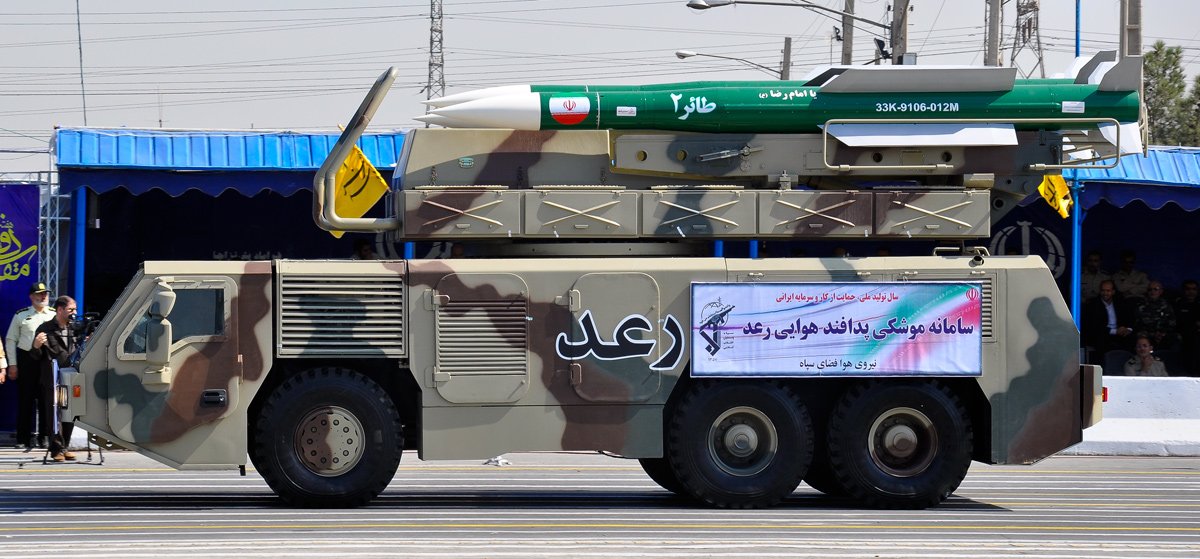
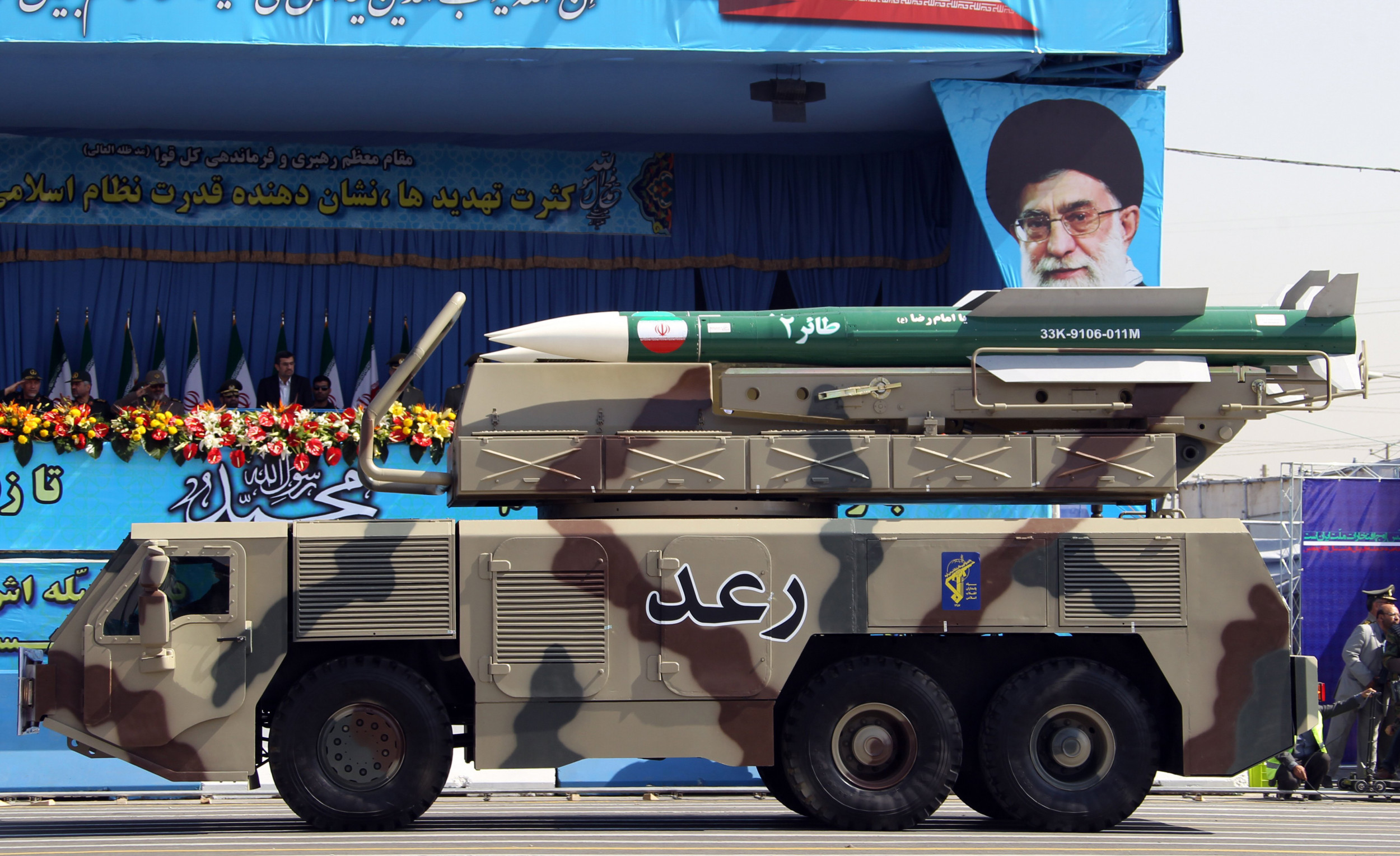
Ra'ad (Thunder- 1) Iranian Medium-Range Surface-to-Air Missile (SAM) System

Ra'ad, Thunder, Ra'd, Raad
Surface-to-Air Electronic Jamming System
Spotted an error? Sign in to suggest an edit.
Basic Information
Name
Ra'ad (Thunder- 1) Iranian Medium-Range Surface-to-Air Missile (SAM) System
Designation
Ra'ad, Thunder, Ra'd, Raad
Alternate Designation
Ra'ad, Thunder, Ra'd, Raad
Equipment Type
Surface-to-Air Electronic Jamming System
Manufacturer
Islamic Revolutionary Guard Corps
Date of Introduction
2012
Description

Raad or Ra'd (Persian: رعد‎, meaning "thunder") is an Iranian aerial defence system deployed in September 2012. The system is designed to enhance Iran's capabilities in terms of defense, and as a partner to Bavar 373 air defense system. According to Fars news agency the Raad is designed to confront fighter jets, cruise missiles, smart bombs, helicopters and drones. The system is also designed specially for US fighters. The system is equipped with "Taer" (Bird) missiles, which can trace and hit targets in ranges up to 50 km and in altitudes from 25 to 27 km (75,000 feet), Ra'd is ranked as a mid-range radar system and air defense system. The Raad 1 mounts a turret appearing to be identical to the Russian 2S1 122mm self propelled howitzer, but on the chassis of the Iranian Boragh APC, a variant of the Chinese WZ-501/503 series, themselves copies of the Russian BMP-1. The artillery piece used was either the standard Russian type 122mm howitzer, manufactured under the designation HM51L by the Armaments Industries Group of the Iranian Defense Industries Organization, or the improved HM51 howitzer. As of 2008 Iran was the sole operator of the system, maintaining a mixed force of upgraded 2S1 and Raad 1 self-propelled howitzers. Iran first announced the "Thunder"-1 type 122mm self-propelled howitzer developed by the Hadid Artillery Factory in early 2002. The chassis was under the responsibility of the Shahid Kladuz Industrial Complex (SKDIC) of the DIO. The combat system is partly handled by the Hadid Artillery Factory. The shape of the "Thunder"-1 self-propelled howitzer is very similar to that of the Soviet 2S1 "Dianzhu" 122mm self-propelled howitzer. Therefore, Iranian military personnel would refer to the 2S1 self-propelled howitzer when developing the gun. The "Thunder"-1 self-propelled howitzer adopts the layout commonly used by similar self-propelled artillery, that is, the cockpit and power cabin are arranged at the front of the vehicle body, the rear is a combat cabin, and the turret is mounted above the combat cabin. The gun features an all-welded steel structure with a maximum armor thickness of 17 mm to withstand light weapons and shell fragments. The chassis of the "Thunder"-1 self-propelled howitzer was improved from the chassis of the Iranian "Bolager" infantry fighting vehicle. The main change was that the body at the rear of the cockpit was raised. The "Thunder"-1 self-propelled howitzer is 6.65 meters long and 3.25 meters wide. It has 4 crew members and 17.5 tons of combat weight. The power unit is the air-cooled BF-8L513 four-stroke eight-cylinder turbocharged diesel engine from Germany Deutz. The maximum power is 231.5 kW. Manual transmission, 2 forward gears and 1 reverse gear, the suspension device is torsion bar type, there are 6 hanging rubber load wheels on each side of the vehicle, the driving wheel is in front, the induction wheel is behind, and there is a supporting pulley in the middle. The maximum speed is 65 km / h, the maximum off-road speed is 4 5 km / h, and the maximum stroke is 400 km. The chassis of the "Thunder"-1 self-propelled howitzer was improved from the chassis of the Iranian "BORAQ" infantry fighting vehicle. The Soviet 2S1 "Dianzhu" 122mm self-propelled howitzer and the Iranian "Thunder"-1 self-propelled howitzer are very similar in appearance, the biggest difference is the use of different chassis. The "Thunder"-1 self-propelled howitzer is equipped with a fully enclosed 3-person turret. The top of the turret is equipped with optical equipment for direct shooting and inter-shot shooting. The turret is equipped with a HM-51 type with a diameter of 122 mm and a diameter of 122 mm. Artillery (imitation of the Soviet 2A31 122mm howitzer), when the marching artillery is placed in the front of the truck body and locked by the fastener. The high-low range of the HM-51 gun is -3° to +72°, the muzzle velocity is 721 m/s, and the range is 15.2 km when the ZBK-13 propellant is used to launch the 122 mm high-explosive grenade. The life of the gun can reach 3000 rounds. The gun is equipped with an automatic loading machine with a maximum firing rate of 4-5 rounds. The gun can also be loaded when shooting at a large elevation angle. The shell carries 35 rounds. The types of shells include grenades, flares, and smoke bombs. The auxiliary weapon of the Thunder "-1 type self-propelled howitzer is a 12.7 mm high-altitude machine gun.

Ground Specifications
Crew 4
Mobility Type Wheeled (6x6)
Active Protection Thunderbolt Air Defense Systems
NBC Protection Yes
Max Speed 80.0 km/h
Range 50.0 km
Variants
3rd Khordad The 3rd Khordad is the most advanced version of the Ra'ad air defense system. It has the greatest reported range of any of the variants.
Tabas The Tabas is a transporter-erector-launcher radar variant of the Ra'ad fitted with a radar similar to the "Fire Dome" radar fitted to the Buk-M1. It can reportedly only engage a single target at a time, while providing guidance to two missiles.
Alam al Hoda The Alam al Hoda is a transporter-erector-launcher in the Ra'ad family. The TEL can carry three missiles.
System
Alternative Designation Ra'ad, Thunder, Ra'd, Raad
Type Surface-to-Air Missile (SAM) System
Family Ra'ad
Manufacturer IRGC aerospace force
In Service 2012-Present
Crew INA ea
Chassis MZKT-6922
Displacement Time INA minutes
Emplacement Time INA minutes
Fire on the Move No
Note #1 A battery contains 1 Transporter Erector Launcher and Radar (TELAR) and 2 Transporter Erector Launcher (TEL) vehicles. These are based on a heavily modified IVECO 6x6 commercial truck chassis. Though there was also a version based on a standard commercial truck chassis, sometimes referred as the Raad-2. Each vehicle carrier 3 missiles. So a single battery has 9 ready-to-fire missiles. A battalion has 4 batteries with 4 TELARs and 8 TELs and can engage multiple targets simultaneously.
Note #2 Each battalion additionally includes a Bashir S-band 3D phased array surveillance radar which has a detection range of 350 km. The battalion also has a command and control (C2) unit, based on IVECO truck chassis. The C2 unit provides communication between Raad batteries. Furthermore, the C2 unit can connect other air defense systems of the Raad family, including the improved Tabas and further improved Sevom Khordad, into a single air defense network. This allows to cover large area and targets can be engaged with a wide range of missiles from the cheapest Taer-1 missiles to the most capable Taer-2s. This adds the capability of facing different types of threats with different types of interceptors. In case of heavy jamming when even the X-band engagement radar can’t handle its duty, the C2 unit can provide an additional data link, connecting the system to electro-optical engagement systems of Raad batteries, in order to guide missiles toward targets.
Dimensions (Chassis: MZKT-6922)
Length 7.5 m
Width 3.3 m
Height 5.1 m
Weight, Combat INA kg
Ground Pressure INA kg/m
Automotive (Chassis: MZKT-6922)
Engine Name YaMZ-7513.10-02
Engine Type turbocharged 8-cylinder diesel
Engine Power 420 hp
Cruising Range 1,000 km
Speed, Maximum Road 80 km/h
Speed, Off-Road 30 km/h
Speed Maximum Swim Not Amphibious
Fording Depth INA m
Fuel Endurance 1,000 km
Communications
Primary INA
Missile System
Missile Launcher
Name INA
Type INA
Missile
Name Taer-2
Type Surface-to-Air Missile
Basic Load 3 ea
Engine Solid Fuel Rocket
Maximum Effective Range 50 km
Minimum Effective Range 1,000 m
Ceiling 25 km
Speed Mach 3.5
Fire Control
Fire Control System
Name INA
Computerized FCS Yes
Direct Fire No
Indirect Fire Yes
Fire Control Sensors Yes
IADS Integration INA
Camera Optics Range 80 km
Note Fire control radars for accurately determining the position of the target in the sky require high resolution and high resolution. Hence, due to the inherent error of several hundred to several hundred meters, the VHF / HF band radar detects positions in air defense sets of these radars only for The initial identification was used and the fire control task was delivered to radar in bands such as x. On the other hand, the range of these radars falls sharply against aircraft with low radar cross-sections.
Radar
Name Alam-Al-Hoodi Air Defense System
Type Long-range radar
Band VHF
Range INA
Number of Targets System can Track INA
Note #1 The Alam-Al-Hoodi Air Defense System utilizes a long-range radar in the VHF band (the ability of this frequency spectrum to detect radar cross-sectional targets is very low), as well as parts of the Thunderbolt air defense systems. Fire control radars for accurately determining the position of the target in the sky require high resolution and high resolution. Hence, due to the inherent error of several hundred to several hundred meters, the VHF / HF band radar detects positions in air defense sets of these radars only for The initial identification was used and the fire control task was delivered to radar in bands such as x. On the other hand, the range of these radars falls sharply against aircraft with low radar cross-sections. Previously, activities have been seen to use VHF radars for initial detection and transfer of data with lower frequency radars or other types of sensors to control fire and provide practical solutions to counteract the world's most secret targets. But according to information published at the IRGC Aerospace Force, the radar of Alam-al-Hoda (the main radar of the Al-Hoda Air Defense System) is engaged in the discovery, tracing, and directing of fire against targets, which, in view of the inherent problems of the frequency band, Determining the exact location of the goals is unprecedented. Therefore, Irans experts must find a way to overcome this problem. The radar consists of two main horizontal and vertical sections, which, with its large length of transport, can be folded onto a two-axle trailer, and its displacement capabilities are faster and faster. It should be noted that in general, fuzzy arrays have the ability to quickly scan the environment, have high stability against electronic warfare, and are able to detect and track a large number of targets. Obviously, as the next target of the Thunderbolt air defense systems is reaching the level of capabilities of systems such as the S-300, other components of this defense suite should also be developed within Iran. Therefore, it can be concluded that the Radar of Al-Hadi as an Iranian example is one of the important species of the Nebo radar, a radar explored as similar to the radars of Bashir and Ghadir and Aliam, each one with the ingenuity and ingenuity of young engineers. Specialists of the Iranian lines have found differences with similar or similar foreign samples forming a modern and integrated set of national air defense. While the provision of airborne radars and air defense complexes that are in full compliance with indigenous needs is today much more difficult than before, the internal construction of these radars and missiles required not only to meet the basic needs of defense. But on the way to cover more and more of all the necessary areas and, in the long run, will replace the existing systems with modern and native products.
Note #2 Each battalion additionally includes a Bashir S-band 3D phased array surveillance radar which has a detection range of 350 km. The battalion also has a command and control (C2) unit, based on IVECO truck chassis. The C2 unit provides communication between Raad batteries. Furthermore, the C2 unit can connect other air defense systems of the Raad family, including the improved Tabas and further improved Sevom Khordad, into a single air defense network. This allows to cover large area and targets can be engaged with a wide range of missiles from the cheapest Taer-1 missiles to the most capable Taer-2s. This adds the capability of facing different types of threats with different types of interceptors. In case of heavy jamming when even the X-band engagement radar can’t handle its duty, the C2 unit can provide an additional data link, connecting the system to electro-optical engagement systems of Raad batteries, in order to guide missiles toward targets.
Protection
Hull Armor No
Turret Armor No
Applique Armor No
Explosive Reactive Armor No
Active Protection System Thunderbolt Air Defense Systems
Mine Clearing No
Self-Entrenching Blade No
NBC Protection Yes
Smoke Equipment INA
Details
Country of Origin Iran
Category Radar Guided Missile Systems
Land > Air Defense > Radar Guided Missile Systems
Filter Label
R
Classification
Domain
Ground
Equipment Status
Active
Dimensions
Length
7.5 m
Width
3.3 m
Height
5.1 m
Weight
17500 kg
Operators (1)
Iran
Something went wrong. Please reload the page. Reload