M777A2 AUS Australian 155mm Towed Howitzer
M777A2 AUS
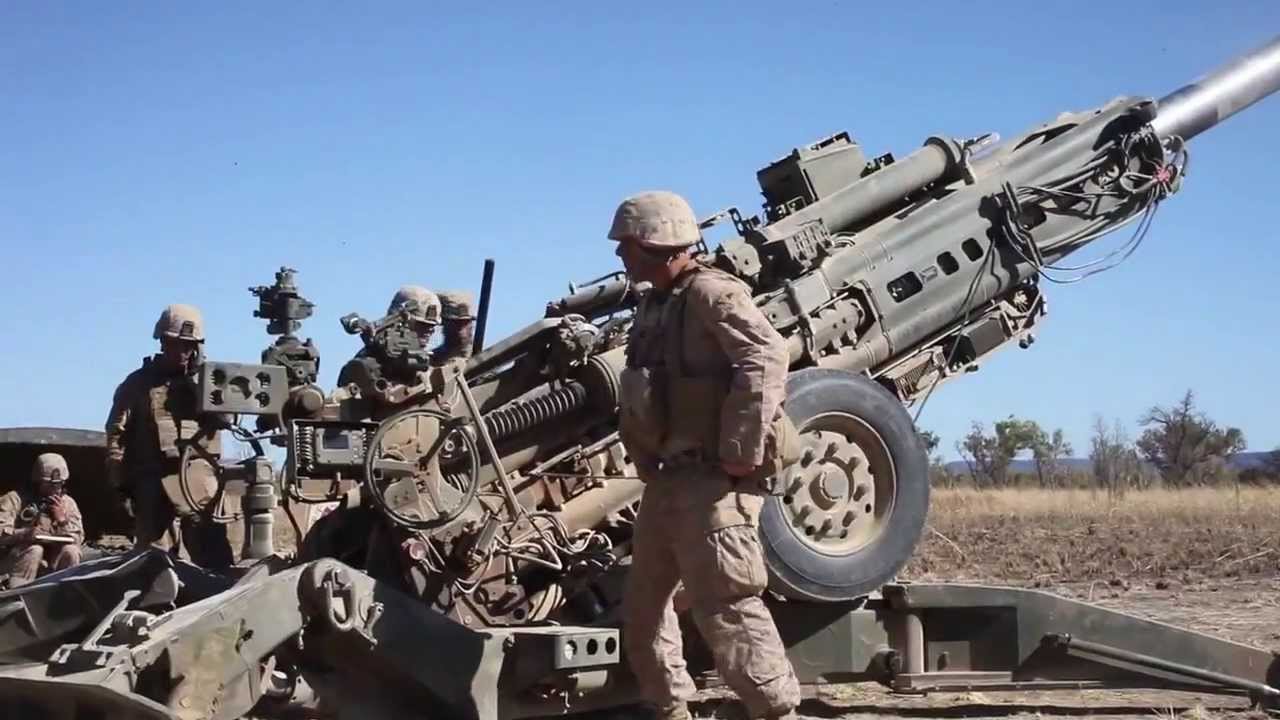
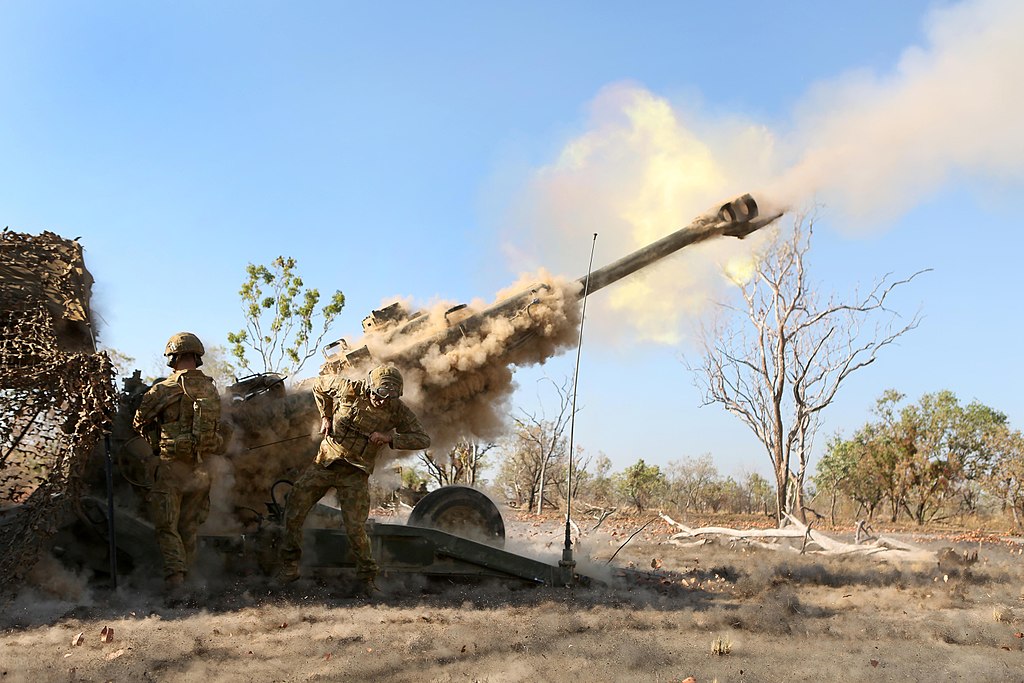
In 2008, the Australian Defence Force made a US Foreign Military Sales request for 57 M777A2s worth an estimated US$248m. Subsequently, 35 guns were purchased for the Australian Army to re-equip the 1st Regiment, Royal Australian Artillery, the 4th Regiment, Royal Australian Artillery and the 8th/12th Regiment, Royal Australian Artillery to replace 155 mm M198s and 105 mm L119 Hamels. The first deliveries of M777A2 began in late 2010. An additional 19 guns will be bought directly from American production lines to enable a total of six batteries. Concurrently, the Australian Army has acquired guided 155 mm munitions in the form of the M982 Excalibur and XM1156 Precision Guidance Kit. M777A2 – Block 1A software upgrade. Addition of an Enhanced Portable Inductive Artillery Fuze Setter (EPIAFS) to enable Excalibur and precision munition compatibility. The M777 howitzer is a towed 155 mm artillery piece. It succeeded the M198 howitzer in the United States Marine Corps and United States Army in 2005. The M777 is also used by the ground forces of Australia, Canada, India and Saudi Arabia. It made its combat debut in the War in Afghanistan. The M777 is manufactured by BAE Systems' Global Combat Systems division. Prime contract management is based in Barrow-in-Furness in the United Kingdom as well as manufacture and assembly of the titanium structures and associated recoil components. Final integration and testing of the weapon is undertaken at BAE's facility in Hattiesburg, Mississippi. The M777 began as the Ultralight Field Howitzer (UFH), developed by Vickers Shipbuilding and Engineering's (VSEL) Armaments Division in Barrow-in-Furness, United Kingdom. VSEL was bought by BAE Systems after the UFH prototypes had been manufactured and demonstrated, consequently BAE became responsible for future design refinements and re-named the gun 'M777'. Upon taking-over responsibility for the weapon BAE to a large degree 'Americanized' the construction and assembly through its US-based BAE Systems Land and Armaments group. The M777 now uses about 70% US-built parts including the gun barrel manufactured at the Watervliet Arsenal. With a weight of 4,200 kg (9,300 lb), the M777 is 41% lighter than the 7,154 kg (15,772 lb) M198 howitzer it replaces. Much of the weight reduction is due to the extensive use of titanium. The M777 can be transported by helicopter sling-load, transporter aircraft such as the C-130, or towed by air-braked vehicles weighing over 2.5 tonnes (2.8 short tons), such as the FMTV and MTVR. The minimal gun crew required is five, compared to a previous nine. The M777 uses a digital fire-control system similar to that found on self-propelled howitzers such as the M109A6 Palladin to provide navigation, pointing and self-location, allowing it to be put into action quickly. The Canadian M777 in conjunction with the traditional "glass and iron sights/mounts" also uses a digital fire control system called the Digital Gun Management System (DGMS) produced by Leonardo MW with components of the Indirect Fire Control Software Suite (IFCSS) built by the Firepower team in the Canadian Army Land Software Engineering Centre. The Leonardo MW portion of the system, known as LINAPS, had been proven previously through earlier fielding on the British Army Royal Artillery's L118 Light Gun The Digital Fire Control System will be powered by a unique new design of rotary hybrid-electric engine designed and manufactured by Liquid Piston. The M777 may be combined with the M982 Excalibur GPS-guided munition, which allows accurate fire at a range of up to 40 km (25 mi). This almost doubles the area covered by a single battery to about 1,250 km2 (480 sq mi). Testing at the Yuma Proving Ground by the US Army placed 13 of 14 Excalibur rounds, fired from up to 24 kilometres (15 mi), within 10 m (33 ft) of their target, suggesting a circular error probable of 5 m (16 ft). In June 2012, Golf Battery, 2nd Battalion, 11th Marines, out of Camp Pendleton, California, dropped the M982 Excalibur round on insurgents at a range of 36 km (22 mi) in Helmand Province, Afghanistan. This marked the longest operational shot in the history of the M777 howitzer, and the longest operational tube artillery shot in history for the Marine Corps. In 2014 the US military began fielding several upgrades to its M777 howitzers including new liquid crystal display units, software updates, improved power systems, and muzzle sensors for onboard ballistic computing. Future upgrades include a touchscreen Chief Section Display, a new Mission System Computer, and a digital radio. In May 2017, the US Army revealed it was buying the Swedish BONUS round as an interim system as a result of the required phasing out of cluster munitions from artillery shells, complying with policy to achieve less than 1% unexploded ordnance from non-unitary explosives; the BONUS has two sensor-fused munitions deployed by a 155 mm carrier projectile that scan the ground for targets and fire explosively formed penetrators down from the air. The system has been tested from the M777 howitzer.