Type 052B Class (Luyang I Class) Chinese Destroyer
Type 052B Class
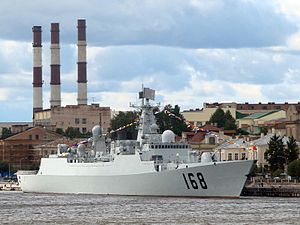
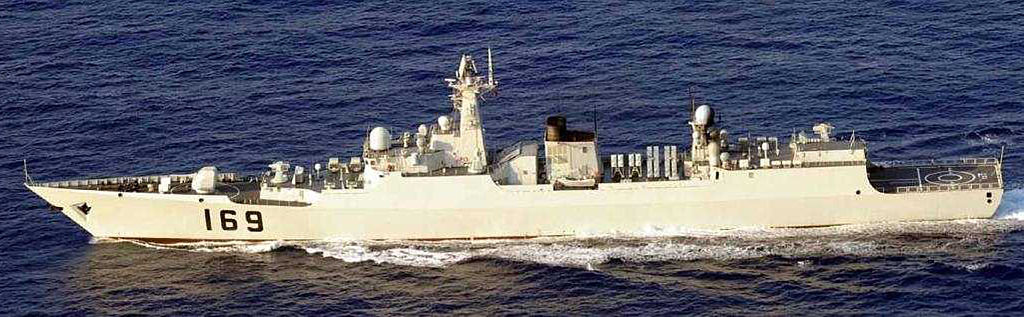
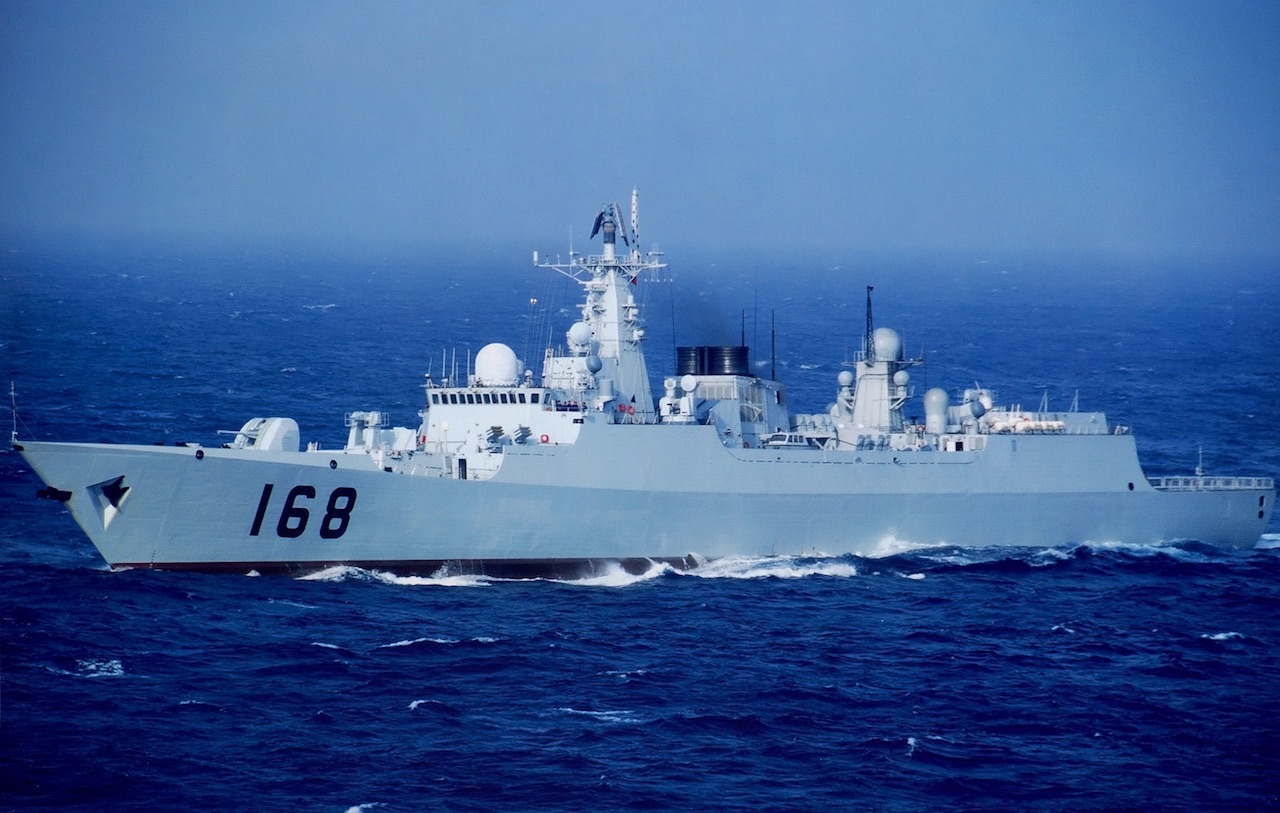
Type 052B Luyang-class Multirole Destroyer Guangzhou Although the PLAN had claimed that Shenzhen was the first indigenously-produced warship to be designed with stealth as a primary design feature, measures to further reduce radar signature from the hull and superstructure are far more pronounced in this second unit of the class. The large smooth and angled surfaces, a common feature among the new generaton of European FFGs such as French La Fayette class, represent a considerable innovation for China. The PLA Navy received two Type 052B (NATO codename: Luyang class) multirole missile destroyer in 2004. These ships, built by Shanghai-based Jiangnan Shipyard, featured enhanced air defence and antisubmarine warfare capabilities using a mixture of Russian-made and Chinese indigenous systems. Building of the first-of-class ship, 168 Guangzhou, began in 2000. The ship was launched on 23 May 2002, and had been stationed at Jiangnan Shipyard sine then for weapon and radar system installations. The sea trial began in May 2003, and the ship officially entered service with the PLA Navy on 15 July 2004. The second hull 169 Wuhan was launched in January 2003 and commissioned in late 2004. Unlike the previous Chinese-built surface combatants, which were mainly equipped with European and indigenous weapon and radar systems, the Type 052B was the first to have adopted Russian technologies including the 9M317 Shtil (NATO codename: SA-N-12 Grizzly) air defence missile and its associated Front Dome fire-control radar, and the Top Plate 3D air search radar. The ship also used two Ukraine-made DA80/DN80 gas turbines as its primary propulsion. Newly developed indigenous technologies onboard the Type 052B included the 100mm single-barrel compact main gun and the Type 730 seven-barrelled close-in defence system (CIWS). The Type 052B is thought to be comparable to the Russian Project 956E Sovremenny class destroyer in terms of general performance and capability. This project has set a perfect example of integrating the indigenous platform with foreign-made systems to fill the gap before similar indigenous systems become available, thus reducing the amount of time required in the whole project. The acquiring of the two Type 052B destroyers further increased the PLA Navy’s capability to combat in deep ocean. It also demonstrates China’s rapid progress in building a ‘blue water’ navy that is capable of operating far away from its homeports, a capability that the Chinese navy has been seeking for nearly two decades. The displacement of the ship is estimated to be 6,500 tonnes. The ship’s hull design incorporates strong radar signature reduction features such as the sloped sides and reduced external features. The hull surface is coated in radar-absorbent paint. The funnel also has cooling devices to reduce the ship’s infrared feature. The ships has a stern flight deck and a helicopter hanger to accommodate one Ka-28 ASW helicopter. The Type 052B destroyer is armed with two Russian-made surface-to-air missile launchers, one on the front deck behind the 100mm main gun, and one on top of the helicopter hanger. The launchers can fire the latest 9M317 Shtil (NATO codename: SA-N-12 Grizzly) semi-active, radar-homing, medium-range air defence missile. The missile uses the ship’s Russian-made Fregat M2EM Top Plate 3D circular scan radar for target acquisition, and the Front Dome (two radar for each launcher, each radar with two guidance channels) indication radar for missile guidance. Up to three missiles can be aimed simultaneously. The range is up to 38km against aircraft and 20km against anti-ship cruise missile. The ship carries 48 missiles. Four 4-cell launcher for the YJ-83 (C-803) sea-skimming, radar-homing anti-ship cruise missile system are installed behind the funnel. The YJ-83 is said to have a final approach speed of Mach 1.5 and a maximum range of 150km. It was noted that the YJ-83 onboard the Type 052B relies on a Russian-made Band Stand fire-control radar to provide target information, which would enable the YJ-83 to reach its maximum range of fire without relaying target information by the shipborne helicopter. The Type 052B destroyer was the first PLA Navy warship to be fitted with the CIWS. There is a seven-barrel 30mm Type 730 CIWS installed on each side of the bridge. The weapon system has a maximum rate of fire of 4,600~5,800 rounds/min. The ship also has a single-barrel 100mm gun developed by 713 Institute on the basis of the French Creusot-Loire T100C design. The gun can be used against surface targets and air targets such as aircraft and low speed missile, with a maximum rate of fire of 90 rounds/min. The gun can be operated in fully automatic mode from the radar control system, from the shipborne optical sighting system, or laid manually. The turret design incorporates strong radar cross-section reduction features. The Type 052B destroyer is fitted with two triple 324mm Yu-7 (Mk-46 Mod 1) antisubmarine torpedo tubes and two Type 75 twelve-barrel 240mm antisubmarine rocket launchers. Range is up to 1,200m. The rocket is armed with a 34kg warhead. Additionally, the destroyer has four 18-barrel multiple rocket launchers (MRLs) installed on the front deck. The purpose of these MRLs remains unknown but is thought to be used to launch antisubmarine rockets, ground- attack rockets and/or decoys/chaffs. The air search radar is a Russian Fregat M2EM (NATO codename: Top Plate) 3D air search radar operating at D/E band. The radar has a maximum detect range of 230km to aircraft and 50km to sea-skimming missile. There are four (in contrast to six on Sovremenny class) Russian Front Dome fire control radar (F band) for the 9M38 air defence missile. The main gun and anti-ship missile are controlled by the Russian Band Stand radar. The ZJK-5 combat system onboard the Type 052B is thought to be an improved variant of the Type 051B (Luhai class)’s ZJK-4-3A. The ZJK-5 is based on the 1553B military data bus and the 100Mbps Ethernet technology. The multi-channel defence suite is capable of engaging several targets simultaneously. The destroyer’s stern hanger accommodates one Kamov Ka-28 (NATO codename: Helix) antisubmarine warfare (ASW) helicopter. Carrying various weapons including torpedoes and deep charges, the helicopter can operate in all weather conditions up to 200km from the host ship. Alternatively, the destroyer can carry an indigenous Z-9C helicopter. The Type 052B’s propulsion is in the form of CODOG, consisting of two Ukraine-made DA80/DN80 gas turbines rated at 48,600hp and two Shaanxi diesels (Chinese copy of the MTU 20V956TB92) rated at 8,840hp (6.5 MW). The unit [hull number 168, initially thought to possibly be named Yantai, but actually named Guangzhou], started building in 1999, with initially completion expected in 2001. By mid-2002 it appeared that this unit was fitting out, and was evidently constructed along modified lines to reduce radar signature. Initially it was expected that the second unit of this class would enter service in 2000, with two more following with commissioning dates in 2002 and 2003. Since 1999, only two hulls had been constructed at Jiangnan Shipyard in Shanghai, with the first ship [168] launched on 25 May 2002. The second ship [169] was launched in October 2002. By April 2003 it became apparent that the ships would carry new Russian weapons -- the effective SA-N-12 anti-aircraft missile plus a long-range Russian search radar, and another radar similar to the Russian BAND STAND over-the-horizon targeting radar. The latter indicated that a new, long range anti-ship missile will be carried. These ships are basically comparable to Taiwan's new U.S. KIDD class destroyers in size and capability, but much more stealthy. In June 2005 it was reported that two Luyang I destroyers were operational or undergoing sea trials. The destroyer "Guangzhou" (Hull Number 168) of the PLA Navy set sail for the sea waters off Pakistan on 21 February 2009 from Sanya City of Hainan Province to participate in the "Peace 09" multinational maritime military exercise. The multinational maritime military exercise was initiated by the Pakistani Navy. Navies from 11 countries, including China, the US, the UK, France, Japan and Turkey, sent their ships, aircraft and Marine Corps elements to participate in the exercise. And military observers from 20-odd countries, including Russia, Germany, Australia, Egypt and Indonesia viewed the exercise. The Chinese Navy sent a task force composed of the destroyer "Guangzhou" from the South China Sea Fleet (SCSF), a helicopter and 10 members of the Marine Corps to participate in this "Peace 09" exercise. Military officials and soldiers of Chinese navy's missile destroyer DDG-168 Guangzhou attended a sail setting ceremony in Sanya, south China's Hainan Province, on March 4, 2010. A new Chinese naval task force set sail on Thursday morning from a military port in the south Hainan Island to replace the fourth batch of flotilla in the Gulf of Aden escorting merchant vessels. Chinese navy's missile destroyer DDG-168 Guangzhou arrived in Guangzhou in south China's Guangdong province, December 26, 2012 and took part in an activity marking the 4th anniversary of the start of China's escorting missions in the Gulf of Aden. The ship was open to the public during its stay in the city. China's Defense Ministry defended a regular training and sailing mission by Chinese ships in the East China Sea. The statement on 26 October 2012 was in response to Japanese reports that three Chinese maritime surveillance ships entered the waters around the Diaoyu Islands. The Ministry added that the mission of China's ships was justified and legal. China hopes related parties will treat the issue objectively and rationally. The three surveillance ships belong to the South China Sea Fleet. They were the 168 Guangzhou guided missile destroyer, the 171 Haikou guided missile destroyer and the missile frigate 571 Yuncheng. Japan's Coast Guard spotted three Chinese maritime ships in waters 471 kilometers off the island of Okinawa. Japan said it would conduct a thorough investigation. A total of seven Chinese vessels registered under China's three People's Liberation Army Navy fleets (South Sea, East Sea and North Sea) sail near Japanese islands before returning to their bases on Oct. 28 and 29. The Type 052B (Guangzhou, 168 ) Destroyer and the Type 054A (Hunagshan, 570) Frigate, both from the South Sea Fleet, are followed by a Japanese destroyer when they sail through the waters at some 600 kilometers from Okinawa.