ARMSNET
Military Equipment Database
Initializing 0%

Admiral Grigorovich Class (Project 11356 Class) Russian Frigate

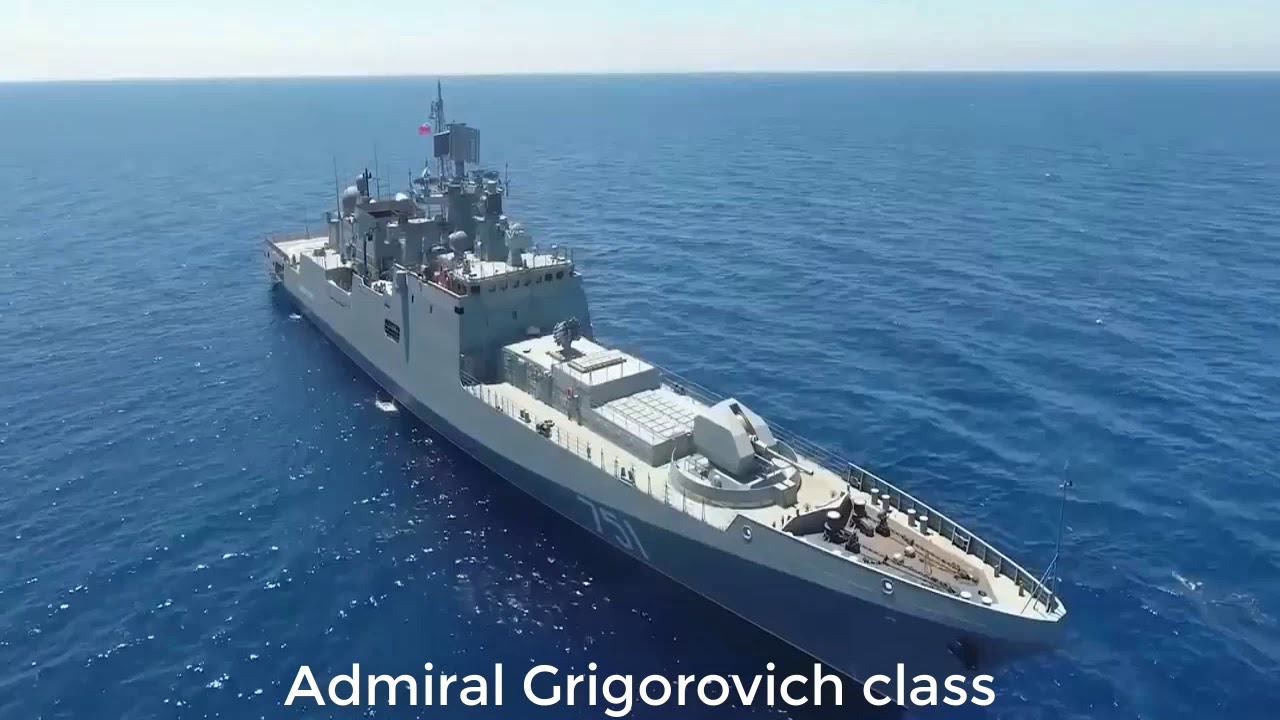
Frigate
Spotted an error? Sign in to suggest an edit.
Basic Information
Name
Admiral Grigorovich Class (Project 11356 Class) Russian Frigate
Designation
Alternate Designation
Equipment Type
Frigate
Manufacturer
Yantar Shipyard
Date of Introduction
2015
Description

Admiral Grigorovich Class (Project 11356 Class) Russian Frigate is a class of frigates built by the Yantar Shipyard in Kaliningrad for the Russian Navy. Based on the Talwar class, six ships were ordered for the Russian Black Sea Fleet under two contracts in 2010 and 2011 as a complement to the Admiral Gorshkov class frigates. By 2010-2011, it was decided the Russian Navy will procure six vessels based on the proven Talwar class design, mainly due to repeated delays with the production of Admiral Gorshkov frigates and because of the urgent need for new frigates necessary for the modernization of the Black Sea Fleet. The Yantar Shipyard won the contract for the construction of the frigates and three vessels were to be completed in four years. Previously, six ships of the same design, known as Talwar class, were built for the Indian Navy between 1999 and 2011 by the Baltic Shipyard, Saint Petersburg, and Yantar Shipyard, Kaliningrad. The lead ship, Admiral Grigorovich, was laid down on 18 December 2010 and was commissioned on 11 March 2016. Initially, Ukrainian state-owned enterprise Zorya-Mashproekt was providing gas turbines for the Russian frigates, but after the Ukrainian crisis, Ukraine said it would no longer supply the engines. Instead, Russian manufacturer, Saturn was asked to supply alternative M90FR gas turbines. Since October 2016, it was claimed the three incomplete frigates, Admiral Butakov, Admiral Istomin, and Admiral Kornilov, that construction was suspended in 2015 due to Ukraine's refusal to supply gas turbine power plants, are considered to be sold to India. The Russian Navy has opposed this export. On 1 June 2017, the United Shipbuilding Corporation (USC) announced that it would resume construction of the last three frigates in 2018 and that the ships will later join the Russian Navy. The decision to resume the work was made following the preliminary testing of the latest Russian gas turbine engines, the M70FRU (14 MW), M70FRU2 (6-8 MW), and M90FR (20 MW , maximal 25-28 MW), from the United Engine Corporation, built at NPO Saturn and TurboRus plants. With access to alternative power plants, the ships were believed to remain in Russian service. However, on 27 October 2018, India's Ministry of Defence and Russia signed a US$950 million deal for the delivery of two incomplete Admiral Grigorovich-class frigates to the Indian Navy. Reportedly, these are to be Admiral Butakov and Admiral Istomin frigates, previously being built for the Russian Navy. As of February 2019, the last three vessels remain without engines. On 3 November 2016, as part of Russian military intervention in the Syrian Civil War, Admiral Grigorivich was deployed to the Mediterranean Sea for the first time. On 15 November 2016, it has launched a Kalibr cruise missile on IS and Al-Nusra targets in Syria's Idlib and Homs provinces, destroying ammunition warehouses, gathering and training centers, and weapon production plants. Admiral Grigorivich was redeployed to the Mediterranean Sea in April 2017, following the US missile strikes against Syria. On 20 November 2018, Rosoboronexport and Goa Shipyard signed a US$500 million deal for the construction of additional two Admiral Grigorovich-class frigates for the Indian Navy. The frigates are to be licensed-built at the Goa Shipyard in India under a technology transfer from Russia. The construction is expected to start in 2020, with the first vessel to be delivered in 2026 and the second in 2027.
Naval & Littoral Specifications
Crew 200
Beam 15.20 m
Draft 4.20 m
Max Speed 30.0 knots
Variants
Admiral Grigorovich Commissioned: 2016 Status: Active Fleet: Black Sea Fleet
Admiral Essen Commissioned: 2016 Status: Active Fleet: Black Sea Fleet
Admiral Makarov Commissioned: 2017 Status: Active Fleet: Black Sea Fleet
Admiral Kornilov Commissioned: 2020 Status: Under construction Fleet: INA
ex-Admiral Butakov Commissioned: 2022 Status: Under construction Fleet: India's Fleet
ex-Admiral Istomin Commissioned: 2022 Status: Under construction Fleet: India's Fleet
System
Alternative designations Admiral Grigorovich Class; Project 11356P/M Class; Krivak IV
Type Frigate
Total Built 6 ships scheduled to be built.
Builder Yantar Shipyard, Kaliningrad Goa Shipyard
Crew 200 ea
Aircraft Carried 1 × Ka-27 series helicopter
Aviation Facilities Helipad and hangar for one helicopter
Note The Admiral Grigorovich class also referred to as Krivak IV class, Russian designation Project 11356Р/М, is a class of frigates built by the Yantar Shipyard in Kaliningrad for the Russian Navy. Based on the Talwar class, six ships were ordered for the Russian Black Sea Fleet under two contracts in 2010 and 2011 as a complement to the Admiral Gorshkov class frigates.
Dimensions
Length 124.8 m
Beam 15.2 m
Draft 4.2 m
Displacement, Standard 3,620 tons
Displacement, Fully Loaded 4,000 tons
Automotive
Propulsion 2 shaft COGAG; 2 DS-71 cruise gas turbines 8,450 shp (6,300 kW); 2 DT-59 boost gas turbines 22,000 shp (16,000 kW) ; Total: 60,900 shp (45,400 kW) or 2x M90FR FRU 20 (25/28) MW boost , 2x cruise M70FRU 14 MW , M70FRU2 8 MW total=56–68 MW
Maximum Speed 30 kn (56 km/h; 35 mph)
Maximum Range 4,850 nmi (8,980 km; 5,580 mi) at 14 kn (26 km/h; 16 mph).
Endurance 30 days
Armament
Weapon Station #1
Name 1 x AK-100 100mm Naval Cannon
Type Naval Cannon
Caliber 100 mm
Barrel Length INA
Weight 35.5 tons
Recoil 51 cm
Maximum Elevation +85 deg
Minimum Elevation -10 deg
Rate of Elevation 30 degrees per second
Traverse Range 360 deg
Traverse Left 180 deg
Traverse Right 180 deg
Traverse Rate 35 degrees per second
Rate of Fire 50 to 60 rounds per minute
Ammunition Weapon Station #1
Shell INA
Caliber 100 mm
Shell Weight 26.8 kg
Type HE anti-air or HE fragmentation varieties.
Basic Load Typical ammo stowage: 350 rounds for a 4,000 ton class frigate.
Weapon Station #2
Name 8 x SS-N-27 Sizzler Anti-Ship Cruise Missile
Type Anti-Ship Cruise Missile
Proliferation Widely Proliferated Russia: Russian Navy uses the 3M14, 3M54, 3M54-1, 91R1, 91RT2. Submarine launched variants (entered service in 2016) are used by Kilo-class submarine, Lada-class submarine, Akula-class submarine, Oscar II-class submarine and the Yasen-class submarine. Surface ship launched variants are used by the Gremyashchy class, Karakurt class, Buyan-M class corvettes, Gepard class, Admiral Gorshkov class and the Admiral Grigorovich class frigates. Algeria: The Algerian National Navy uses the 'Club-S' variant for their Kilo class submarines. India: The Indian Navy uses both 'Club-S' and 'Club-N' variants for the Kilo class submarines (known as the Sindhughosh Class in Indian service), the Talwar class frigates respectively. Vietnam: The Vietnam People's navy uses the 'Club-S' variant for its six Kilo class submarines. China: The People's Liberation Army Navy uses the 'Club-S' variant for its Kilo class submarines. Iran: Contradictory sources indicate that the Iranian Navy is thought to have purchased or is about to purchase 'Club-S' missiles for its three Kilo class submarines.
Manufacturer Novator Design Bureau, KTRV, MKB Fakel, NPO Mash, Raduga, NPO Zvezda Strela (Orenburg)
In Service 1990-Present
Length Varies on variant, from 6.2 m to 8.9 m.
Diameter 0.533 m
Warhead 400-500 kg HE or thermonuclear.
Weight Varies on variant, from 1,300 kg-1780 kg-2300 kg.
Engine Multi-stage solid-fuel rocket, turbojet engine for 3M-54/E/TE/E1/TE1, -14/E/TE, solid fuel rocket for 91RE1/RTE2
Operational Range 50 km
Flight Ceiling 1,000 m
Flight Altitude 50-150 m AGL; 20 m over water
Speed 0.8-2.5-2.9 Mach
Guidance System Inertial guidance plus terminal Active radar homing, By satellites, DSMAC.
Accuracy 3 m (Club-S/Kalibr-PL)
Weapon Station #3
Name 2 x Kashtan CIWS
Type Close-in weapon system (CIWS) is a modern naval air defence gun-missile system deployed by the Russian Navy
Caliber 30 mm
Barrel Length INA
Main Armament 8 × 9M311K + 32 missiles
Secondary Armament 2 × AO-18K autocannon
Barrels 2 × 6 (guns); 2 × 4 launch tubes
Height 2,250 mm (above deck)
Weight 15,500 kg
Action Gas-operated rotary cannon
Rate of Fire 9,000 rounds/min; 1–2 (salvo) missiles per 3–4 sec.
Muzzle Velocity 860 m/s
Effective Firing Range By missiles: Kashtan: 1,500–8,000 m.
Feed System Link-less, helical; 1000 rounds
Sights Radar / TV-optical
Warhead Continuous-rod w/ frag layer
Note The weapon is a modular system consisting of a command module and typically two combat modules, as in the case of the two Sovremennyy-class destroyers Taizhou (ex-Vnushitelnyy) and Ningbo (ex-Vechnyy) in Chinese service, although the number can be as many as 8 in the case of Admiral Kuznetsov. The command module detects and tracks threats, distributes targeting data to the combat modules, and interrogates IFF of approaching threats. The command module has a 3-D target detection radar, and an all weather multi-band integrated control system. Depending on the number of installed combat modules, the system can engage multiple targets simultaneously. The combat modules automatically track using either radar, electro-optronic control system (such as FLIRs) or both, and then engages targets with missiles and guns. The combat modules are typically equipped with two GSh-30K (AO-18K) six-barrel 30 mm rotary cannons, fed by a link-less feeding mechanism, and two 9M311-1 missile launchers equipped with 4 ready-to-fire missiles each and fed by a reloading system storing 32 missiles in ready-to-launch containers. The guns used in the Kortik are the GSh-30K six-barrel 30 mm rotary cannon. Individually, each GSh-30K has a higher rate of fire compared to other guns used by other CIWS such as the GAU-8 on the Goalkeeper and the M61 Vulcan on the Phalanx. Along with a high rate of fire, the fairly heavy round (390 g or 14 oz) used by the Kortik is comparable to the DPU rounds of the GAU-8 Avenger (425 g or 15.0 oz), although the muzzle velocity (and therefore both the kinetic energy and effective range) is slightly lower, partially offsetting the high caliber and rate of fire. The missiles used in the Kortik are the 9M311 missiles, which is also used on the 9K22 Tunguska. The 9M311 is a SACLOS guided missile, however, it is steered automatically by the command module. The warhead weighs 9 kilograms (20 lb) and is either laser or radio fused. The warhead is a continuous-rod warhead with a steel cube fragmentation layer. The detonation of the warhead will form a complete circle of fragmentation that is 5 meters in radius, and damage or destroy anything in that circle. The combination of the missiles and guns, provides more comprehensive protection when compared to other CIWS utilising either missiles or guns only. The system's combined kill probability is 0.96 to 0.99
Flight Altitude 3,500 m
Ammunition Weapon Station #3
Shell HEI-Frag, Frag-T, APDS-T
Caliber 30 mm
Shell Weight 0.39 kg (HEIF, FT); 0.30 kg (APDS-T)
Basic Load INA
Weapon Station #4
Name 1 x RBU-6000 Smerch-2 Anti-Submarine Rocket
Type Anti-Submarine Rocket
Caliber 213 mm
Launcher Length 2 m
Launcher Width 1.75 m
Launcher Height 2.25 m
Launcher Weight 3,100 kg (empty)
Maximum Elevation +65 deg
Minimum Elevation -15 deg
Traverse Range 180 deg
Traverse Left 90 deg
Traverse Right 90 deg
Basic Load INA
Rocket Weapon Station #5
Name RGB-60
Type Ballistic Anti-Submarine Rocket
Length 1.83 m
Diameter 0.212 m
Warhead Weight 23 kg
Weight 113.5 kg
Range Ballistic 1 - 350 m to 1700 m, Ballistic 2 - 1500 m to 5500 m
Depth 10 to 500 m
Sink Rate 11.6 m/s
Weapon Station #6
Name DTA-52
Type Twin 533mm fixed Torpedo Launchers
Quantity 2
Torpedo Basic Load INA
Maximum Effective Range On Average, The torpedo has an effective launch range of 7km and cruising range of 10km.
Note There is no information on the type of torpedoes used onboard this vessel.
Radars
Air and Search Radar 1 x Fregat M2M radar
Surface Search Radar 1 x 3Ts-25 Garpun-B, 1 x MR-212/201-1, and 1 Nucleus-2 6000A Radars.
Fire Control Radar 1 x JSC 5P-10 Puma FCS, 1 x 3R14N-11356 FCS, and 1 x MR-90 Orekh SAM FCS.
Protection
EW Suite 1 x TK-25-5 EW Suite
Air Defense System 1 x Shtil air defense system
Countermeasures 4 × KT-216
Sonar #1 1 x Humsa bow-mounted
Sonar #2 1 x SNN-137 towed-active array
Details
Country of Origin Russia
Category Naval
Naval
Filter Label
A
Classification
Domain
Naval & Littoral
Equipment Status
Active
Dimensions
Length
124.8 m
Width
15.2 m
Height
Weight
3620000 kg
Operators (2)
Russia
India
Something went wrong. Please reload the page. Reload