ARMSNET
Military Equipment Database
Initializing 0%

T-50 Golden Eagle South Korean Lead-In Fighter Trainer (LIFT) Aircraft

T-50
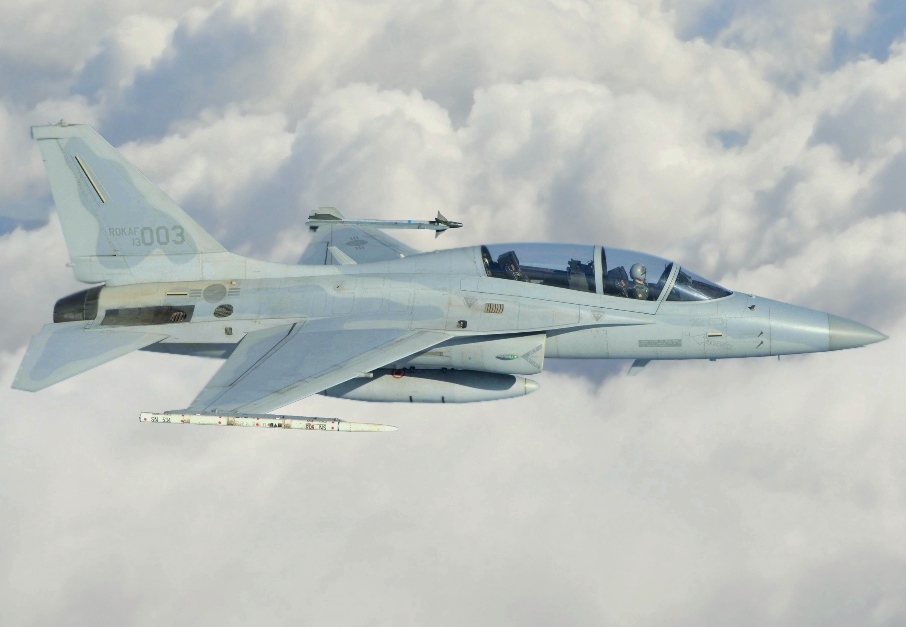
Light Combat Aircraft/ Trainer
Spotted an error? Sign in to suggest an edit.
Basic Information
Name
T-50 Golden Eagle South Korean Lead-In Fighter Trainer (LIFT) Aircraft
Designation
T-50
Alternate Designation
Equipment Type
Light Combat Aircraft/ Trainer
Manufacturer
Korea Aerospace Industries / Lockheed Martin
Date of Introduction
2005
Description

The KAI T-50 Golden Eagle (골든이글) is a family of South Korean supersonic advanced trainers and light combat aircraft, developed by Korea Aerospace Industries (KAI) with Lockheed Martin. The T-50 is South Korea's first indigenous supersonic aircraft and one of the world's few supersonic trainers. Development began in the late 1990s, and its maiden flight occurred in 2002. The aircraft entered active service with the Republic of Korea Air Force (ROKAF) in 2005. The T-50 has been further developed into aerobatic and combat variants, namely T-50B, TA-50, and FA-50. The F-50 single-seat multirole fighter variant was considered. The T-50B serves with the South Korean air force's aerobatics team. The TA-50 light attack variant has been ordered by Indonesia. The Philippines ordered 12 units of the FA-50 variant. The T-50A was marketed as a candidate for the United States Air Force's next-generation T-X trainer program but failed to win. Thailand ordered 12 units of the T-50 advanced trainer variant. The T-50 Golden Eagle design is largely derived from the F-16 Fighting Falcon, and they have some similarities. KAI's previous engineering experience in license-producing the KF-16 was a starting point for T-50 development. The trainer has seating for two pilots in a tandem arrangement. The high-mounted canopy developed by Hankuk Fiber is applied with stretched acrylic, providing the pilot's good visibility. The trainer has been tested to offer the canopy with ballistic protection against 4-lb objects impacting at 400 knots. The altitude limit is 14,600 meters (48,000 ft), and the airframe is designed to last 8,000 hours of service. There are seven internal fuel tanks with a capacity of 2,655 liters (701 US gal), five in the fuselage and two in the wings. An additional 1,710 liters (452 US gal) of fuel can be carried in the three external fuel tanks. T-50 trainer variants have a paint scheme of white and red, and aerobatic variants are white, black, and yellow. The T-50 uses a single General Electric F404-102 turbofan engine license-produced by Samsung Techwin, upgraded with a FADEC system jointly developed by General Electric and KAI. The engine consists of three-staged fans, seven axial stage arrangements, and an afterburner. The aircraft has a maximum speed of Mach 1.5. Its engine produces a maximum of 78.7 kN (17,700 lbs) of thrust with an afterburner. The more powerful F414 and EJ200 engines have been suggested as the new engine for the T-50 family

Air & Air Defense Specifications
Crew 2
Engine Turbofan (5409 hp)
Max Speed 1.4 km/h
Range 1853.0 km
Variants
T-50 Advanced trainer version.
T-50i Version of the T-50 for Indonesian Air Force.
T-50TH Version of the T-50 for Royal Thai Air Force.[
T-50A Failed candidate for the US Air Force T-X program, based on the FA-50.
T-50B Aerobatic specialized T-50 version for Korea Air Force's aerobatic display team, the Black Eagles.
TA-50 Lead-in fighter trainer and light attack version.
FA-50 Light attack/fighter version, originally named A-50. A prototype from a converted T-50 first flew in 2011.
FA-50PH Version of the FA-50 for the Philippine Air Force.
T-50IQ Version of the FA-50 for Iraqi Air Force.
F-50 A single seat multirole fighter variant that was considered, but was cancelled in favor of the KF-X.
System
Alternate Designation(s) T-50 Golden Eagle
Type Lead-In Fighter Trainer (LIFT) Aircraft
Manufacturer Korea Aerospace Industries / Lockheed Martin
Crew 2 ea
Number of Engines 1 ea
Number of Hard Points Total of 7 with 4 underwing 2 wingtip and one under fuselage; holding up to 3,740 kg of payload.
Dimensions
Length 12.98 m
Width (Wing Span) 9.11 m
Height 4.78 m
Empty Weight 6,441 kg
Takeoff Weight, Clean 8,890 kg
Maximum Takeoff Weight 13,470 kg
Maximum External Stores 3,100 kg
Automotive
Engine Name 1 x General Electric F404-GE-102
Engine Type Turbofan
Engine Power 5,409 kg, 53.07 kN static thrust
Fuel Capacity 2,655 liters
Maximum Speed Mach 1.4
Range 1,853 km
Climb Rate 137 m/sec
Ceiling 14,630 m
Load 8 g to -3 g
Main Gun System
System
Name M61 Vulcan
Type Rotary Cannon
Caliber 20 mm
Length 1.827 m
Weight 112 kg
Barrels 6-barrel (progressive RH parabolic twist, 9 grooves)
Action Hydraulically operated, electrically fired, rotary cannon
Rate of Fire 6,000 rounds per minute
Muzzle Velocity 1,050 m/s
Feed System Belt or linkless feed system
Ammunition
Type Rifle
Caliber 20 mm
Cartridge 20×102 mm
Basic Load 205 Rounds
Missile Systems
Wingtip Pylon AIM-9 Sidewinder
Undertip/Centerline Mk 82/83/84 bombs or rocket launchers
Bomb Weapon Systems
Option 1 Mk 82
Option 2 Mk 83
Option 3 CBU-97/105 Sensor Fuzed Weapon
Option 4 Spice-equipped bombs
Option 5 Joint Direct Attack Munition (JDAM) bombs
Fire Control / Avionics
Navigation Radar Honeywell H-764G global positioning/inertial navigation system; HG9550 radar altimeter; Rockwell Collins VIR-130A integrated VOR/instrument landing system; ARN-153V advanced digital tactical aid.
Fire Control Radar 1 x AN/APG-67(V)4
Communications Raytheon ARC-232 VHF radio
Protection
Stealth Properties None
Heat Signature Reduction No
Add on Armor INA
NBC Protection INA
EW Counter Measures INA
Chaffs/Flares Yes
Details
Country of Origin South Korea
Category Trainers
Air > Trainers
Filter Label
T
Classification
Domain
Air & Air Defense
Equipment Status
Active
Dimensions
Length
12.98 m
Width
9.11 m
Height
4.78 m
Weight
13470 kg
Operators (5)
South Korea
Indonesia
Iraq
Philippines
Thailand
Something went wrong. Please reload the page. Reload