BREM-D Russian Armored Maintenance-Recovery Vehicle
BREM-D
Armored Recovery Vehicle
Spotted an error? Sign in to suggest an edit.
Other
Basic Information
Name
BREM-D Russian Armored Maintenance-Recovery Vehicle
Designation
BREM-D
Alternate Designation
BREM-D
Equipment Type
Armored Recovery Vehicle
Manufacturer
Volgograd Tractor Plant
Date of Introduction
1989
Description
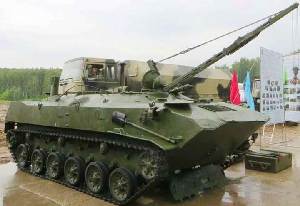
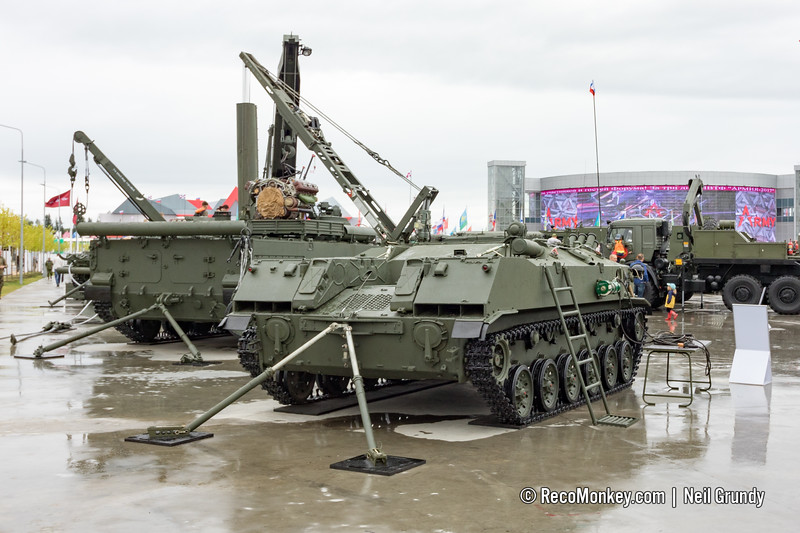
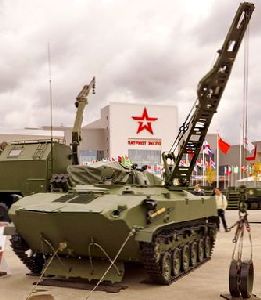
The BREM-D is a late Cold War-era armored recovery vehicle of Soviet origin. It was developed in the early 1980s to support BMD-1 and BTR-D combat vehicles for airborne troops in the field. The BREM-D is based on the BTR-D and can be airdropped from cargo aircraft. It features a light crane, winch with earth anchor, and spare parts and equipment to carry out maintenance in the field. A limited number of these vehicles were produced.
Ground Specifications
Crew
1
Mobility Type
Tracked
Engine
Diesel (240 hp)
Active Protection
None
NBC Protection
Yes
Variants
BTR-DG (Ob'yekt 925G)
Cargo variant without bow machine guns, firing ports and periscopes. The troop compartment was modified to serve as a cargo compartment.
BTR-DG
converted into an airborne SPAAG fitted with a specially built three-legged ZU-23-2 twin anti-aircraft autocannon mount over the roof of the cargo compartment.
BTR-D San
BTR-D converted into an airborne armoured ambulance.
BREM-D
(BREM-D stands for bronirovannaya remonto-evakuatsionnaya mashina desanta – armoured maintenance-recovery vehicle of the airborne) (Ob'yekt 932) – BTR-D converted into an airborne ARV. It carries specialized equipment for the repair and recovery of BMD-1 type vehicles. This equipment includes a light collapsible crane stored on the roof of the personnel compartment, which can be traversed through 180°, a recovery winch, a combination spade and dozer blade, a generator, towing equipment, electric welding system, tools and ready use spares. One of the 7.62 mm bow PKT tank machine guns was eliminated. This entered service in 1989 in very small numbers
BTR-RD "Robot"
BTR-D converted into an airborne ATGM team carrier with two 9P135M-1 ATGM launchers capable of firing 9M113 "Konkurs" (AT-5 Spandrel), 9M113M "Konkurs-M" (AT-5B Spandrel B), 9M111 "Fagot" (AT-4 Spigot) and 9M111-2 "Fagot" (AT-4B Spigot B) ATGMs. They can be used by the dismounted ATGM squad or fitted on a pintle mount on the right side of the hull. This is basically a BTR-D with a pintle mount added and with missile racks inside the troop compartment
BTR-ZD "Skrezhet"
(ZD stands for zenitnaya ustanovka) – BTR-D converted into an airborne air defense vehicle for carrying two MANPAD teams. The vehicle is fitted with racks for spare MANPAD missiles. It also is fitted with external stowage rails for a MANPAD on the right hand side of the roof of the troop compartment. It can also carry a complete ZU-23-2 twin anti-aircraft autocannon mount on the roof of the troop compartment.
NPDU "Sterkh"
(NPDU stands for nazemnyj punkt distantsionnogo upravleniya) – BTR-D converted into an airborne unmanned aerial vehicle carrier and launch vehicle of the "Stroy-P" set. It is used to launch Yak-061 "Pchela-1T" UAV for reconnaissance or jamming at ranges up to 60 km. The single-rail launcher is mounted on left hand side of the roof of the hull. It has large three-piece tube on forward right hand side of the roof of the hull. It entered service in 1990
BMD-1KSh "Soroka" (Ob'yekt 926)
(KSh stands for komandno-shtabnaya – command and staff) – airborne command post equipped with the R-123M, R-111 and R-130M or R-134 radio sets, as well as an AB1 portable 1 kW generator, the TNA-3 navigation system, folding CLOTHES HORSE type antennae around the superstructure and two slim antenna masts. Bow mounted machine guns and firing ports were removed. The commander's hatch is offset to the left and does not project forward. It's sometimes called BMD-KSh or KShM-D
BMD-1R "Sinitsa"
(R stands for radiostantsiya – signals vehicle) – Division-level command and signals vehicle equipped with R-161A2M radio set, one heavy telescopic antenna mast stowed along the left hand side of the roof of the hull and one slim elevatable antenna mast on the rear right hand side of the roof of the personnel compartment. Only a small number was delivered.
R-440-ODB "Kristall-BDS"
BTR-D converted into an airborne satellite communications vehicle with R-440 system with a range of 15,000 km. The vehicle has a roof-mounted satellite dish AK-12 that is covered with a cage-like structure during transport.
R-440-ODB "Kristall-BDS"
BTR-D converted into an airborne satellite communications vehicle with R-440 system with a range of 15,000 km. The vehicle has a roof-mounted satellite dish AK-12 that is covered with a cage-like structure during transport.
1V119 "Reostat"
BTR-D converted into an airborne artillery battalion fire direction vehicle. The vehicle is fitted with a turret equipped with NNP-21 and V-7 observation devices, three R-173 and R-159 radiosets, PAB-2AM aiming circle, three antennae mounts, DSP-30 and DAK-2 rangefinders. The turret was also equipped with PSNR-5K (1RL-133-1) "Tall Mike" ground surveillance radar mounted on the roof of the turret. Located over the turret front sights were the visors hinged in the center
2S9 Nona-S (Ob'yekt 925S) –
Airborne self-propelled mortar, armed with a 120 mm 2A60 mortar. Entered service 1981.
System
Alternative Designation
BREM-D
Type
Armored Maintenance-Recovery Vehicle
Manufacturer
Volgograd Tractor Factory
Family
BTR
In Service
1989-Present
Crew
1 ea
Passenger Capacity
12 ea
Note
This equipment includes a light collapsible crane stored on the roof of the personnel compartment, which can be traversed through 180°, a recovery winch, a combination spade and dozer blade, a generator, towing equipment, electric welding system, tools and ready use spares.
Dimensions
Length
5.88 m
Width
2.63 m
Height
2 m
Weight, Combat
8 tons
Ground Pressure
INA
Automotive
Engine Name
5D20 V6 Diesel
Engine Type
Diesel
Engine Power
240 hp
Cruising Range
500 km
Speed, Maximum Road
62 km/h
Speed, Average Cross
INA
Speed Maximum Swim
10 km/h
Gradient
60%
Side Slope
30%
Vertical Step
0.7 m
Trench
2.0 m
Fording Depth
Amphibious
Note
The BTR-D is amphibious and is propelled on water by two waterjets
Main Weapon System
Note
One of the 7.62 mm bow PKT tank machine guns was eliminated, leaving only 1 x 7.62mm PKT (Kalashnikov's Machine Gun)
System
Name
1 x PKT (Kalashnikov's Machine Gun)
Caliber
7.62mm
Type
General-Purpose Machine Gun
Function
In use as a front-line infantry and vehicle-mounted weapon with Russia's armed forces.
Manufacturer
Degtyaryov plant
In Service
1961-Present
Proliferation
+1 Million
Length
1,203 mm
Barrel Length
605 mm
Weight, Gun Only
9 kg
Weight, Tripod Only
7.7 kg
Max Rate of Fire
650 rds/min
Effective Rate of Fire
250-300 rds/min
Action
Gas-operated, open bolt
Feed System
Non-disintegrating metal 50 round belts in 100 and 200/250 round ammunition boxes
Sights
Iron Sights
Ammunition
Type
Rifle
Caliber
7.62 mm
Cartridge
7.62×54mmR km
Muzzle Velocity
855 m/s
Accuracy of fire at 300 m
90 mm
Basic Load
2,000 ea
Fire Control
Name
INA
Computerized FCS
No
Thermal Sight Vehicle Commander
Yes
Thermal Sight Gunner
Yes
Main Gun Stabilization
INA
Protection
Hull Armor
Protection of this vehicle is very light. Hull of the BTR-D is welded from aluminum armor in attempt to save weight, however it protects the occupants only from small arms fire and artillery shell splinter
Turret Armor
INA
Applique Armor
Available
Explosive Reactive Armor
No
Active Protection System
No
Mine Clearing
No
Self-Entrenching Blade
No
NBC Protection
Yes
Smoke Equipment
INA
IR Signature
INA
Firing Ports
All-round firing ports
Image Sources
Details
Country of Origin
Russia
Category
Survivability
Land > Survivability
Filter Label
B
Classification
Domain
Ground
Equipment Status
Active
Dimensions
Length
5.88 m
Width
2.63 m
Height
2 m
Weight
8000 kg
Operators (3)
Russia
Ukraine
CFE Treaty
Something went wrong. Please reload the page.
Reload