Steyr M Austrian 9mm Semi-Automatic Pistol
Steyr M
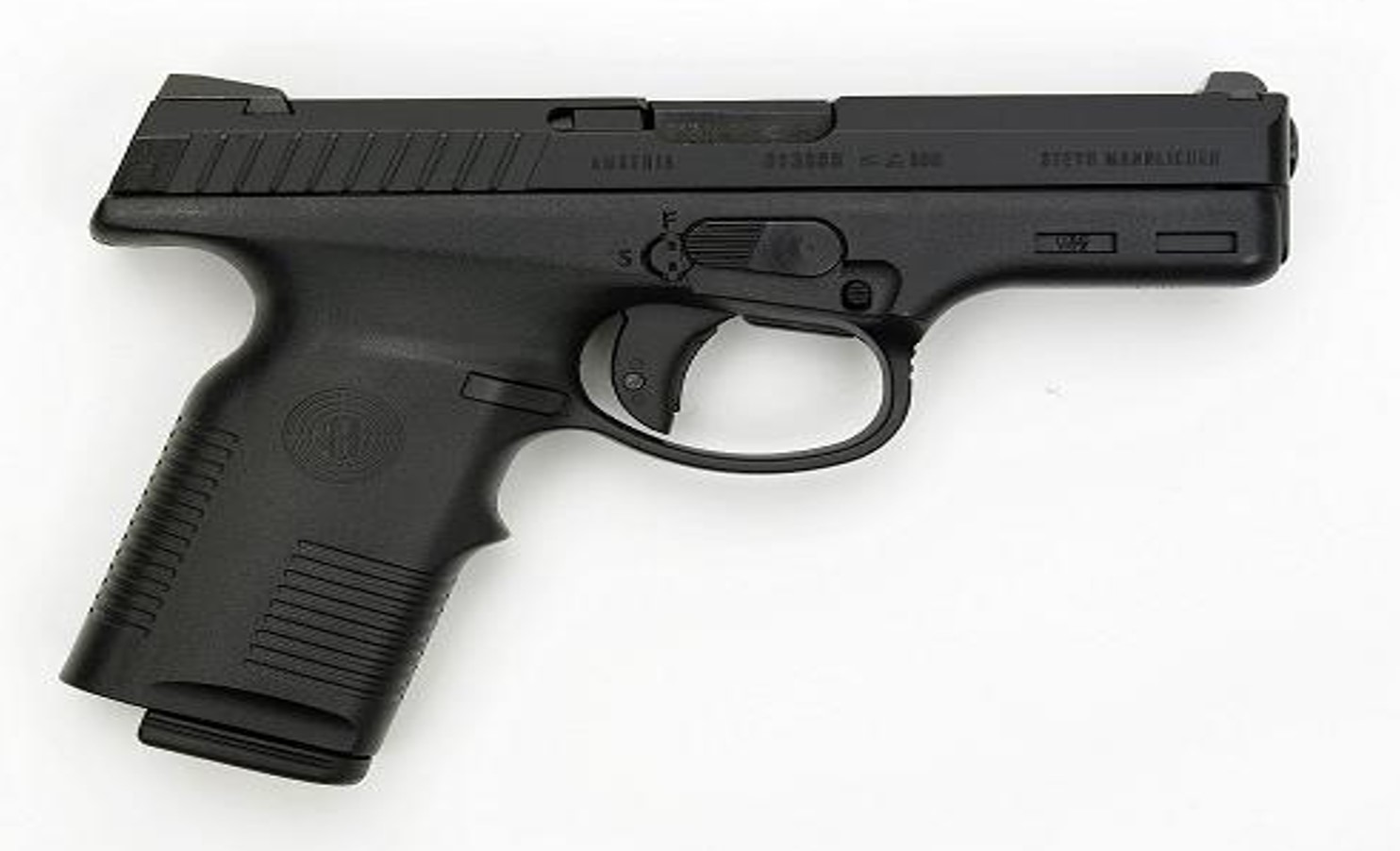
The Steyr M is a series of semi-automatic pistols developed by Steyr Mannlicher GmbH & Co KG of Austria for police services and the civilian shooting market. Design work on the new pistol began in the early 1990s and the final product known as the M9 (adapted to fire the 9×19mm Parabellum cartridge) was officially unveiled in the spring of 1999. The M40 version chambered in .40 S&W was developed before the M9, followed later by the M357 (chambered in .357 SIG) and two smaller variants of the M9 and M40 designated the S9 and S40 respectively. These pistols were developed primarily for concealed carry and have a shortened barrel, slide, smaller frame and a reduced magazine capacity. In 2013 the Steyr M (Medium) and S (Small) form factors were complemented by the L (Large) sized series and the C (Compact) sized series both available in 9×19mm Parabellum and .40 S&W chamberings as the L9-A1, L40-A1, C9-A1 and C40-A1. The Steyr M series of pistols employs the mechanically locked Browning short recoil method of operation with a linkless, vertically dropping barrel. The cold-hammer-forged conventional rifled barrel is locked to the slide by means of a single rectangular lug around the barrel chamber that recesses into the ejection port in the slide. When fired, the recoil impulse from the ignited cartridge drives the barrel and slide back, locked together until the bullet leaves the barrel and pressures drop to a safe level. A locking block integrated into the frame then engages a lug at the base of the chamber and drives the barrel downward, separating it from the slide and terminating any further rearward movement while the slide continues back in a straight line. Design Details The Steyr M series uses a very high grip profile which holds the barrel axis close to the shooter's hand and makes the Steyr M more comfortable to shoot by reducing muzzle rise and allowing for faster aim recovery in rapid shooting sequence. Hammerless and striker-fired, the Steyr M features a double action only (DAO) pre-set trigger mechanism marketed as a "Reset Action" trigger. When the trigger is in the forward position, the firing pin spring remains lightly compressed (pre-cocked by the forward motion of the slide as it returns to battery). Pulling the trigger all the way to the back will compress the firing pin spring completely, draw the firing pin fully to the rear and position the trigger bar to release the firing pin and fire a round. The trigger travel is 4 mm (0.16 in) with a pull weight of 25 N (5.6 lbf). The pistol has a multi-stage safety system consisting of two automatic internal safeties, two external trigger safeties and a manual lock safety. The first external trigger safety acts as the primary fail-safe. A small, spring-loaded inner trigger is housed in a wide, outer trigger and cannot be actuated unless the inset trigger is depressed first. This keeps the trigger from being pulled by an inadvertent off-angle trigger pull. This trigger safety also activates and when released—deactivates the two internal safeties: the firing pin and drop safety. The firing pin safety is contained in the pistol's slide and blocks the longitudinal movement of the striker. The second trigger safety is an optional, manually operated plastic bar located inside the trigger guard and projecting out from the base of the pistol's frame when activated, revealing a small white dot. This indicates that the pistol is currently incapable of being fired. It is used as an additional safety that disables the trigger with the firing pin spring cocked (after reloading the pistol). This safety is engaged by simultaneously pushing in two buttons on both sides of the frame and then deactivated by simply lifting the trigger finger and pushing the bar up and into the pistol's frame, thus allowing the trigger to be pulled back and the weapon fired. These safeties enable safe handling of the pistol with a round present in the chamber (the so-called "cocked and locked" condition) and allow for rapid deployment and immediate firing; this arrangement however does not permit the firing mechanism to be re-cocked in case of a misfire after the trigger has been pulled. Product Evolution Steyr Mannlicher has updated its basic design several times throughout its production history. Second-generation models In 2004, an improved version of the pistol replaced the original Steyr M in production. The new 'second generation' Steyr M-A1 and S-A1 pistols received several improvements. The grip of the pistol has been redesigned with some textured surfaces as was the magazine well (uses the same magazines), ergonomics have been slightly altered to improve grip, the manual safety button is now optional (not in models sold in the United States, all US imports lack the manual safety) and the lower forward portion of the frame now consists of a STANAG 2324 Picatinny rail for mounting accessories. Later 'second generation' models also have a modified extractor for easier ejecting of casings. Third-generation models In 2010, Steyr Mannlicher US began reimporting Steyr M-A1 and S-A1 pistols. The newly imported 'third generation' Steyr M and S have a revised slide and grip imprinted with the Steyr Arms logo. Post 2009 'third generation' models have a roll pin in the slide just under the rear sight element, feature an improved trigger and 17-round magazines with a +2 baseplate are available for the 9×19mm Parabellum M9-A1, C9-A1 and S9-A1 models. These new 15+2 magazines, designed to compete with the classic Glock 17 rounds magazines, are fully compatible and interchangeable no matter what generation or serie the gun belongs to. In 2010 the C (Compact) sized C-A1 series was introduced in 9×19mm Parabellum and .40 S&W chamberings as the C9-A1 and C40-A1. This C (Compact) form factor mainly pairs the S (Sub-Compact/Small) barrel lengths to the M (Medium) form factor grip. For Italy only the C9-A1 is offered in the 9×21mm chambering. In 2013 the Steyr M (Medium), Steyr C (Compact) and S (Sub-Compact/Small) form factors were complemented by the L (Large) sized L-A1 series available in 9×19mm Parabellum that uses 17-round +2 base plate magazines as the L9-A and .40 S&W chamberings 1 that uses 12-round magazines as the L40-A1. The L-A1 series feature additional serrations on the front sides of the longer slide and 115 mm (4.5 in) barrel length puts it more in line with full-size service pistols offered by other manufacturers. Fourth-generation models In 2019 Steyr introduced the A2 MF series in 9×19mm Parabellum in three form factors: the Large size L9-A2 MF, Medium M9-A2 MF and Compact C9-A2 MF. The "MF" in the designations stands for Modular Frame. The 'fourth generation' A2 MF series have a (serialized) removable chassis/trigger pack, making them not backwards compatible to previous series. The revised grip frame features a full length STANAG 2324 Picatinny rail, more aggressive surface texturing, a lengthened beaver tail and is adjustable to user preferences with different sized back-straps and side grip inlay panels. The conspicuous finger support protrusion on the upper half of the grip is omitted and the grip has a flared magazine well. The magazines were modified and feature orange followers. The ejector was modified to counteract erratic spent cartridge case ejection. Dimensional the A2 MF series are somewhat longer and wider than the preceding A1 series.