Type 056A Class (Jiangdao II Class) Chinese Corvette
Type 056A Class

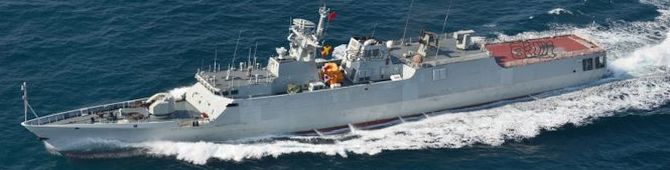
The Type 056A is a anti-submarine warfare configuration of the Type 056 Corvette. The Type 056A includes a SJG-206 Variable-Depth, Low-Frequency, Towed Array Sonar System. Jiangdao Type-056 Frigate/Corvette (FFL) Reputed as the new-generation “maritime cavalry”, the 056 frigate is rapidly augmenting the PLA Navy’s littoral warfare capabilities, especially in the South China Sea and East China Sea. This new class of small combatant augment the 60 HOUBEI-class wave-piercing catamaran missile patrol boats (PTG) (Type 022). The frigate was deployed primarily for patrol and escort missions as well as anti-submarine operations and sea combat tasks, independent or in coordination with other forces. Its primary duty is to patrol sea areas. The South China Sea has relatively high requirements for single patrol boats because it is far from the coast and is often choppy. Patrolling is a daily labor-intensive task, and requires a large number of soldiers. Therefore, patrol boats should be deployed in a large scale and cost less than warships. Unlike fighting, patrolling does not need too many weapons. Overall, ships designed for patrolling should have good seakeeping ability and be relatively cheap. The Type-056 frigate aimed at changing the situation of China's active-service base-defense system featuring aging military strength, single function and low combat power. The new-generation base-defense military strength commissioned in large quantities was another important platform for optimizing the equipment structure of the PLA Navy, improving the base-defense combat power as well as enhancing the PLA Navy's capability of safeguarding China's national security and territorial integrity, and defending China's maritime sovereignty and maritime rights and interests. The construction of the 056 frigate has come to an end in late 2019 and the upgrading of the domestic offshore combat system has been completed. Type 056 frigate is a type 1 light frigate developed by the Chinese Navy in the new century. According to overseas sources, it has a length of 89 meters, a width of 12 meters, a full-load displacement of 1,300 tons, diesel power, dual-axis propulsion, a maximum speed of 28 knots, and a cruising range of 3,500 nautical miles. The type 056 frigate weapon and the onboard electronic system are relatively simple. The weapon includes two double-mounted YJ-83 anti-ship missile launchers, one 8-unit red flag 10 ship-to-air missile launcher, and the main gun is a 76 mm gun. , 2 30mm single-tube remote-control naval guns, and anti-submarine weapons are two 2-unit antisubmarine torpedo launchers. Shipborne electronic systems include air / sea search radars, optoelectronic fire control systems, electronic warfare systems, and shipborne combat systems. The bow has a helicopter take-off and landing deck, which can take off and land straight -9 anti-submarine helicopters, but there is no hangar, which limits its helicopter operation capabilities. The Type 056 frigate weapon is relatively simple and mainly performs offshore patrol tasks. The PLA Navy had to build large warships if it is to go to the high sea, but large warship will be a waste of resources if it’s only used for “yard-protecing”. The PLA Navy needed vessels that are suitable for carrying out fishing protection, patrol and guarding tasks at the “house gate”, so that it can free the large combat ships from the trivial everyday maritime services and consequently ensure the combat capacity of main high-sea-going taskforces. With complete functions, the 056 guided missile frigate is capable of air defense, anti-submarine warfare, assault, and garrisoning. Such high cost effectiveness better caters to the rapidly increasing equipment manufacturing of the PLA Navy. The PLA Navy’s inshore combat tasks mainly consist of daily patrol, guarding, fishing protection, and other low-intensity and low-risk tasks. It provides the basic maritime force support for the civilian and law enforcement forces of oceanic administration and fishing affair bureau in coping with the provocations by military vessels of enemy states. Light surface vessels have to be used in the early stage of islands disputes. The flexible body and comprehensive combat capability of the 056 guided missile frigate decide that it is of best use on islands and the surrounding waters, where it can deal with all kinds of maritime crisis flexibly and make the mobilization and deployment of large vessels more effective. Designed not solely for islands disputes but for more extensive purposes such as maritime target assaulting, air defense and anti-submarine, the 056 guide missile frigate is a light maritime striking weapon platform with the highest performance-price ratio and the widest applications. It can be manufactured by a number of coastal and inland shipyards on a large scale and in large quantities and supplied to the PLA Navy incessantly. Light guide missile frigate can serve as steady support for PLA Navy’s high-sea-going maneuver combat and help free the inshore fast attack forces from everyday coast defense tasks, so as to establish a new-type inshore defensive combat system. China has an 18,000km-long coastline to guard. The new-type frigate is able to engage in low-intensity conflicts and carry out patrol, escort and fishing protection tasks in key waters. It makes the military force structure more reasonable, shows greater flexibility in carrying out combat tasks, and will soon become the main combat equipment for base defense. Moreover, the large-scale commissioning of the new-type frigate was expected to exert considerable effects on the PLAN’s combat thinking, methods of operation, training, management and application, talent cultivation and battlefield construction. The long coastline needs to be patrolled, the disputes over several islands need to be solved, and the maritime transportation routes need to be protected. Guided missile frigate is the most economic choice if those issues need to be solved by force. According to a ranking by the British website Naval Technology, the Type-056 is one of the world's 10 best modern corvettes along with Sweden's Visby class and Germany's K130 Braunschweig class. Cao Weidong, a researcher at the PLA Naval Military Studies Research Institute, said despite the Type-056 class being smaller compared with frigates, it will be as powerful as frigates in battles in coastal waters thanks to its stealth design and strong firepower. Because the ship's weapons and electronic systems are relatively simple, many international sources classify it as "corvettes" (light frigates) rather than "frigates". In fact, the Chinese Navy's original intention to develop the Type 056 frigate was also to replace the Type 037 hunting submarine, performing offshore patrol, escort, search and rescue tasks. For quite a long time, the Type 037 submarine hunting submarine has been the main battleship of the Chinese Navy's offshore defense, and has built more than 100 ships. However, the type 037 submarine hunting ship has a small tonnage and poor long-range combat capabilities, making it difficult to perform combat missions in far-off sea areas. After the 1990s, the Chinese Navy built several 053H frigates to perform such tasks, but the 053H frigate tactical and technical indicators had fallen behind. It is difficult to meet the needs of the battlefield in the new century. In this case, the 056 frigate appeared. The first 056 frigate was started in 2011, launched in 2012, and delivered to the Navy in 2013. From a practical point of view, compared with the 037 frigate, the 056 frigate had a larger tonnage, more internal space, and can carry more supplies and materials, which is conducive to long-duty maritime operations. The crew's long-distance sea mission execution environment has been improved and efficiency has been improved. The ship was loved by the troops and became an ideal replacement for the 037 hunting submarine. Since then, the Type 056 frigate has entered a period of high-speed construction. It is reported that within about 9 years from 2011 to 2019, about 70 Type 056 frigates were built. On average, about 8 ships per year, and this speed can be said to be very amazing. Along with rapid construction, the Type 056 frigate also developed a series of improved and modified ships. For example, in use, the army found that the 30mm single-barrel remote-control naval gun was not very useful and the price was relatively expensive. Large-caliber machine guns can be used for patrol tasks. Therefore, the latest batch of 14.5-mm naval machine guns was used instead. Considering that there are many advanced AIP submarines in the first island chain, the anti-submarine type was developed for this type 056. It is the first domestic surface ship equipped with active / passive towed line sonars, improving the ship's ability to resist modern quiet submarines. In order to cooperate with the advanced underwater acoustic system, the 056 anti-submarine type has been replaced with a new type of anti-submarine missile. The new missile uses a turbojet engine with a longer range and stronger attack capabilities. Sonar, better detection performance. The 056 anti-submarine service effectively improved the Chinese Navy's offshore anti-submarine combat capabilities. Exports The Type 056 1,440-ton class corvette is available for the export market with Bangladesh having ordered at least two ships and the Nigerian Navy ordering the P18N offshore patrol vessel with a full load displacement of 1,800 tons. In October 2012, the first ship P18N in Wuhan shipyard started. In 2013, Bangladesh and China signed a purchase for a group of vessels contract, believed to consist of two frigates, two patrol boats and six large patrol boats. Type C13B [B for Bangladesh] is one of two light frigates ordered by the Bangladesh Navy in 2013. The ship was improved on the basis of Type 056. It replaced the weapon and radar system different from the domestic version and cancelled the anti-submarine capability. The most advanced frigate in the media, once known as China's export, its shape has been fully integrated with the overall trend of international light frigates. Although there is no such new trend as the chasing wind, the high cost performance has won the praise of the Bangladesh Navy. Two more ships have been added. The Thai Navy's Pattani-class OPV bears a resemblance to the subsequent Chinese Type 056 corvette / light frigate, though the later is up-gunned relative to the the Thai OPV, with four YJ-3/C803 ASM and a FL-3000N RAM launcher aft, while the former has a much taller superstructure. Built for the Royal Thai Navy by the China State Shipbuilding Corporation, each OPV cost about US$50 million. The vessels were commissioned in 2006-2007. In November 2014 China completed sea trials of a offshore patrol ship on order for the Nigerian Navy that will assist in suppressing the growing threat of piracy off West African shores. The vessel was the first of two acquired by the Nigerian Navy to bolster its maritime surveillance, patrolling, search-and-rescue and to counter piracy. The patrol ship was launched by state-owned shipbuilder China Shipbuilding & Offshore International Co (CSOC) in January 2014, and was taken for sea trials by affiliated shipyard Wuchang Shipbuilding Industry. The second patrol ship was built by CSOC in China but would be outfitted at the naval shipyard in Port Harcourt, Nigeria, in a technology transfer arrangement. According to specifications provided by CSOC, the ship has a full load displacement of 1,800 tonnes and can go 21 knots. The vessel can accommodate 75 crew, has 20 days endurance, and a standard range of 3,000 nautical miles. A computer-generated image issued by the Nigerian Navy suggested that the ship will have a helicopter hangar and landing deck. The weapons fit comprises a single 76mm NG-16-1 gun with a TR47 fire-control radar, as well as pairs of 30mm and 20mm guns. Nigerian Chief of Naval Staff Vice Admiral Dele Ezeobam told reporters in January 2014 that the F 91 would be handed over mid-2014. The Nigerian Navy is standing up to a host of challenges it faces in the Gulf of Guinea. Prior to 2009 before it commissioned the Sea Eagle-class patrol boats, the navy struggled to counter the often heavily armed pirates of West Africa. The two patrol ships is the latest in a string of measures to wrest back control of its seas from criminal groups.