Steregushchiy Class (Project 20380 Class) Russian Corvette
Steregushchiy Class


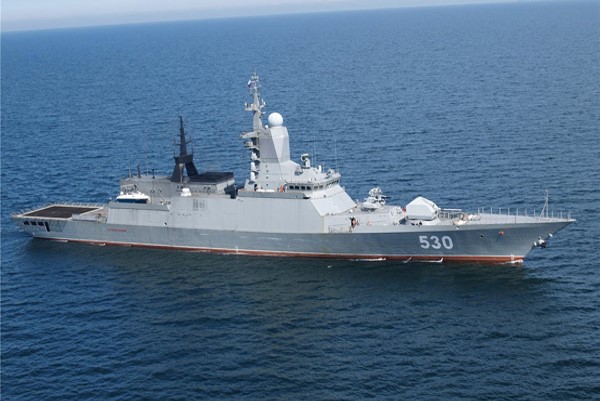
Steregushchiy Class (Project 20380 Class) Russian Corvette is the newest class of corvettes being built for the Russian Navy. Designed by the Almaz Central Marine Design Bureau, subsequent vessels were built to an improved design (Project 20381), incorporating the Poliment-Redut SAM system. The ship's full displacement and dimensions are large for a corvette, thus it is designated as a frigate by NATO. The Steregushchiy class has been further developed into the Gremyashchiy class (Project 20385) and Project 20386 subclasses. The export variant is known as Project 20382 Tigr. The ships of the Steregushchiy class are multipurpose corvettes, designed to replace the Grisha class. Such ships are used for littoral zone operations, engagement of enemy submarines and surface ships, and gun support of landing operations. The first batch built at the Severnaya Verf shipyard in St. Petersburg consists of four ships. A second building line has been started at Komsomolsk. The lead ship of this second batch was named Sovershennyy. The Russian Navy has publicly announced that they expect to buy at least 30 of these ships, for all four major fleets. According to Jane's Naval Forces News, the first vessel was commissioned on 14 November 2007. An additional order of 10 corvettes was under consideration in late 2019, according to the Deputy Commander of Pacific Fleet Igor Korolev. The ships were to be laid down at Amur Shipyard and to be commissioned into the Pacific fleet. The Steregushchiy-class corvettes have a steel hull and composite material superstructure, with a bulbous bow and nine watertight subdivisions. They have a combined bridge and command center, and space and weight provision for eight SS-N-25 missiles. Stealth technology was widely used during the construction of the ships, as well as 21 patents and 14 new computer programs. The newest physical field reduction solutions were applied too. As a result, designers considerably reduced the ship's radar signature thanks to hull architecture and fire-resistant radar-absorbent fiberglass applied in tophamper's design. The Kashtan CIWS on the first ship was replaced in subsequent vessels by 12 Redut VLS cells containing[9] 9M96E medium-range SAMs of the S-400 system. SS-N-27 (Kalibr type missiles) will be fitted to a larger domestic version, Project 20385. The export version known as Project 20382 Tigr carries either eight supersonic SS-N-26 (P-800 Oniks) anti-ship missiles or sixteen subsonic SS-N-25 'Switchblade' (Kh-35E Uran). It also carries two twin-tube launchers for 533mm heavy torpedoes. The A-190E 100mm gun first used in the Talwar-class frigates is controlled by a 5P-10E system that can track four targets simultaneously. Protection from air attacks is provided by the Kashtan CIWS and eight mounts for the SA-N-10 'Grouse' (9K38 Igla) SAM. In 2007 the Indonesian Navy made an agreement in principle (pending a full contract) for four vessels of this type to replace their aging Dutch-built Fatahillah-class corvettes. The first was to be built in Spain and fitted out in St. Petersburg, leaving open the option of Indonesian involvement in building the subsequent ships. This agreement appears to have lapsed; in 2011 Indonesia signed a deal for two Milgem-class corvettes from Turkey. Rosoboronexport has briefed Singapore and the United Arab Emirates on the vessel. The first actual contract for the export version, Project 20382 Tigr, was signed at the 5th International Maritime Defense Show in St. Petersburg in July 2011 when Algeria ordered two ships. The cost was estimated at US$120–150 million per ship. One was to be delivered in 2014 and one in 2015.