Sevom Khordad (3rd Khordad) Iranian Long-Range Air Defense Missile System
Sevom Khordad


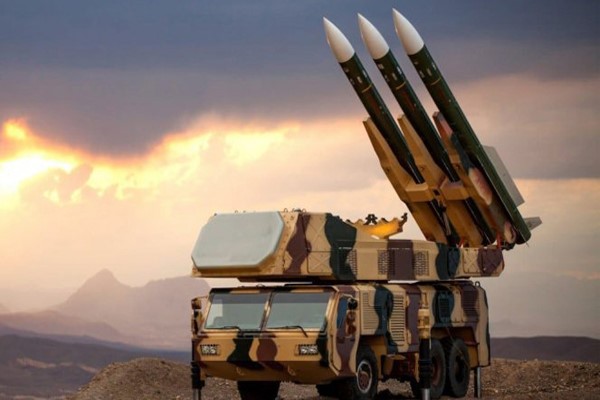
The Sevom Khordad, also known as the 3rd Khordad is the most advanced version of the Ra'ad air defense system. It has the greatest reported range of any of the variants. It employs a phased-array radar on its transporter-erector-launcher radar (TELAR) that is visually similar to the Chair Back radar on the Buk-M2. The phased-array radar can reportedly provide guidance for up to two additional Alam al Hoda transporter-erector-launchers. The system can employ Taer-2B missiles as well as the Sayyad-2C missile which is based on the American SM-1R. The Sayyad-2C has a reported range of 46 miles and a maximum intercept altitude of 100,000 ft. The missile has a maximum speed of Mach 4.5. When fitted on the 3rd Khordad, the Sayyad missiles are not carried in canisters. The system can engage two targets at a time. The name comes from the Persian date (May 24) that Iran recaptured Khorramshahr in 1982 during the Iran-Iraq war. A 3rd Khordad battalion consists of four batteries, each consisting of one 3rd Khordad TELARs linked to two Alam al Hoda TELs for a total of four TELARS and eight TELs. Overall air surveillance is achieved with a Bashir 3D phased array surveillance radar operating in the S-band with a range of 190 mi (350 km). The 3rd Khordad is a specialised variant of the Iranian Raad medium range air defence system which entered service in the mid 2010s, and deploys Taer-2B missiles from mobile transporter erector launchers. The missile systems have been mass produced and are heavily relied on today by the country’s air defence forces - complementing longer ranged platforms acquired from Russia including the S-200 and the S-300PMU-2. The 3rd Khordad is the longest ranged variant of the Raad system, and reportedly retains an engagement range of up to 200km. The platform can engage up to four targets with up to eight missiles simultaneously, and makes use of a powerful phased array radar. The successful testing of the missile system against a high end American drone is likely to have significant consequences for the balance of power in the Middle East - with Iran’s adversaries likely to be more wary about the risks of engaging the country’s indigenous defence systems. Iran itself may well speed up development of new long range missile platforms domestically - and the incident may also affect the military's decision making regarding the need to import more sophisticated foreign weapons systems such as the Russian S-400 which is reportedly currently under consideration.