SU-100 Russian Tank Destroyer
SU-100
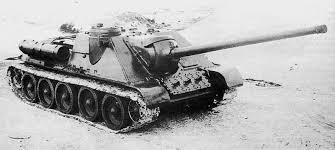
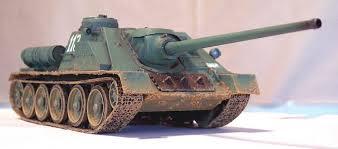
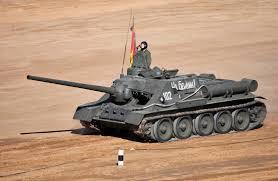
The SU-100 (Samokhodnaya Ustanovka 100) was a Soviet tank destroyer armed with a 100 mm anti-tank gun in a casemate superstructure. It was used extensively during the last year of World War II and saw service for many years afterwards with the armies of Soviet allies around the world. The SU-85 was developed from the chassis of the T-34 tank replacing the turret with a larger, fixed superstructure that allowed a larger gun to be fitted: the 85 mm D-5 gun, providing dramatically upgraded firepower compared to the T-34's 76.2 mm models. Introduced to service in 1943, the SU-85 was quickly rendered obsolete as a new tank design featured the same gun on the T-34-85. This prompted the design of a more advanced turretless tank destroyer with an even more powerful cannon. Development was conducted under supervision of L. I. Gorlitskiy, chief designer of all medium Soviet self-propelled guns. The work started in February 1944 and the first prototype of the SU-100, "Object 138", was delivered in March. After intensive testing with different models of 100 mm gun Soviet engineers approved the D-10S gun for mass production. This gun was developed in Constructors Bureau of Artillery Factory No. 9 under the guidance of F. F. Petrov. After the Second World War this gun was installed on T-54 and T-55 tanks; these vehicles and their derivatives were in service forty years after initial development. It was built at the UZTM (Russian abbreviature УЗТМ for Уральский Завод Тяжелого Машиностроения – Ural Heavy Machinery Factory, also called Uralmash) in Yekaterinburg. The SU-100 quickly proved itself to be able to penetrate around 125 mm (4.9 in) of vertical armor from a range of 2,000 m (1.2 mi) and the sloped 80 mm (3.1 in) front armor of the German Panther from 1,500 m (0.93 mi). The hull of the SU-100 had major improvements over the SU-85; the thickness of the front armour was increased from 45 to 75 mm (1.8 to 3.0 in), and the commander's workplace was made in a small sponson on the right side of the hull; combined with the commander's cupola this improved the commander's effectiveness. Its German Jagdpanzer-family counterparts — the Jagdpanzer IV, Jagdpanther and Jagdtiger, by comparison, lacked this key piece of observational equipment. On the other hand, the SU-100's optics were inferior. For better ventilation two ventilator units were installed, instead of only one as in the SU-85. Mass production began in September 1944.