Type 22 Class (Houbei Class) Chinese Fast Attack Missile Boat
Type 22 Class
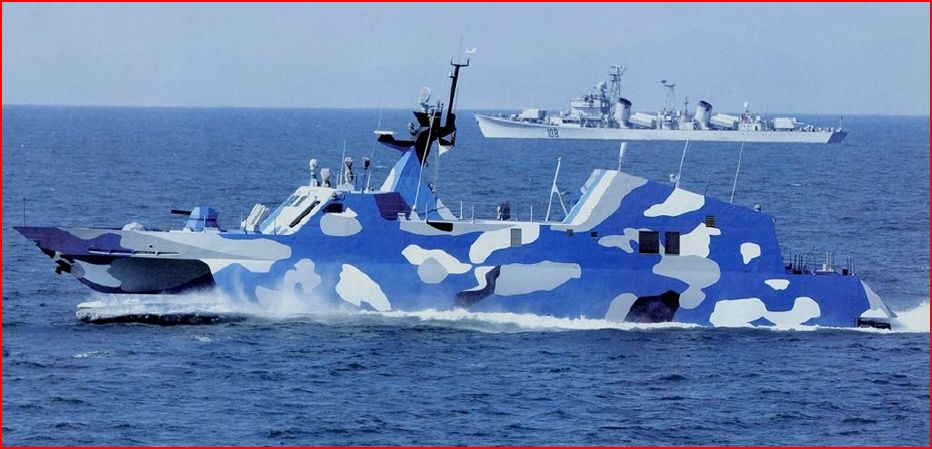

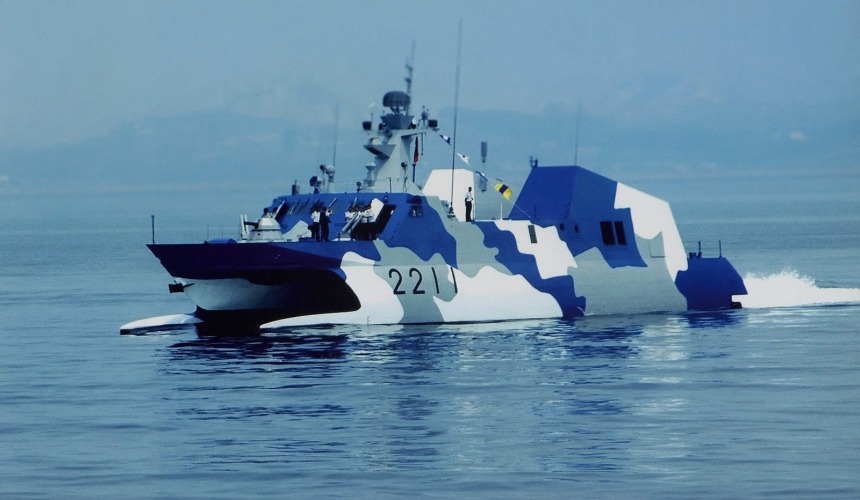
In April 2004, China's Quixin Shipyard in Shanghai produced the lead Houbei Type 022 wave-piercing catamaran, hull number 2208. The Type 022 was 43 meters (140 feet) long and displaces 225 tons. It was equipped with two missile launchers and has a top speed of 38 knots. The Type 022 was the PLA Navy's new-generation stealth missile fast attack craft (FAC). The boat features a unique high-speed, wave-piercing catamaran hull design with evident radar cross-section reduction design features. A number of Chinese shipyards across the country were involved in the construction of the boat. The Salvo equations are the successors to Lanchester Equations whose square law was applied to the formation of battleships. Specifically, the salvo equations apply when missiles or torpedoes are fired in batches instead of “continuously.” The salvo-like phenomenon was also seen in the five big Pacific carrier battles in World War II in which each side endeavored to detect and attack first with all its air wings simultaneously in a single pulse, or “salvo,” of aircraft attacking as a coordinated unit. The salvo equations show that if a fleet has three times as many combatants, then for parity in loss ratios (in other words, which side will have ships remaining when all of the opponents are out of action), to overcome a numerical advantage each of my ships must have thrice the offensive power, thrice the defensive power, and thrice the survivability (the “staying power”). The weight of ordnance to put a warship out of action increases only as of the one-third power of its displacement, making smaller missile ships a cost-effective offensive capability. Another general property of missile warfare shown by the equations is that if ship numbers and staying power are both small, then an unstable combat situation arises, in which the shift in results of exchange moves from total victory to total loss within a small change in the number of ships on either side. This is to an extent an artifact of the equation structure, but it is a warning that a fleet of big surface warships can be put out of action with a small number of missile hits in 21st Century combat. This first ship appears to be focused on the FAC mission and appears to be designed for the installation of anti-ship missile launchers amidship (in the middle of the ship). But some speculated that the Chinese will soon design and build larger models that can carry UAVs and small boats for landing commandoes, as the U.S. may soon be doing. The Chinese probably already has its version of the digital connectivity which lies at the heart of the LCS program. So here is an area of military-technical competition in which the Chinese are demonstrating creativity and potential ability to match the U.S. just as it was embarking on a new direction in naval warship and combat tactics modernization. The new Chinese FAC design also demonstrates that the real naval threat from China was not aircraft carriers and large destroyers bought from Russia. The real threat was quiet diesel submarines and small ships like this new FAC. The real potential of this new design would be its use in coordination with their diesel subs and, possibly, theater ballistic missiles with precision guidance. A combination like that could enable the Chinese to deny the U.S. Navy the ability to safely move in some vital areas, such as the waters surrounding Taiwan First spotted under construction at Qiuxin Shipyard in Summer 2004, the vessel completed sea trials in late 2004 and was possibly commissioned in 2005. It was followed by three additional boats (2209, 2210, and 2211) in or around the 2005-06 time period. More hulls were subsequently spotted under construction at other locations starting in early 2006. The Type 022 appeared to be replacing the aging Type 021 (Huangfeng class) missile FAC in the PLA Navy service. After several years of extensive prototype testing, Quixin then produced hulls 2209, 2210, and 2211. Many observers thought this could be only a four-ship design, such as the People's Liberation Army Navy's (PLAN's) previous five new guided-missile destroyers (DDG) designs of only one or two hulls since 1991. The startup of production for additional Type 022 hulls in Dalian, Quixin, and Jiangnan shipyards in Shanghai, as well as in the Huangpu shipyard in Guangzhou, changed this precept. A large number of wave-piercing catamaran Type 022 hulls being launched several at a time at five different shipyards was a major event in PLAN shipbuilding. By early 2008 China was believed to have built as many as 40 Type 022 missile boats to replace the aging Huangfeng class missile boats. The Type 022 Houbei PCFG appeared to be building at a rate of about 10 units per year. The August 2009 US Office of Naval Intelligence report "The People's Liberation Army Navy: A Modern Navy With Chinese Characteristics" stated " ... the PLA(N) has built up its long-range capability, it has also reinforced its coastal defense and near-littoral strengths with the introduction of the highly-capable Houbei class guided-missile patrol craft (PTG) in 2004. The Houbei utilizes a wave-piercing catamaran hull form, probably based on a commercial fast ferry design, and water jet propulsion to attain considerably better seakeeping, speed, and mission flexibility than the older Gsa and Houku missile boats that they replaced. The relatively low construction, operating, and crew costs of the Houbeis have allowed China to build well over 50 by 2007, with more under construction." About the new stealth boat, the U.S. Congress submitted to Congress Armed Services Committee report entitled "China's impact on the U.S. Navy's modernization," the report said, "2004 China launched anti-ship cruise missile-equipped attack boats, the boat prominent stealth performance, can quickly walk through the waves, and has a double hull shape of the double hull is a more advanced hull shape design, the world's navies are trying this design approach in this area was currently a leading Australian company. " In recent years, China and Australia have engaged in the production of different types of wave-piercing vessels. So far, China produced a total of several models of civilian-type Rogue boats. The general law of development of the shipbuilding industry, the continuous improvement of 022 boats will refer to civilian-type catamaran trends. China's missile boats have used French diesel engines, and with high-power engines, the type 022 may reach 40 or more full speed. The most noteworthy was that all 022 missile boats are equipped with one-way hn900 tactical data links, which can work together to achieve the intent. It can collaborate with other frigates, missile destroyers, shore-based reconnaissance, early warning aircraft, boats, and even between the implementation of the "proper reach," the distant sea offensive operations. As a result of jet propulsion, with no propeller, the 022 more than anyone Chinese navy missile boats to was quiet, especially when at high speed. Chinese military's "Liberation Army Daily" reported that "China Water National Key Laboratory of acoustic vibration casing vibration and noise reduction technology research made fruitful achievements in scientific research." Military experts believe that this technology was important for high-speed vessels. Type 022 stealth missile boats with double hull shape, highlighting the invisibility. The Chinese trimaran fast attack craft (FAC) design may grow into a larger more versatile platform, similar to the U.S. Littoral Combat Ship (LCS) program. China Shipbuilding Trading Corporation (CSSC) revealed a concept for a 700 tonne derivative of the PLAN's Type 022 catamaran fast attack craft (FAC). The design was modeled in February 2017 at Abu Dhabi’s IDEX expedition and showcased many possible features for the vessel. It was armed with a 76 mm gun and four anti-ship missile launchers. CSSC officials said the PLAN has so far shown no interest in this version and there are no plans to build it. The CSSC consortium, comprised of over a dozen Chinese industry shipbuilders, showcased designs for export vessels, mostly based on existing designs from the Chinese Coast Guard or the Navy. There was no indication that China was building an additional level of conventional missile boats, showing the 022-boat, and on the basis of improvement, improved missile boats could become China's future development direction. A workshop sponsored by the Secretary of Defense’s Office of Net Assessment on retaining American influence in East Asia led to a report published in October 2011. The workshop participants advocated four force elements to reduce the chance of Chinese aggression and a shooting war. One component is a flotilla of small, highly lethal combatants that can be sent on the surface into the China Seas. Analysis at the Naval Postgraduate School and wargaming at the Naval War College independently saw the potential of such low-cost missile combatants and the need for a more detailed examination, since no such capability exists in the U.S.Navy.